If you've spent any time researching SEO tools for a small business, you've almost certainly ended up staring at the same two names: Ahrefs and Semrush. Both are legitimately powerful platforms with real capabilities, and both cost enough that the question "which one should I buy?" quickly becomes "do I actually need either one?" That's the honest version of the Ahrefs vs Semrush for small business debate that most comparison articles quietly skip past, because affiliate commissions on these tools reward you signing up for one, not walking away thoughtfully.
This guide covers the real 2026 pricing for both platforms, where each one genuinely earns its price tag, honest cheaper alternatives that cover 80 percent of small business SEO needs, and how to decide whether a paid SEO tool is even the right investment for your business right now. If you'd rather have an experienced team handle the tooling and analysis for you, our PPC management services and broader digital marketing services at Digitano LLC include this kind of tool-agnostic strategic work as part of standard engagements.
First: Do You Actually Need Ahrefs or Semrush?
Before comparing pricing tiers, the honest answer for many small businesses is that neither tool is the right first purchase. If you're running a smaller local business, a solo service practice, or a bootstrapped startup where SEO is one of several priorities rather than a full-time role, the productivity gain from a $130 to $250 monthly SEO tool often doesn't outperform what free alternatives can deliver.
A realistic decision framework:
- Monthly SEO revenue impact under $2,000: Start with free tools (Google Search Console, Google Analytics 4, and Google Keyword Planner cover the majority of what most small businesses actually need to know). Paid tools are premature.
- Monthly SEO revenue impact $2,000 to $10,000: Consider a budget-tier paid tool like Ubersuggest ($12 to $40 per month), SE Ranking (around $52 per month annual), or Ahrefs Starter ($29 per month) rather than jumping straight to Pro-tier plans at either Ahrefs or Semrush.
- Monthly SEO revenue impact above $10,000: Ahrefs Lite ($129) or Semrush Pro ($139.95) start to earn their cost, especially if you have someone on staff dedicated to executing on the data.
- Monthly SEO revenue impact above $20,000: Running both simultaneously (a common agency practice) can be justified, especially if you're doing content-heavy work with Semrush and backlink prospecting with Ahrefs.
Being honest about which tier you actually belong in prevents one of the most common small-business SEO mistakes: paying for professional-tier tooling before your business generates the revenue to justify it.
Real 2026 Pricing: Ahrefs vs Semrush
Understanding the true cost of each platform matters, because both companies have refined their pricing multiple times and hidden costs can meaningfully change the effective monthly total.
Ahrefs 2026 Pricing
- Ahrefs Starter: $29 per month, aimed at individual bloggers and casual users. Limited but legitimately useful for occasional research.
- Ahrefs Lite: $129 per month, the true entry-level professional plan. Five projects, essential SEO features, and adequate keyword and backlink research capacity for most small businesses.
- Ahrefs Standard: $249 per month, adding 20 projects, unlimited credits on many features, and Looker Studio integration.
- Ahrefs Advanced: $449 per month, expanding to 50 projects with API access.
- Ahrefs Enterprise: Custom pricing, with the notable advantage of unlimited users under a single plan.
Annual billing typically saves around 17 percent. One hidden cost to watch: Ahrefs' credit-based model automatically charges for overages when you exceed plan limits, meaning your actual bill can be higher than the sticker price if you're running heavy analysis.
Semrush 2026 Pricing
- Semrush Pro: $139.95 per month, five projects, 500 tracked keywords, includes PPC competitive intelligence and social media tools not available at any Ahrefs tier.
- Semrush Guru: $249.95 per month, 15 projects, 1,500 tracked keywords, Content Marketing Toolkit, historical data access, and Looker Studio integration.
- Semrush Business: $499.95 per month, 40 projects, 5,000 tracked keywords, API access, and third-party tool migration support.
- Semrush Enterprise: Custom pricing for large organizations.
Semrush's newer "One Starter" plan at around $165 per month bundles core SEO tools with AI visibility tracking across platforms like ChatGPT and Perplexity, useful given how much of SEO now involves AI search visibility. Annual billing saves roughly 17 percent, bringing effective monthly rates down substantially: Pro drops to about $117, Guru to about $208, Business to about $417.
Additional Semrush users cost around $45 per month, which adds up for small teams. Ahrefs' overage charges can be less predictable but tend to affect fewer users at typical small business usage levels.
Where Ahrefs Genuinely Wins
Based on multiple independent 2026 comparisons, Ahrefs is the stronger choice specifically for:
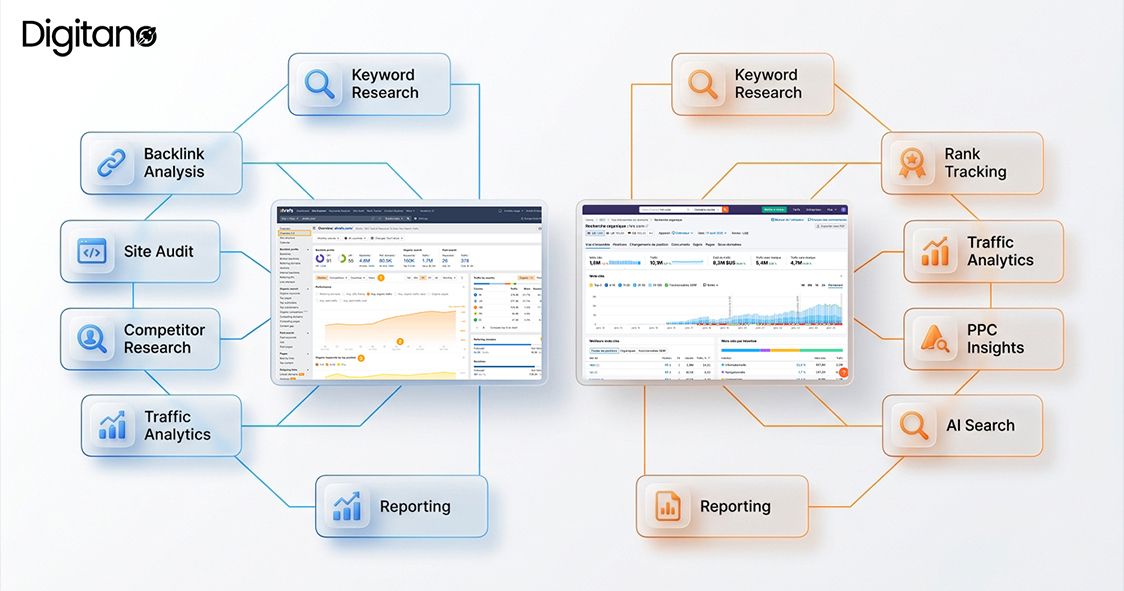
- Backlink research and link building. Ahrefs indexes over 500 million referring domains and refreshes its backlink database more frequently than Semrush, often surfacing new links faster and more accurately. If link building is a core part of your SEO strategy, this alone can justify Ahrefs over Semrush.
- Cleaner, less-cluttered interface. Many independent reviewers describe Ahrefs as easier to navigate day-to-day than Semrush, which matters if you'll be spending an hour or more in the tool daily.
- Actual click data in keyword research. Ahrefs' Keywords Explorer shows estimated clicks rather than just search volume, giving a more realistic picture of real traffic potential from a target keyword.
- Always-on site crawling. Ahrefs crawls continuously rather than waiting for scheduled audits, catching technical issues in real time.
- Content Explorer for research. Powerful for identifying high-performing content in your niche and analyzing competitor content strategies.
Where Semrush Genuinely Wins
Semrush is the stronger choice specifically for:
- All-in-one marketing platform functionality. PPC competitive intelligence, social media tools, and ad copy research are included at tiers where Ahrefs offers no equivalent.
- Content marketing workflow. Semrush's Topic Research, SEO Writing Assistant, Content Templates, and brand-voice tooling are built for teams producing multiple articles per month. Ahrefs has Content Explorer for research but no integrated writing workflow.
- AI visibility tracking. Semrush tracks visibility across AI platforms like ChatGPT and Perplexity, which is becoming a more meaningful signal in 2026 as AI-driven search grows.
- Native Google integration. Direct connections to GA4, Search Console, Google Ads, and Google Business Profile out of the box, whereas Ahrefs typically requires Zapier or custom API work for the same connections.
- Free trial availability. Semrush offers a 7 to 14 day free trial (depending on entry point), while Ahrefs offers no free trial in 2026, only a 7-day refund window after payment. For small businesses, this is a genuine risk-reduction advantage for Semrush.
- Better keyword database for certain markets. Semrush's keyword data tends to be more complete for Spanish, Portuguese, Arabic, and Southeast Asian markets specifically, though Ahrefs occasionally surfaces English long-tail queries Semrush misses.
The Honest "You Probably Don't Need Either" Alternatives
For many small businesses, cheaper tools cover 70 to 80 percent of what Ahrefs or Semrush actually deliver, at a fraction of the cost:
- Google Search Console (free): The single most valuable free SEO tool. Provides real click, impression, and ranking data directly from Google. Cannot be replaced by any paid tool for your own site's data.
- Google Analytics 4 (free): Free, powerful traffic and conversion analytics that integrate directly with Search Console.
- Google Keyword Planner (free with Google Ads account): Real search volume data, particularly useful for local search and paid campaign planning.
- Ubersuggest ($12 to $40 per month): Neil Patel's tool offers keyword research and basic backlink data at a fraction of premium tool pricing. A unique lifetime deal is available. Best fit for solo bloggers and small businesses under a $50 monthly SEO budget. Limitation: backlink and competitive data are noticeably thinner than Ahrefs or Semrush.
- SE Ranking (around $52 per month annual): Delivers roughly 70 percent of Semrush's features at about half the price. Includes a 14-day free trial. One of the best value-for-money tools in the SEO space.
- Moz Pro (starting around $99 per month): Cheaper entry point than Ahrefs or Semrush, though the backlink database is meaningfully weaker.
For most small businesses spending less than $100 a month total on SEO tools, some combination of Google Search Console, GA4, and Ubersuggest or SE Ranking will cover the actual work being done, with the paid tool complementing rather than replacing the free ones.
Common Small Business Mistakes When Choosing an SEO Tool
Based on repeated patterns from independent reviews and small business feedback:
- Buying premium tools before you have the revenue to justify them. A $250 per month SEO tool needs to drive meaningful ROI to be worth it, and if your total monthly SEO-driven revenue is under $2,000, that's a bad investment.
- Tracking too many keywords. Fifty high-intent, tracked keywords with strong data depth drive smarter decisions than 500 speculative keywords with shallow data.
- Overlooking the learning curve. Both Ahrefs and Semrush require significant time investment to master. Multiply your subscription price by roughly 1.3 to account for the learning curve and setup time in your actual monthly cost calculation.
- Ignoring integration costs. Semrush integrates natively with Google products; Ahrefs often requires Zapier or custom APIs. A $20 per month Zapier subscription can erase Ahrefs' price advantage over Semrush.
- Skipping the free trial (when available). Semrush's free trial is one week of real use that will teach you more than any comparison article. If a free trial is available, use it before committing.
A Simple Decision Framework
Given the honest analysis above:
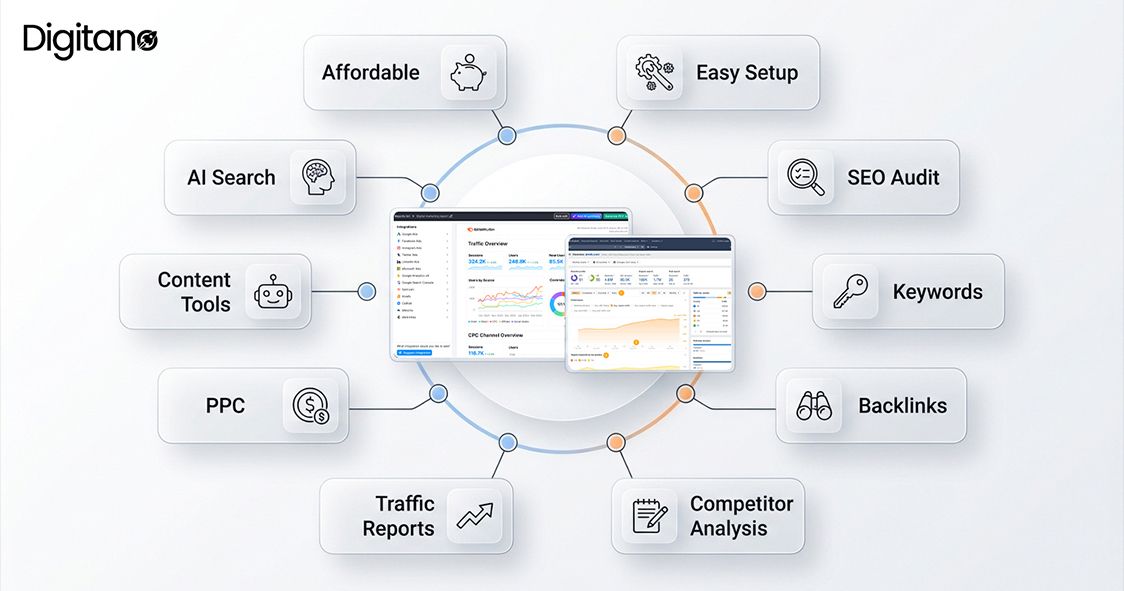
Choose Semrush if you need: All-in-one marketing (SEO plus PPC plus social plus content), AI-search visibility tracking, native Google integrations, or the ability to trial the tool before paying. Best for small agencies and in-house teams that need broader capability across marketing disciplines.
Choose Ahrefs if you need: Deep backlink research, technical SEO with continuous crawling, cleaner interface for daily use, actual click data in keyword research, or you specifically don't need PPC and social features. Best for focused SEO practitioners and content publishers where backlinks matter.
Choose neither if: Your monthly SEO-driven revenue is under $2,000, you're new to SEO and haven't yet learned to make decisions from free tools, or you have a specific narrow use case (like local SEO or basic keyword research) that a $30 to $50 per month tool can handle.
Consider running both if: Your monthly SEO-driven revenue is above $20,000, you have a dedicated SEO person on staff, and you're doing serious content marketing (Semrush) plus serious link building (Ahrefs) simultaneously. Combined cost is typically $260 to $700 per month depending on tiers, which is justified only when the tools directly drive that much or more in monthly revenue.
Frequently Asked Questions
Q1: Which is better for pure SEO, Ahrefs or Semrush?
Ahrefs is generally considered stronger for backlink-focused pure SEO work due to its faster crawler and larger, more frequently refreshed backlink database. Semrush is better for content-driven SEO strategies where the integrated writing workflow and topic research add value beyond raw SEO data.
Q2: Do I need Ahrefs or Semrush if I'm just doing local SEO?
Probably not. Google Business Profile, Google Search Console, and a cheaper local-focused tool like Whitespark or BrightLocal often cover local SEO needs at a fraction of the cost of Ahrefs or Semrush. Only consider the premium tools if you're competing for statewide or national visibility.
Q3: Can I run both Ahrefs and Semrush simultaneously?
Yes, and many agencies do. The common hybrid is Semrush for keyword research, content, AI visibility, and PPC alongside Ahrefs for backlink auditing and link prospecting. Combined cost is roughly $260 to $700 per month depending on tiers. Worth it only if SEO drives meaningful monthly revenue for your business.
Q4: What's the cheapest way to start with either tool?
Semrush Pro at $117 per month billed annually is the cheapest entry point to serious tooling with a free trial. Ahrefs Starter at $29 per month is genuinely useful for occasional research but limited for professional daily use. Both companies also offer free tools (Ahrefs Webmaster Tools and Semrush's free tier) that provide basic functionality without any subscription.
Q5: Are there any completely free alternatives worth considering?
Yes. Google Search Console, Google Analytics 4, Google Keyword Planner, Ahrefs Webmaster Tools (free tier), and Bing Webmaster Tools together cover a surprising amount of what small businesses actually need. For most sub-$2,000 monthly revenue businesses, the combination of these free tools provides more than enough capability to run effective SEO.
The Bottom Line
The honest answer to Ahrefs vs Semrush for small businesses is that neither is the right first purchase for many of the businesses asking the question. Free tools cover most needs at the earliest stages, cheaper alternatives like Ubersuggest and SE Ranking cover the middle stages, and premium tools like Ahrefs and Semrush earn their price only once your business generates enough SEO-driven revenue to justify the ongoing cost. When you do reach that stage, choose Semrush for all-in-one marketing capability and Ahrefs for focused SEO work with strong backlink emphasis.
If you'd rather have an experienced agency handle the tooling, analysis, and strategy so you can focus on your business, contact Digitano LLC. We combine the right tool stack with real strategic execution as part of our SEO and PPC engagements, rather than expecting small business owners to become full-time SEO analysts on top of running their businesses.