Every marketing budget conversation eventually lands on the same question: should this money go to Google Ads or Meta Ads? It's a fair question, since both platforms compete for a growing share of digital ad spend, and the wrong split can quietly waste thousands of dollars a month on the wrong kind of traffic.
The honest answer for Google Ads vs Meta Ads in 2026 is that neither platform is universally better. Each one is built for a different moment in the customer's decision, and the businesses getting the strongest results this year aren't choosing one over the other. They're matching each platform to the part of the funnel it's actually good at. This guide breaks down the real cost and performance benchmarks for 2026, when each platform tends to win, and how to think about splitting your budget based on your specific business model.
The Core Difference: Captured Demand vs. Created Demand
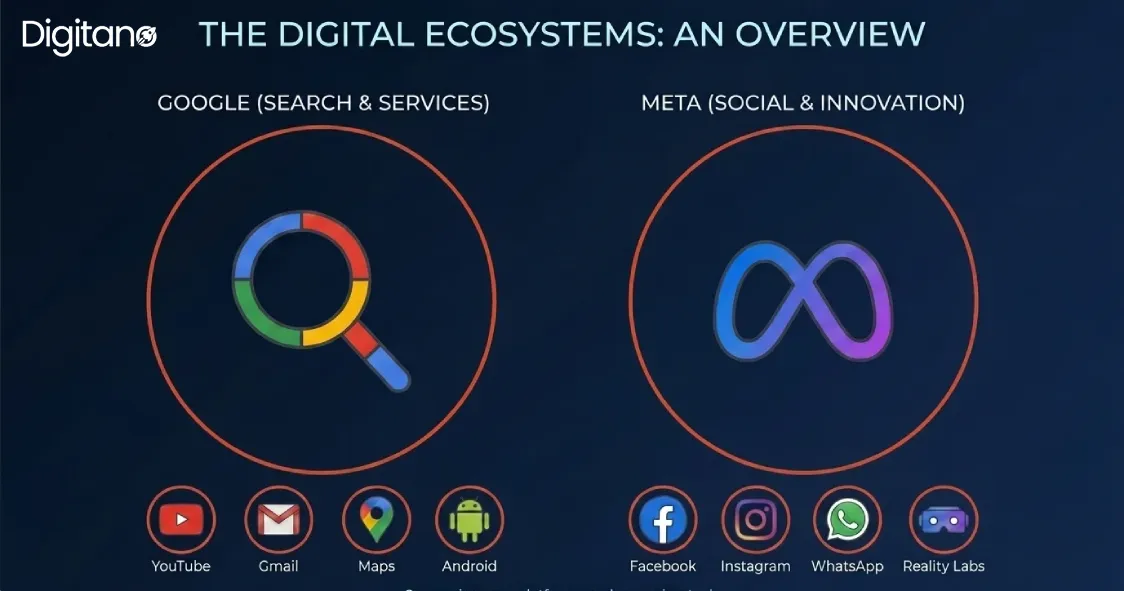
Before looking at a single number, it helps to understand the fundamental split between these two platforms. Google Ads is built around intent. Someone typing a search query has already decided they have a need and is actively looking for a solution, which means Google captures demand that already exists. Meta Ads works the opposite way. Someone scrolling Instagram or Facebook wasn't necessarily looking for your product at that moment, so Meta's job is to create interest and demand where none existed a few seconds earlier.
This single distinction explains almost every other difference in cost, conversion rate, and best use case between the two platforms, and it should be the starting point for any budget conversation.
2026 Cost Benchmarks: Google Ads vs. Meta Ads
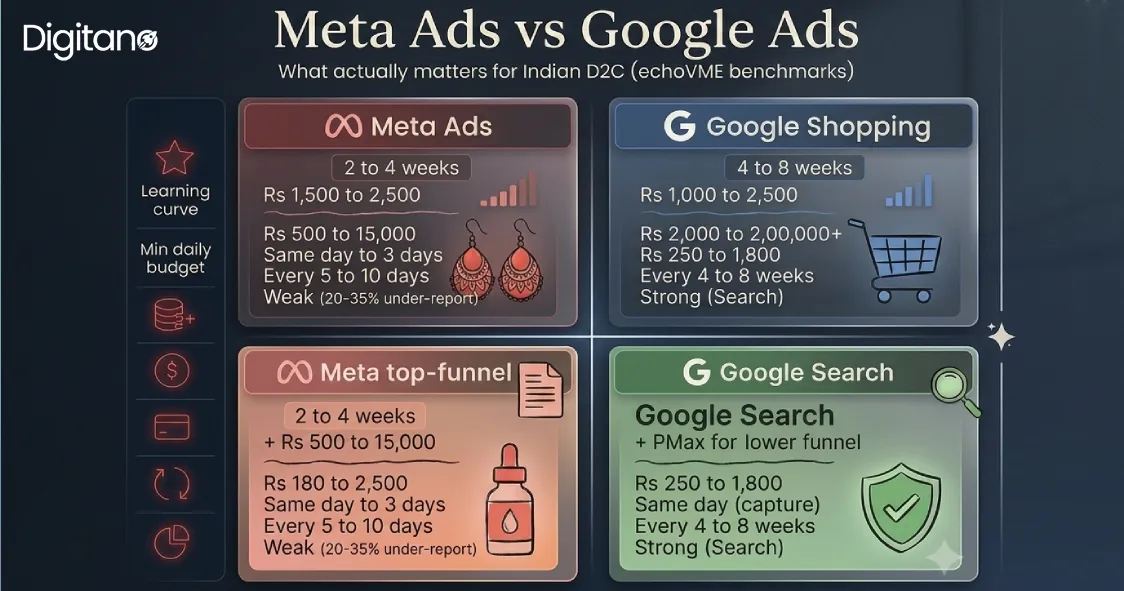
Cost per click is usually the first number people compare, and the gap between platforms remains significant in 2026. Google Search CPC benchmarks average somewhere in the $4 to $5.26 range depending on the reporting source, while Meta Ads CPC typically falls between $0.50 and $1.50, with some benchmark sets citing an even lower $0.62 to $0.97 range.
On the surface, Meta looks like the cheaper option by a wide margin. But cost per click alone doesn't determine value. Google's conversion rate benchmarks average around 3.75 percent, compared to roughly 0.9 percent on Meta. That gap exists because Google traffic arrives with existing purchase intent, while Meta traffic still needs to be persuaded, which is exactly why cost per acquisition, not cost per click, is the number that should actually drive a budget decision.
2026 ROAS Benchmarks by Platform
Return on ad spend benchmarks reinforce the same pattern. Google Ads averages around 3.5x to 4.2x ROAS across industries in 2026, with Search campaigns specifically reaching 6.0x to 8.0x and Shopping campaigns landing around 5.0x to 6.5x. Meta Ads averages closer to 1.86x to 2.8x overall, though this varies enormously by campaign type. Meta retargeting campaigns frequently exceed 8.0x ROAS, while cold prospecting campaigns typically land between 1.8x and 3.2x.
That retargeting number is worth sitting with for a moment, since it reveals something important: Meta's weakest use case is cold prospecting, and its strongest use case is retargeting people who already know your brand. This is a big part of why the highest-performing accounts in 2026 aren't running Meta and Google as separate, competing budgets. They're running them as connected stages of the same funnel.
Industry Makes a Real Difference
Averages only tell part of the story, since performance on both platforms varies significantly by industry. E-commerce brands selling visually appealing or impulse-friendly products tend to see strong Meta performance, with some reporting averages around 7.5x ROAS and top performers exceeding 8x. Higher-consideration categories with clear search demand, like specific product searches with obvious buying intent, tend to favor Google, with e-commerce ROAS on Search averaging around 4x.
High-stakes service categories such as legal, insurance, finance, and B2B SaaS tend to see Google Ads deliver stronger lead quality, since buyers in these categories are actively searching for a solution rather than discovering the need for one while scrolling. These same categories often carry the highest Google CPCs, sometimes exceeding $8 to $10 per click, but the higher cost is frequently justified by stronger downstream conversion value.
When Google Ads Deserves the Bigger Share of Your Budget
Google Ads tends to earn a larger allocation when your business fits one or more of these patterns:
- Your customers actively search before they buy. Local services, legal, healthcare, home repair, and B2B categories all benefit from Google's intent-based targeting.
- You sell something with urgency behind it. Emergency repairs, replacement products, and time-sensitive services convert well on Google because the buyer is already looking for a solution today.
- Your average order value or customer lifetime value is high enough to absorb a higher CPC. A $5 click is easy to justify if it reliably turns into a $2,000 customer.
- You already have strong organic visibility and brand recognition. Established brands tend to see stronger returns concentrating spend on Google's conversion capture, since awareness has already been built elsewhere.
When Meta Ads Deserves the Bigger Share of Your Budget
Meta tends to earn a larger allocation under different conditions:
- You're an early-stage business without existing brand recognition. Meta is generally the stronger choice for building initial awareness before search demand for your brand even exists.
- Your product is visual, lifestyle-driven, or impulse-friendly. Fashion, home goods, beauty, and consumer products with strong visual appeal consistently perform well on Meta.
- Your average order value is lower. Products under roughly $50 tend to favor Meta's lower barrier to entry and impulse-purchase mechanics.
- You need retargeting, not just prospecting. Meta's retargeting performance consistently outpaces its cold-audience performance, making it a strong second-touch platform even for businesses that acquire most new customers through Google.
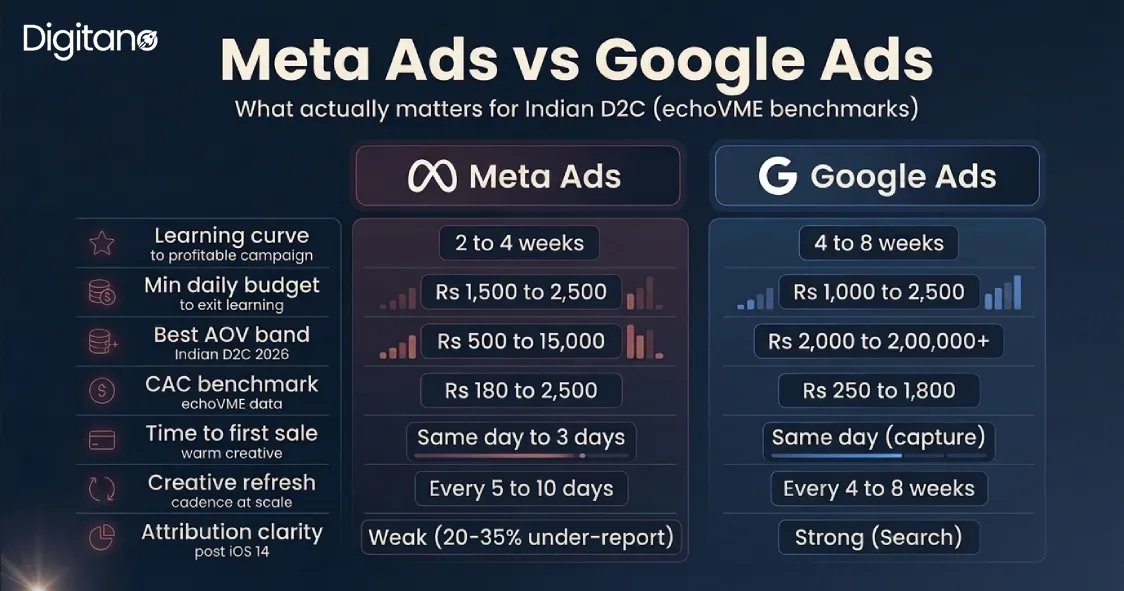
A Practical Budget Allocation Framework for 2026
Since business maturity and average order value both influence the right split, here's a general framework worth starting from:
- Early-stage companies with limited brand recognition: Consider weighting 70 to 80 percent of budget toward Meta for awareness building and audience development, with the remainder reserved for Google to capture whatever branded search demand starts appearing.
- Established brands with existing organic search presence: Consider flipping that ratio, allocating 60 to 70 percent toward Google for conversion capture, while using Meta for expansion, retention, and retargeting.
- Businesses with an adequate combined budget: Rather than treating this as an either-or split, run both platforms in complementary roles. Use Meta to build awareness and warm up cold audiences, then use Google to capture the resulting demand when those same people begin actively searching.
This hybrid, full-funnel approach has been shown to deliver meaningfully higher blended ROAS than single-platform campaigns, though it does require solid cross-platform tracking and attribution to actually measure whether it's working.
Why Your Google and Meta Numbers Will Never Match Exactly
One frustration worth addressing directly: conversion counts reported by Google, Meta, and your own analytics platform will rarely match perfectly. Attribution windows, view-through conversions, and each platform's own modeling assumptions all differ, which means a certain amount of discrepancy is normal rather than a sign that something is broken.
The more useful goal in 2026 isn't chasing perfectly matched numbers across platforms. It's establishing consistent measurement rules, strong first-party tracking, and a reliable way to compare blended performance across both channels, since privacy changes and cross-platform automation have made platform-native reporting less reliable on its own than it used to be.
Common Budget Allocation Mistakes to Avoid
- Judging Meta purely on cost per click. A cheap click that never converts is more expensive than an expensive click that does.
- Expecting Google-level conversion rates from Meta prospecting campaigns. Cold Meta traffic is doing a different job than a Google search click, and holding it to the same immediate conversion standard sets unrealistic expectations.
- Cutting Meta entirely because it "doesn't convert" without a Google follow-up channel in place. Meta's biggest weakness in isolation is often its biggest strength as the first stage of a two-platform funnel.
- Ignoring retargeting. Since retargeting frequently delivers some of the strongest ROAS on either platform, an account that skips it is leaving a straightforward performance improvement on the table.
- Spreading budget too thin across both platforms without enough spend on either to gather meaningful data. A small budget usually performs better concentrated on whichever platform matches your buyer's intent level, rather than split evenly.
Frequently Asked Questions
Q1: Is Meta Ads always cheaper than Google Ads?
On a per-click basis, generally yes. Meta's average CPC typically runs well below Google's, though a cheaper click doesn't automatically translate into a cheaper cost per acquisition, since conversion rates and buyer intent differ significantly between the two platforms.
Q2: Should a small business with a limited budget split spend evenly between Google and Meta?
Not necessarily. With a limited budget, it's often more effective to concentrate spend on whichever platform best matches your customer's buying behavior, rather than splitting a small budget too thin to gather meaningful performance data on either platform.
Q3: Does running both platforms actually improve results, or is that just an agency talking point?
The benchmark data supports it in most cases. A coordinated approach using Meta for awareness and Google for conversion capture has been shown to produce meaningfully higher blended ROAS than running either platform alone, provided tracking and attribution are set up properly.
Q4: Why doesn't my conversion count match between Google Ads, Meta Ads, and my analytics tool?
This is normal and expected. Each platform uses different attribution windows and conversion modeling, so perfect alignment across tools is uncommon. Focus on consistent measurement rules rather than expecting the numbers to match exactly.
Building the Right Mix for Your Business
There's no universal answer to Google Ads vs Meta Ads in 2026, and any agency claiming otherwise is oversimplifying a decision that depends heavily on your industry, average order value, and how much brand awareness you already have. What the data does make clear is that Google tends to win at the bottom of the funnel where intent already exists, while Meta tends to win at the top, building the awareness that eventually turns into a search.
If you're trying to figure out the right budget split for your specific business, or you want a strategy built around real performance data rather than guesswork, our PPC management services are built around exactly that kind of platform-specific strategy. Contact Digitano LLC today to talk through where your 2026 ad budget should actually go.