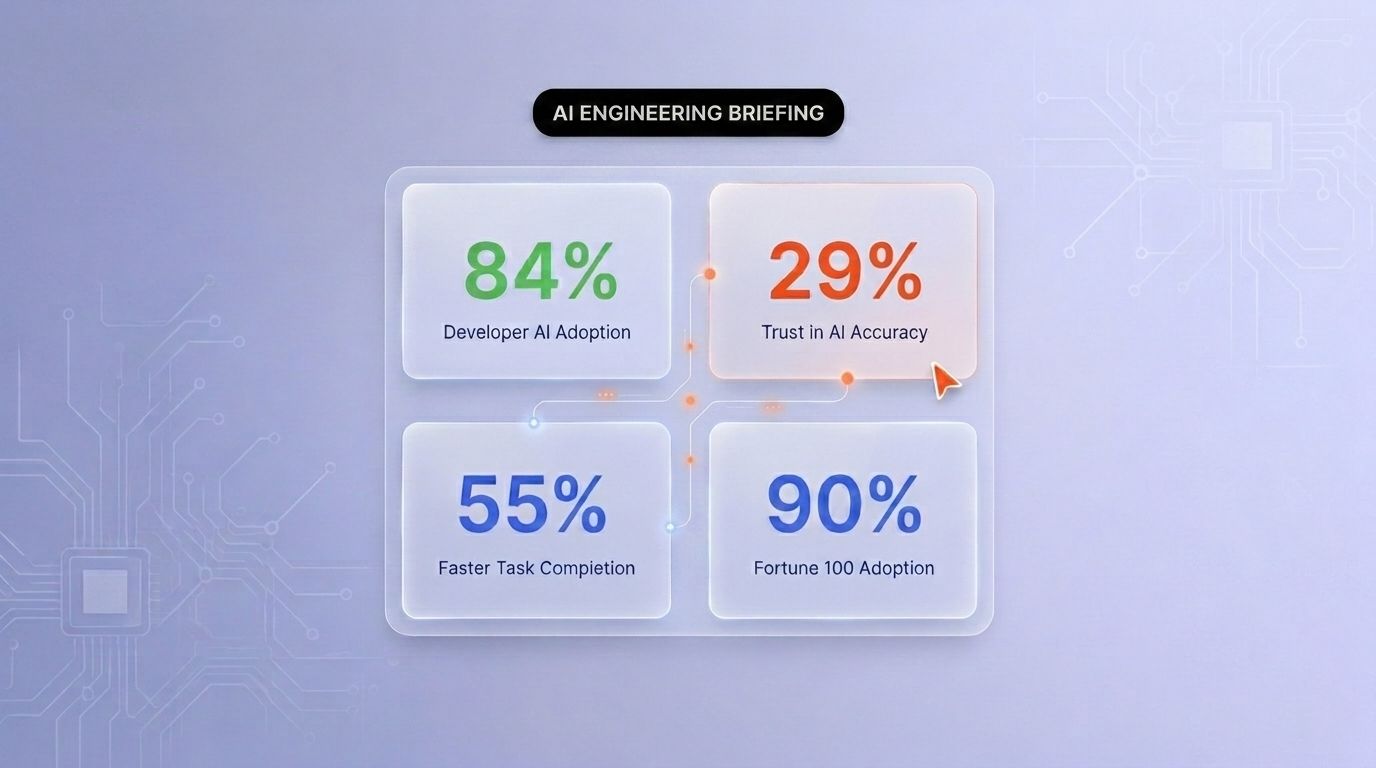
Here's a stat that sums up where we actually are in 2026: 84% of developers use or plan to use AI coding tools, but only 29% trust the output, according to the Stack Overflow Developer Survey 2025 with over 49,000 respondents. That trust number is down from 40% in 2024. So the story of AI in software development isn't one of universal adoption or universal skepticism. It's a story of widespread use paired with growing awareness of what AI genuinely does well and where it consistently falls short. The engineering leaders who understand both sides ship faster, better code. The ones who treat AI as either a magic wand or a threat consistently underperform teams that do neither.
This guide walks through exactly what AI is doing in software development in 2026, the real opportunities backed by data, the specific risks that show up in production, and the practices that separate teams capturing meaningful ROI from teams that adopted AI tools but never got the returns. If you'd rather have an experienced team help you build the workflows that make AI-assisted development actually work, our digital marketing services and consulting work at Digitano LLC include this kind of technical strategy for organizations serious about disciplined engineering.
The 2026 State of AI in Software Development: Real Numbers
Before jumping into opportunities and risks, let's ground the conversation in verifiable 2026 data from named primary sources:
- 84% of developers use or plan to use AI coding tools in 2026, up from 76% in 2024 (Stack Overflow Developer Survey 2025, n=49,000+)
- 51% of professional developers use AI tools daily (Stack Overflow 2025)
- Only 29% of developers trust AI outputs to be accurate in 2026, down from 40% in 2024 (Uvik Software 2026)
- GitHub Copilot reached 4.7 million paid subscribers by January 2026, up 75% year-over-year (SQ Magazine 2026)
- 90% of Fortune 100 companies have adopted Copilot (Quantumrun 2026)
- 90% of developers regularly use at least one AI tool at work, per JetBrains April 2026 survey
- 55.8% faster task completion using GitHub Copilot (GitHub/Microsoft controlled study of 4,800 developers)
- 46% of code written with Copilot is AI-generated on average, reaching 61% for Java developers (Quantumrun 2026)
- 75.9% of developers use AI for daily tasks like writing, debugging, and testing (DORA 2024 report, 39,000+ professionals)
- ~30% suggestion acceptance rate for Copilot (which means human review still filters most output) (GetPanto 2026)
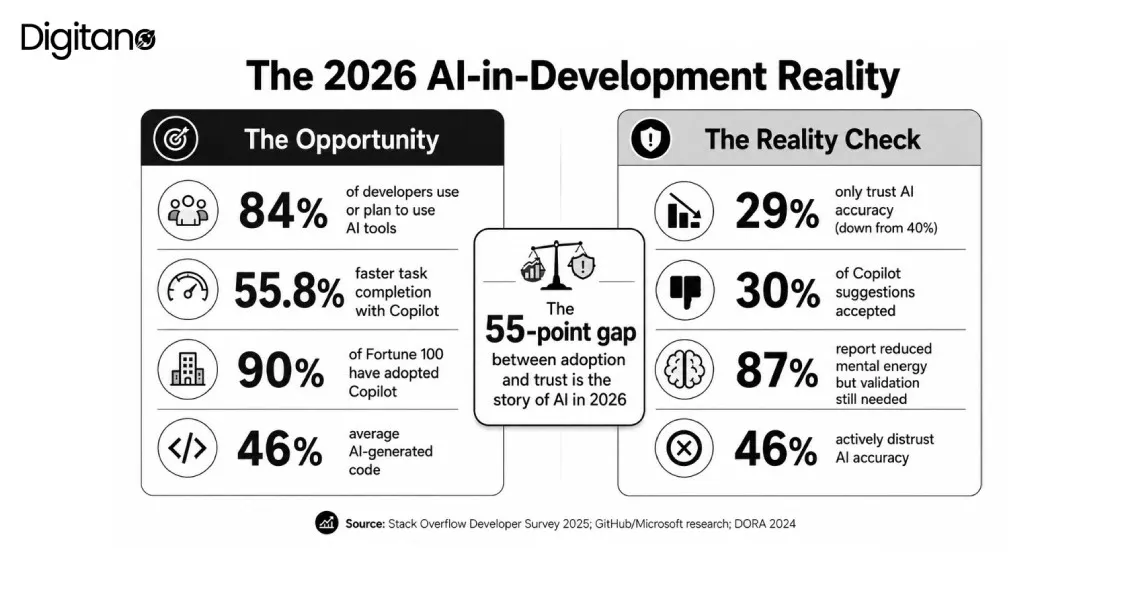
The picture is nuanced: real productivity gains are happening, real risks are showing up, and the teams that navigate both consistently outperform teams that pick one narrative over the other.
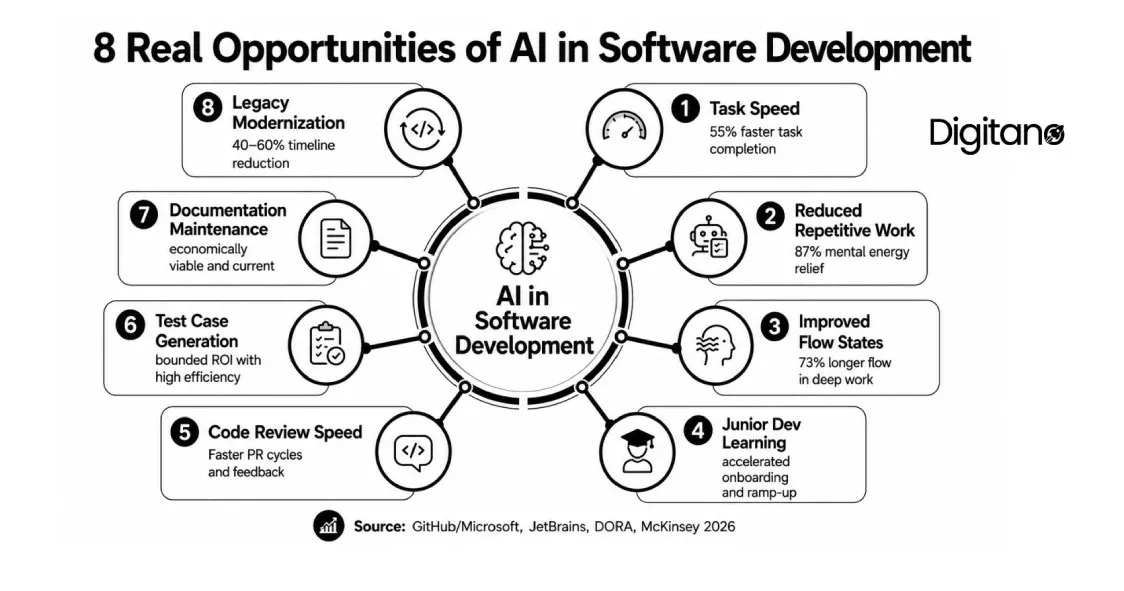
The Real Opportunities: Where AI Genuinely Delivers in 2026
Being specific about what AI actually does well matters more than generic claims. Here are the categories where the productivity data is genuinely strong.
1. Task Completion Speed
The most-measured productivity gain from AI coding tools. Controlled GitHub/Microsoft research with 4,800 developers found average task completion times dropped from 2 hours 41 minutes to 1 hour 11 minutes with Copilot, a 55% improvement. This isn't marketing spin; it's controlled experimental data with real developers on real tasks.
The 2026 baseline: nearly 9 in 10 developers who use AI save at least one hour per week, and one in five saves eight hours or more. For a team of 20 engineers, that's roughly 160-1,600 hours per week in aggregate savings, depending on adoption depth.
2. Reduced Repetitive Work
87% of developers report reduced mental energy spent on repetitive tasks (GitHub research cited by Quantumrun 2026). AI handles the tedious parts of programming (boilerplate code, standard patterns, common conversions) freeing developers to focus on architectural decisions and complex problem-solving where human judgment still leads.
3. Improved Developer Flow States
73% of developers report maintaining flow states longer when using Copilot, per Quantumrun's 2026 research. This is genuinely significant because flow state is where developers do their best work. AI reducing context switching (searching Stack Overflow, looking up syntax, remembering API details) directly correlates with higher-quality output.
4. Learning Acceleration for Junior Developers
Junior developers use AI tools especially heavily for autocompletion and code explanation, according to JetBrains research. This accelerates learning curves meaningfully. What used to require weeks of mentoring and Stack Overflow diving now happens through natural interaction with AI coding assistants during actual development work.
5. Faster Code Reviews and Debugging
AI-powered code review tools identify common issues, suggest improvements, and catch obvious bugs before human review. This doesn't replace human review but makes it meaningfully faster and more focused on architectural and business logic concerns rather than syntax and style issues.
6. Automated Test Case Generation
AI generates structured test cases from requirements automatically, including edge cases humans often miss. Combined with human review of the generated tests, this is one of the highest-ROI applications of AI in software development.
7. Documentation Generation and Maintenance
AI produces initial documentation drafts, keeps API docs synchronized with code changes, and generates code comments at scale. Documentation has historically been where teams cut corners; AI makes maintaining it economically viable.
8. Cross-Language Translation and Legacy Modernization
AI tools now handle language translation (Python to TypeScript, Java to Go) at production quality with human oversight. For legacy modernization projects, this compresses timelines dramatically. According to McKinsey's 2026 research, AI-assisted code modernization can reduce legacy migration effort by 40-60% for well-scoped projects.
The Real Risks: What Actually Goes Wrong
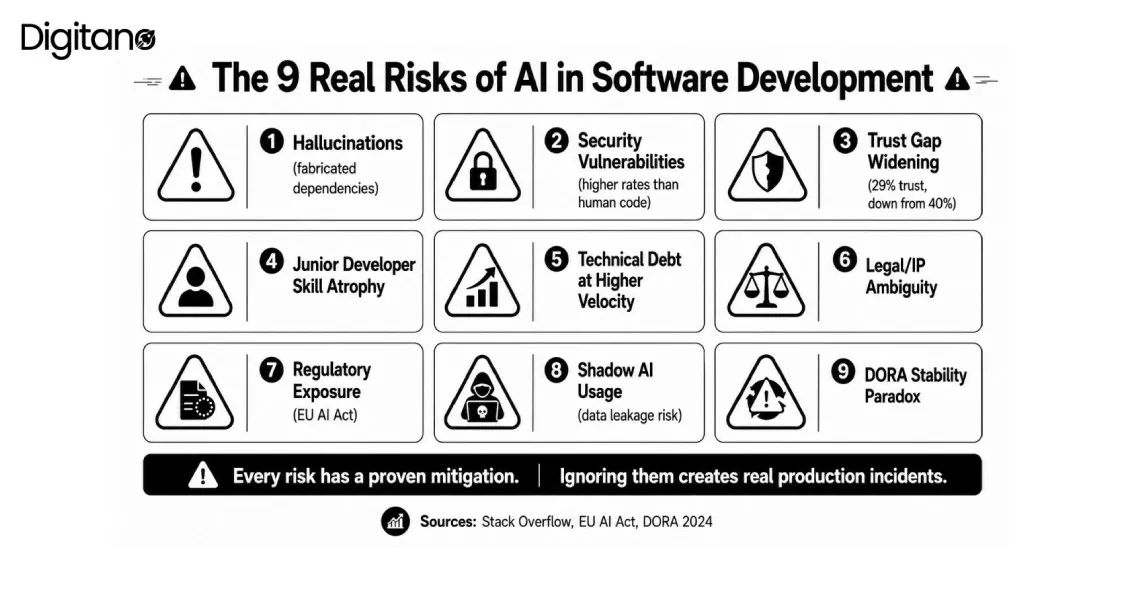
Being honest about risks is what separates good technical advisory content from hype. Here are the specific 2026 risks that show up when teams adopt AI without proper practices.
1. Hallucinations and Fabricated Dependencies
AI models sometimes generate incorrect outputs with high confidence, including references to functions, libraries, or APIs that don't exist. This is called hallucination, and it's genuinely one of the most dangerous risks because the fabricated code looks plausible. Without careful review, hallucinated dependencies can enter production and cause runtime failures.
2. Security Vulnerabilities in Generated Code
Multiple studies have documented that AI-generated code carries meaningfully higher security vulnerability rates than human-authored code. Common issues include: SQL injection vulnerabilities, insufficient input validation, hardcoded credentials, insecure default configurations, and outdated cryptographic practices from the model's training data.
3. The Trust Gap Widening
The Stack Overflow 2025 data showing only 29% trust (down from 40% in 2024) reflects real, growing developer concern about AI output quality. When 46% of developers "actively distrust" AI accuracy, that's not a communication problem. That's genuine experience with AI failures compounding across the industry.
4. Skill Atrophy in Junior Developers
An emerging concern in 2026: junior developers heavily reliant on AI tools may not develop deep problem-solving skills. When AI writes the boilerplate code, junior devs may never learn the patterns underlying it. This becomes visible only when they need to debug edge cases or work in AI-restricted environments.
5. Technical Debt at Higher Velocity
AI generates code faster, which means teams also generate technical debt faster if quality controls aren't disciplined. Poorly-reviewed AI code compounds into refactoring debt at unprecedented speeds.
6. Legal and IP Concerns
AI models trained on open source code create genuine legal ambiguity about ownership and licensing of generated code. Enterprise legal teams increasingly require governance frameworks documenting how AI-generated code is reviewed, licensed, and attributed.
7. Compliance and Regulatory Exposure
The EU AI Act (now in force) and emerging US state-level regulations require documentation of AI use in software systems. Teams that adopted AI informally now face compliance work to retrofit governance frameworks.
8. Shadow AI Usage
Individual developers frequently use ChatGPT, Claude, or other AI tools informally without organizational governance. This creates data leakage risk (proprietary code sent to external services), compliance gaps, and inability to measure or manage AI's actual impact on the codebase.
9. The DORA Stability Paradox
One of the most important 2026 findings: teams using AI often see higher velocity but lower stability. The 2024 DORA report identified a paradox: AI increases task completion speed but change failure rates rise in teams that lack disciplined review workflows.
Best Practices That Actually Work in 2026
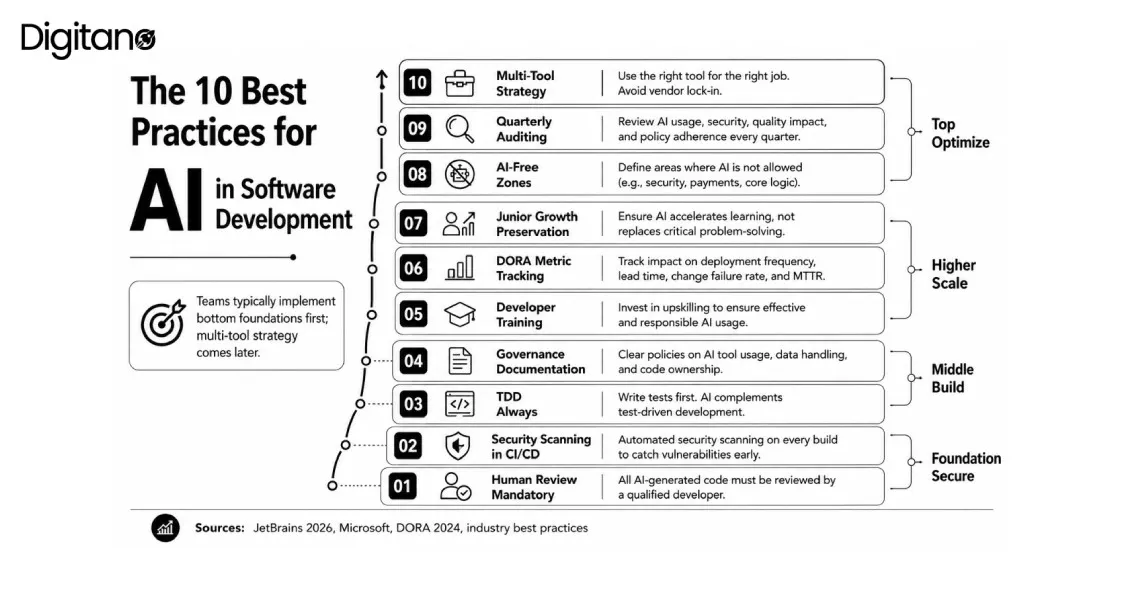
Based on what genuinely separates high-performing teams from those seeing negative AI ROI, here are the practices that consistently work:
1. Mandatory Human Review for All AI-Generated Code
Non-negotiable. Every AI-generated function, module, or test needs human review before merging. The 30% suggestion acceptance rate for Copilot actually reflects good practice: developers reject two-thirds of suggestions because they're wrong, unnecessary, or suboptimal. Preserve that filter.
2. Security Scanning in CI/CD for AI-Generated Code
Add automated security scanning specifically tuned for common AI vulnerabilities (SQL injection, credential leaks, insecure defaults). Tools like Snyk, GitHub Advanced Security, and Semgrep catch AI-introduced vulnerabilities before they reach production.
3. Test-Driven Development When Using AI
TDD's discipline (write test, generate code, verify against test) is genuinely more valuable in the AI era than pre-AI. AI-generated code that passes tests is meaningfully more reliable than AI-generated code accepted without verification.
4. Governance Documentation From Day One
Document your AI usage policies before scaling adoption:
- Which AI tools are approved for which use cases
- How AI-generated code is reviewed and validated
- Data handling policies (what data can/can't be sent to AI services)
- Attribution and licensing requirements
- Audit trails for AI-generated content in production
5. Invest in Developer Training on AI Tools
Nearly 11 weeks are typically needed for developers to fully realize productivity gains from AI coding tools, per Microsoft research. Teams often see initial productivity dips during ramp-up. Budget for training and expect a learning curve rather than immediate results.
6. Measure DORA Metrics Alongside AI Adoption
Track deployment frequency, lead time for changes, change failure rate, and MTTR before and after AI adoption. If AI increases velocity but change failure rate rises, you've hit the DORA stability paradox. Adjust your review workflows before the problem compounds.
7. Preserve Manual Coding for Junior Developer Growth
Deliberately assign some coding work to junior developers without AI assistance for deep learning. Skill development matters for long-term team capability even when short-term productivity trades against it.
8. Establish Clear AI-Free Zones
Some code should never be AI-generated: security-critical modules, authentication flows, payment processing, encryption logic. Define these zones explicitly so nobody assumes AI use is universally acceptable.
9. Regular AI Output Auditing
Quarterly review AI-generated code that reached production. Look for patterns: what types of bugs slipped through? Where did AI-generated code create maintenance issues? Use these findings to refine your review processes.
10. Multi-Tool Strategy Rather Than Single-Vendor Lock-In
The JetBrains April 2026 survey shows developers using multiple AI tools: GitHub Copilot (29%), ChatGPT (28%), Claude Code and Cursor (18% each). Multi-tool usage protects against vendor lock-in and gives teams flexibility as capabilities evolve rapidly.
Real Company Examples: How Enterprises Actually Deploy AI in 2026
Abstract best practices only tell part of the story. Here are real 2026 examples:
Siemens: 30,000 Developer Rollout
Siemens adopted GitHub Copilot across 30,000 of its developers after successful pilot programs, per Microsoft's Q2 FY2026 earnings call. The scale represents one of the largest single enterprise AI development deployments in 2026.
Google: 25% AI-Assisted Code with Discipline
Google CEO Sundar Pichai has publicly stated that approximately 25% of Google's code is now AI-assisted, delivering roughly 10% engineering velocity improvements. Notably, Pichai frames the gain as velocity (not developer replacement), reinforcing the augmentation model.
GitHub Copilot Enterprise: 140,000 Organizations
Microsoft disclosed GitHub Copilot enterprise adoption reached nearly 140,000 organizations by Q3 FY2026, tripled from a year earlier. This scale demonstrates that AI in development has moved from experimental to standard enterprise infrastructure.
These aren't outliers. They're the pattern: large enterprises adopting AI at scale with governance frameworks that let them capture productivity while managing risks. The key insight: none of these organizations replaced developers. They amplified them.
Common Mistakes Engineering Leaders Make
Based on 2026 industry patterns:
- Adopting AI without governance frameworks. Retrofitting governance after adoption is exponentially harder than building it from the start.
- Measuring adoption instead of outcomes. License counts don't equal ROI. Business impact metrics (velocity + stability + quality) do.
- Skipping training investment. Expecting developers to figure out AI tools alone leads to surface-level adoption that captures maybe 20% of possible productivity gains.
- Ignoring the security dimension. AI-generated code has documented higher vulnerability rates. Security scanning isn't optional.
- Treating AI as a developer replacement. Companies that reduced engineering headcount expecting AI to close the gap have generally regretted it within 12-18 months.
- Underestimating the trust learning curve. Developer trust in AI took a real dip in 2026 (40% → 29%). Communicating validation practices helps rebuild that trust internally.
- Failing to measure DORA metrics. Without DORA tracking, teams can't detect when AI velocity is coming at the cost of stability.
Frequently Asked Questions
Q1: What are the main opportunities of AI in software development?
The primary opportunities are: 55% faster task completion (verified in GitHub/Microsoft controlled studies), 87% reduction in mental energy spent on repetitive work, 73% longer developer flow states, accelerated learning for junior developers, faster code reviews, automated test case generation, documentation maintenance, and 40-60% timeline reduction on legacy modernization projects.
Q2: What are the biggest risks of using AI in software development?
The main risks are: hallucinations (fabricated dependencies), higher security vulnerability rates in generated code, developer trust gap widening (29% trust in 2026 down from 40% in 2024), junior developer skill atrophy, faster technical debt accumulation, legal/IP ambiguity, regulatory compliance exposure (EU AI Act), shadow AI usage creating data leakage risk, and the DORA stability paradox where velocity rises but stability falls.
Q3: How does AI improve software development productivity?
Verified productivity gains come from: 55.8% faster task completion (GitHub/Microsoft controlled study of 4,800 developers), 87% mental energy relief on repetitive tasks, longer flow states, faster code reviews, and automated test case generation. Nearly 9 in 10 developers who use AI save at least one hour per week; one in five saves eight hours or more.
Q4: What percentage of developers use AI tools in 2026?
According to the Stack Overflow Developer Survey 2025 with 49,000+ respondents, 84% of developers use or plan to use AI coding tools, up from 76% in 2024. 51% use AI tools daily. JetBrains research shows 90% of developers regularly use at least one AI tool at work.
Q5: How do I safely adopt AI in software development?
Follow these core practices: mandatory human review for all AI-generated code, security scanning in CI/CD, test-driven development, governance documentation from day one, developer training investment (expect ~11 weeks to full productivity), DORA metric tracking alongside AI adoption, preservation of manual coding for junior developer growth, AI-free zones for security-critical code, quarterly AI output auditing, and multi-tool strategy rather than single-vendor lock-in.
Q6: Will AI replace software developers?
No, based on 2026 evidence. AI amplifies developer productivity rather than replacing developers. Google CEO Sundar Pichai frames Google's 25% AI-assisted code as velocity gains (roughly 10% improvement) rather than developer replacement. Companies that reduced engineering headcount expecting AI replacement have generally regretted it within 12-18 months. The role is evolving toward higher-value work, not disappearing.
Q7: What's the biggest mistake teams make with AI in software development?
Adopting AI tools without governance frameworks and skipping mandatory human review. This looks like productivity in the short term while accumulating security vulnerabilities, technical debt, and compliance exposure that become visible only after production incidents. Every AI-generated code artifact needs human validation before entering production.
The Bottom Line
AI in software development has moved from experimental technology to standard practice in 2026. 84% of developers use or plan to use AI coding tools, GitHub Copilot has reached 90% of Fortune 100 companies, and controlled research consistently shows 55% task completion improvements. The opportunities are real and measurable.
But so are the risks. Developer trust in AI accuracy dropped from 40% to 29% between 2024 and 2026, reflecting real experience with hallucinations, security vulnerabilities, and quality issues. Teams adopting AI without disciplined practices consistently see the DORA stability paradox: higher velocity but lower stability, resulting in more production incidents rather than fewer.
The winning strategy for 2026 is neither uncritical adoption nor cautious avoidance. It's disciplined integration: adopt the tools that deliver measurable productivity, build the review workflows that catch AI's characteristic failures, invest in the governance frameworks that meet regulatory requirements, and preserve the human judgment that AI cannot replicate. Teams that get this right capture the real productivity gains while avoiding the failure patterns.
For organizations that need help designing AI-augmented development workflows, building the governance and review practices that make AI adoption succeed, or transitioning existing engineering teams into disciplined AI-augmented roles, contact Digitano LLC. We help engineering teams move beyond debates about whether to adopt AI into disciplined, measurable AI-augmented engineering practices that ship better software and reduce operational risk at scale.