Let's cut through the noise. When a US business owner asks "how much does it cost to build a custom application," they get quotes ranging from $25,000 to $1 million for what sounds like the same project. That is not a mistake or bad math. That is the reality of a market where hourly rates span $30 to $350, developer seniority varies dramatically, and hidden costs (post-launch maintenance, cloud infrastructure, security compliance) often add another 20 to 30 percent to any initial estimate.
According to verified 2026 industry data compiled from over 200 real custom software development projects, the honest answer is: a custom business application in the US typically costs between $50,000 and $500,000, with enterprise-grade platforms often exceeding $1,000,000. But those numbers only make sense when you understand what drives them.
At Digitano, we have been helping US businesses budget and build custom applications for years, and we consistently see the same three questions come up: what does the money actually pay for, what are the hidden costs no one talks about, and how do you get the biggest return per dollar spent. This complete 2026 pricing guide answers all three with real market data from BLS, Statista, Andersen Lab, Keyhole Software, and other verified sources.
The Fast Answer: 2026 Custom Business Application Cost Ranges
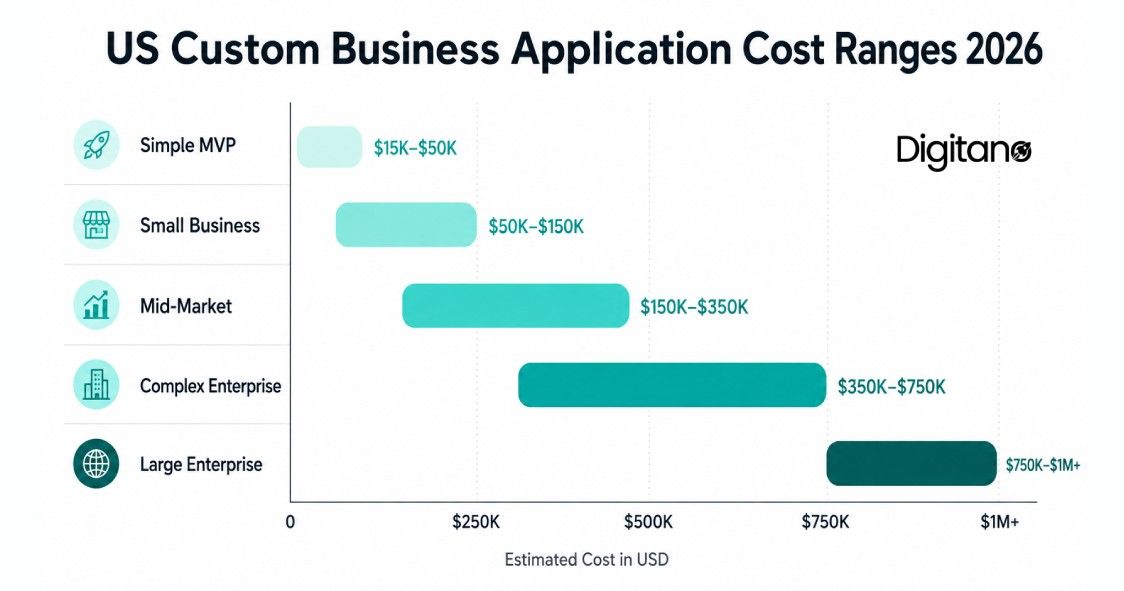
Before we dig into what drives cost, here are the verified 2026 ranges from real US market data:
| Project Type | Cost Range (2026) | Timeline | Example |
|---|---|---|---|
| Simple MVP / Small App | $25,000 – $75,000 | 6–12 weeks | Basic internal tool, single-purpose calculator, simple customer portal |
| Small Business Application | $75,000 – $150,000 | 3–5 months | Custom booking system, basic CRM, workflow automation tool |
| Mid-Market Business App | $150,000 – $300,000 | 5–8 months | Custom ERP module, member portal with integrations, multi-user dashboard |
| Complex Enterprise Application | $300,000 – $500,000 | 8–12 months | Full CRM/ERP system, multi-department platform, HIPAA/SOC 2 compliant tools |
| Large Enterprise Platform | $500,000 – $1,000,000+ | 12–18+ months | AI-enabled platform, multi-region compliance, real-time analytics engine |
Why the Cost Range Is So Wide (And Why That's Not Actually a Problem)
The reason quotes vary from $25,000 to $1 million for what sounds like similar projects is that "custom business application" describes everything from a spreadsheet replacement to a Salesforce competitor. According to Keyhole Software's 2026 research analyzing 200+ verified projects, the same feature specification can cost 200 percent more or less depending on team seniority, delivery model, risk tolerance, and post-launch requirements.
Here are the seven factors that actually determine your cost in 2026:
1. Project Complexity and Feature Scope
The single biggest cost driver. A simple internal tool with 3 to 5 features costs a fraction of a multi-user platform with 20+ features, third-party integrations, and admin dashboards. Every additional feature typically adds 40 to 200 hours of development time.
2. Development Team Location and Seniority
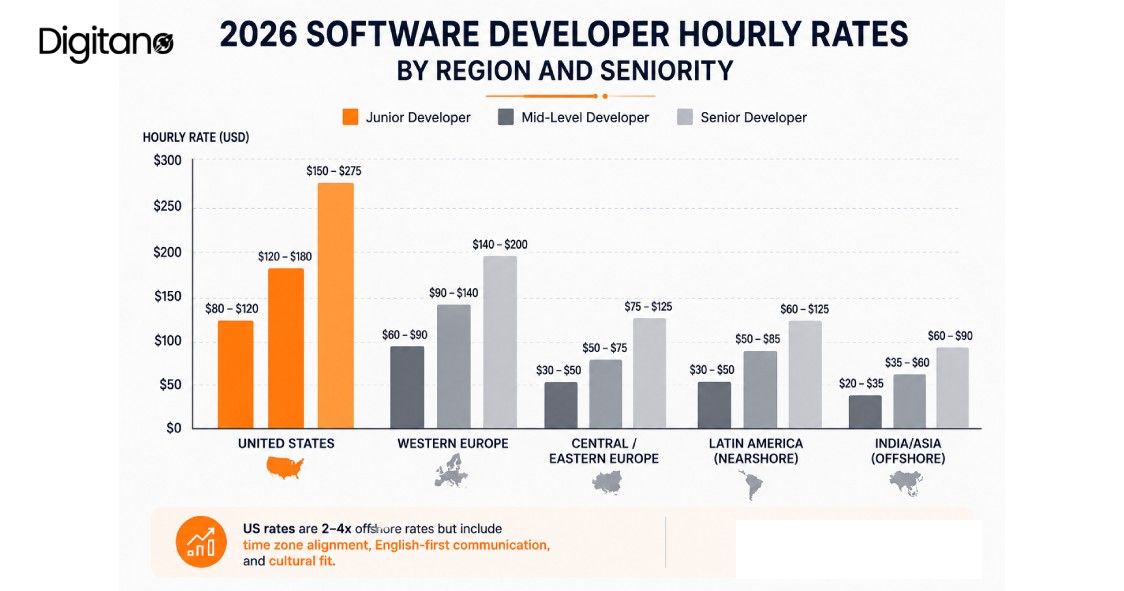
According to verified 2026 hourly rates from multiple industry sources:
| Region | Junior Developer | Mid-Level Developer | Senior Developer |
|---|---|---|---|
| United States | $80 – $120/hr | $120 – $180/hr | $150 – $275/hr |
| Western Europe | $60 – $90/hr | $90 – $140/hr | $140 – $200/hr |
| Central/Eastern Europe | $30 – $50/hr | $50 – $75/hr | $75 – $125/hr |
| Latin America (Nearshore) | $30 – $50/hr | $50 – $85/hr | $60 – $125/hr |
| India/Asia (Offshore) | $20 – $35/hr | $35 – $60/hr | $60 – $90/hr |
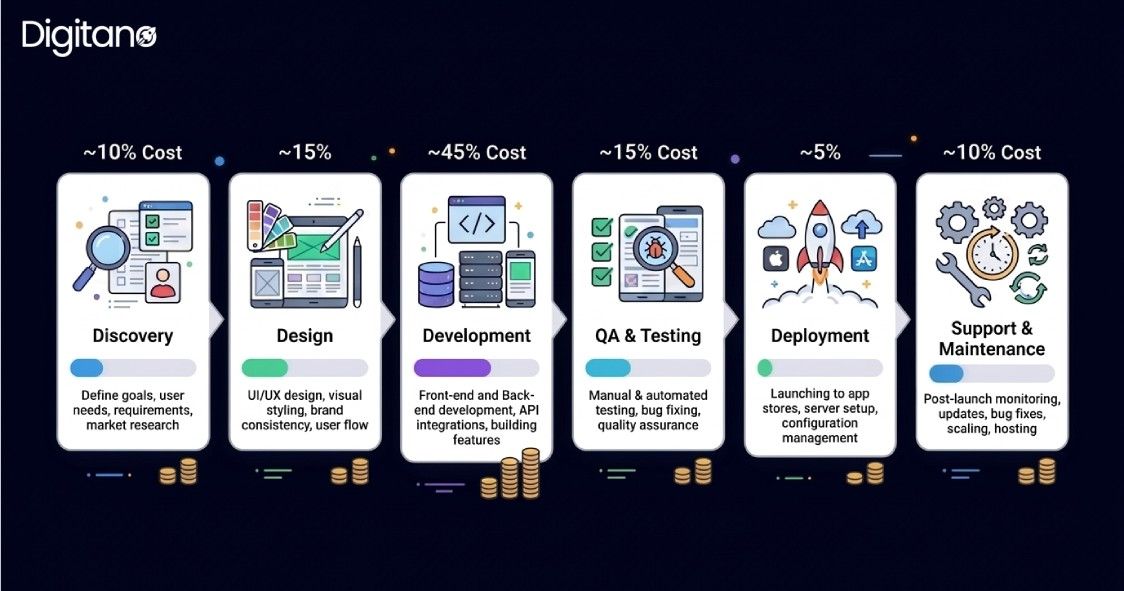
3. Team Composition (What You're Actually Paying For)
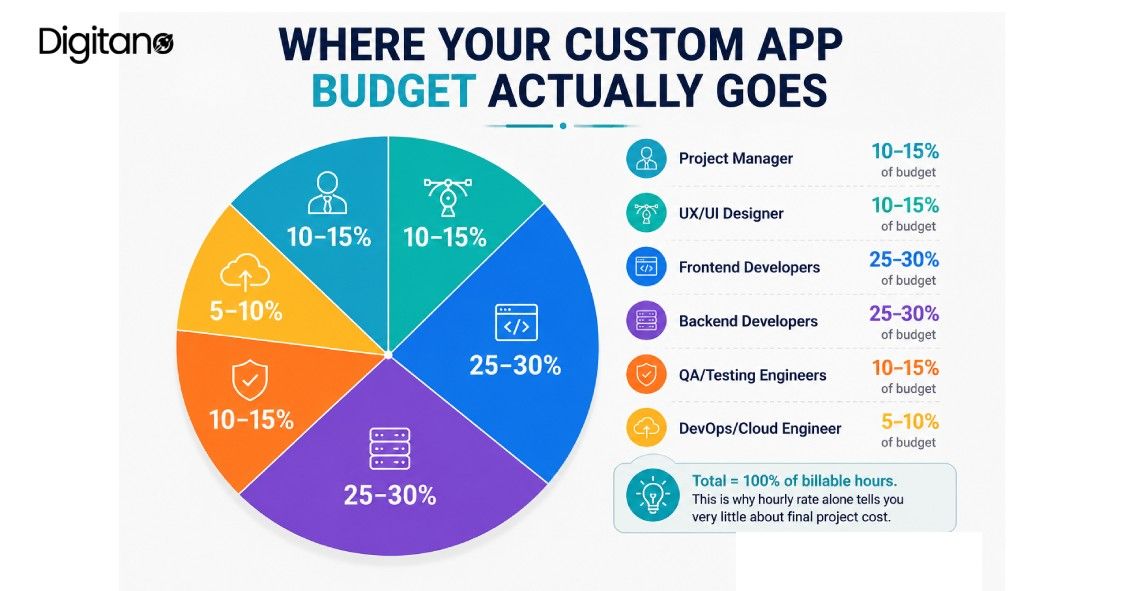
A common misconception is that you are paying for one developer. A real custom application team in 2026 typically includes:
- Project Manager: 10 to 15 percent of budget
- UX/UI Designer: 10 to 15 percent of budget
- Frontend Developers: 25 to 30 percent of budget
- Backend Developers: 25 to 30 percent of budget
- QA/Testing Engineers: 10 to 15 percent of budget
- DevOps/Cloud Engineer: 5 to 10 percent of budget
4. Technology Stack and Programming Language
Rare or specialized languages command premium rates. According to 2026 Stack Overflow Developer Survey data, developers working in Rust, Go, and Scala command 15 to 25 percent premiums over standard Python/JavaScript developers. This matters for niche projects but rarely for typical business applications.
5. Integration Requirements
Every third-party integration (payment processors, CRM sync, email marketing, analytics tools) adds 20 to 80 hours per integration. A "simple" business app that integrates with Stripe, Salesforce, Mailchimp, and Google Workspace can easily add 200 to 400 hours to the base project.
6. Security, Compliance, and Regulatory Requirements
HIPAA, SOC 2, PCI-DSS, and GDPR compliance can add 20 to 40 percent to project costs. Healthcare and fintech applications almost always fall into this category. Standard business applications for internal use often do not require this level of investment.
7. AI-Assisted Development (New 2026 Factor)
According to Soltech's 2026 research, AI-assisted development workflows can reduce development effort by 20 to 30 percent compared to traditional approaches. However, actual savings vary widely by project type. At Digitano, we integrate AI-assisted development throughout our workflow, which is one reason our project costs are typically 15 to 25 percent lower than agencies still using purely traditional methods.
Real 2026 Cost Breakdown: A Mid-Market CRM Example
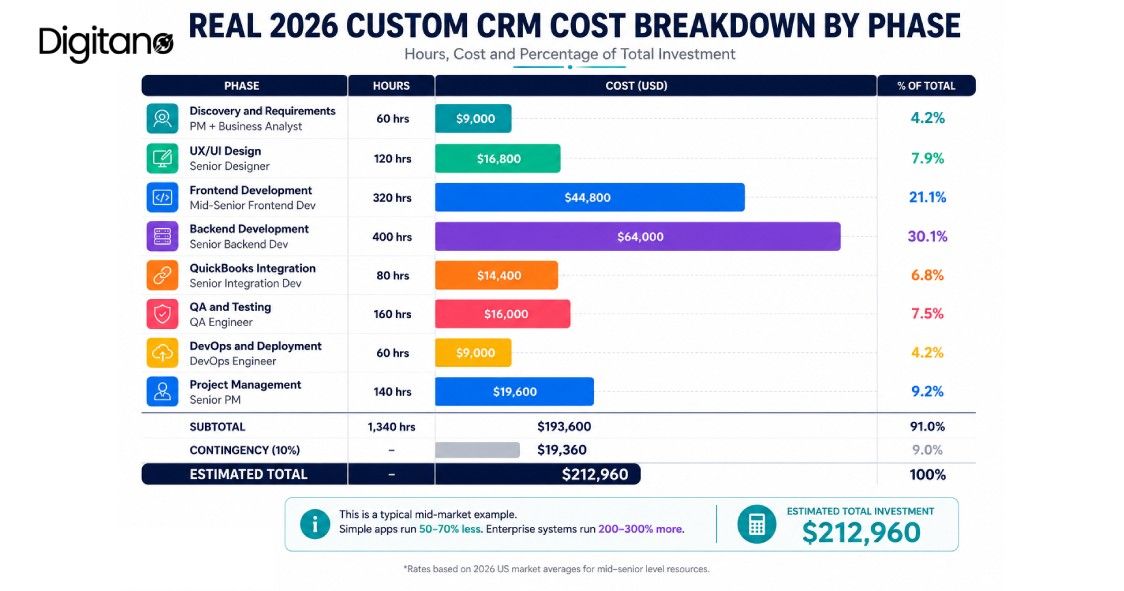
Numbers only mean something in context. Here is a real-world cost breakdown of a typical mid-market custom CRM built for a US B2B company in 2026:
Project: Custom B2B CRM with lead scoring, email automation, and QuickBooks integration
| Phase | Hours | Team | Cost |
|---|---|---|---|
| Discovery and Requirements | 60 hrs | PM + Business Analyst | $9,000 |
| UX/UI Design | 120 hrs | Senior Designer | $16,800 |
| Frontend Development | 320 hrs | Mid-Senior Frontend Dev | $44,800 |
| Backend Development | 400 hrs | Senior Backend Dev | $64,000 |
| QuickBooks Integration | 80 hrs | Senior Integration Dev | $14,400 |
| QA and Testing | 160 hrs | QA Engineer | $16,000 |
| DevOps and Deployment | 60 hrs | DevOps Engineer | $9,000 |
| Project Management | 140 hrs | Senior PM | $19,600 |
| SUBTOTAL | 1,340 hrs | $193,600 | |
| Contingency (10%) | $19,360 | ||
| Estimated Total | $212,960 |
The Hidden Costs Nobody Tells You About
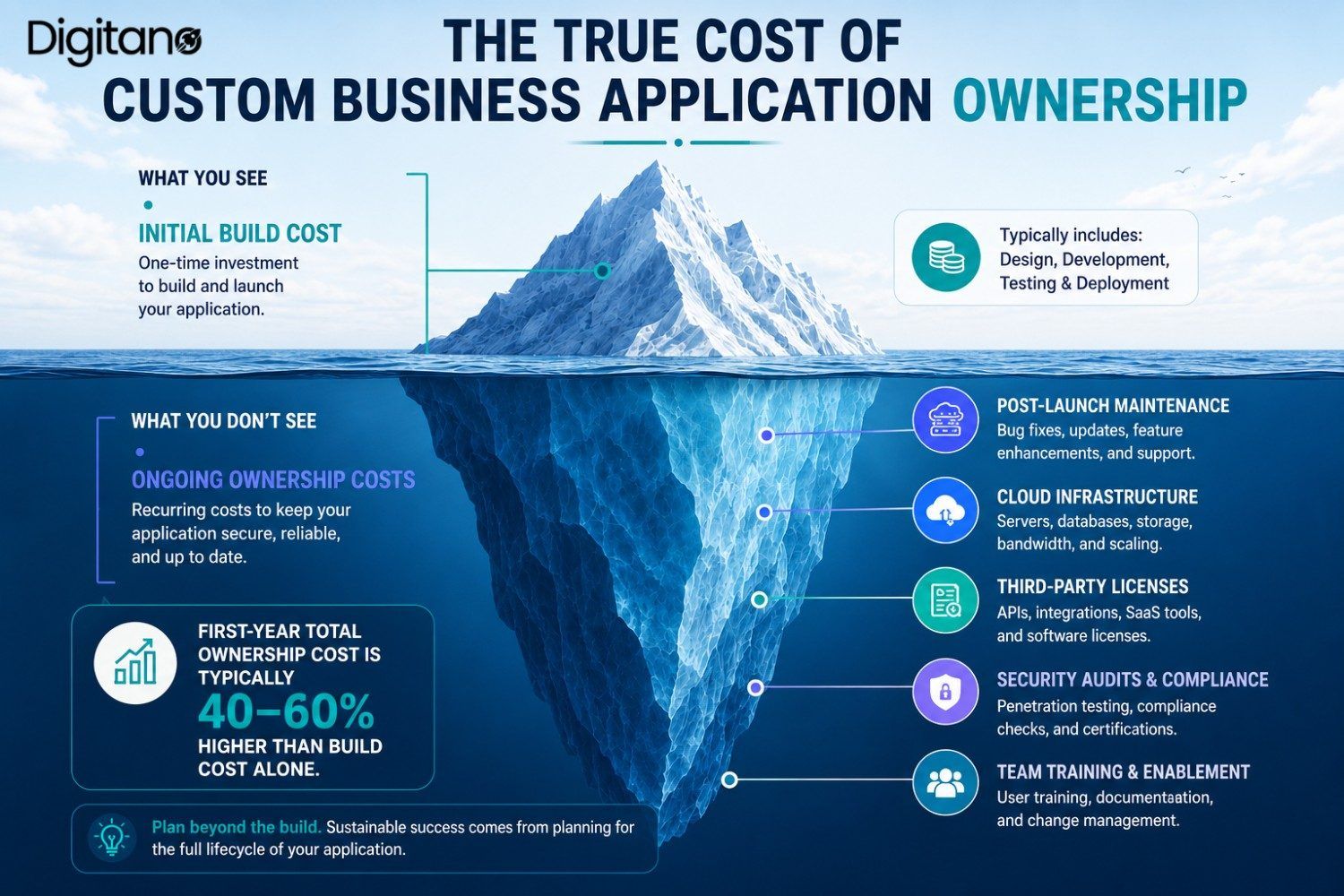
According to Keyhole Software's 2026 analysis, hidden costs typically add 20 to 40 percent to any initial estimate. Here is what they cover:
Post-Launch Maintenance (15-20% of Build Cost Annually)
Custom applications need ongoing bug fixes, security patches, dependency updates, and feature refinements. A $200,000 application typically requires $30,000 to $40,000 per year in maintenance. Budget for this from day one.
Cloud Infrastructure and Hosting ($200-$5,000/month)
AWS, Azure, and Google Cloud costs scale with usage. A small internal tool might cost $200/month. A mid-market business application with heavy database usage can easily reach $2,000 to $5,000/month.
Third-Party Software Licenses ($500-$10,000/month)
Payment processors (Stripe, 2.9% + $0.30 per transaction), email services (SendGrid $89-$449/month), analytics tools (Mixpanel $89-$779/month), and CRM APIs (Salesforce $150/user/month) add up quickly.
Security Audits and Compliance ($15,000-$75,000)
HIPAA, SOC 2 Type 2, and PCI-DSS audits typically cost $15,000 to $75,000 annually. Even non-regulated businesses should budget $5,000 to $15,000 for annual security penetration testing.
Team Training and Change Management ($5,000-$50,000)
Rolling out a new custom application means training your existing team, updating internal documentation, and managing the change process. This is almost always underbudgeted.
Custom Software Development Market Data (2026 US Context)
To ground these numbers in the bigger picture, here are the verified 2026 US market indicators:
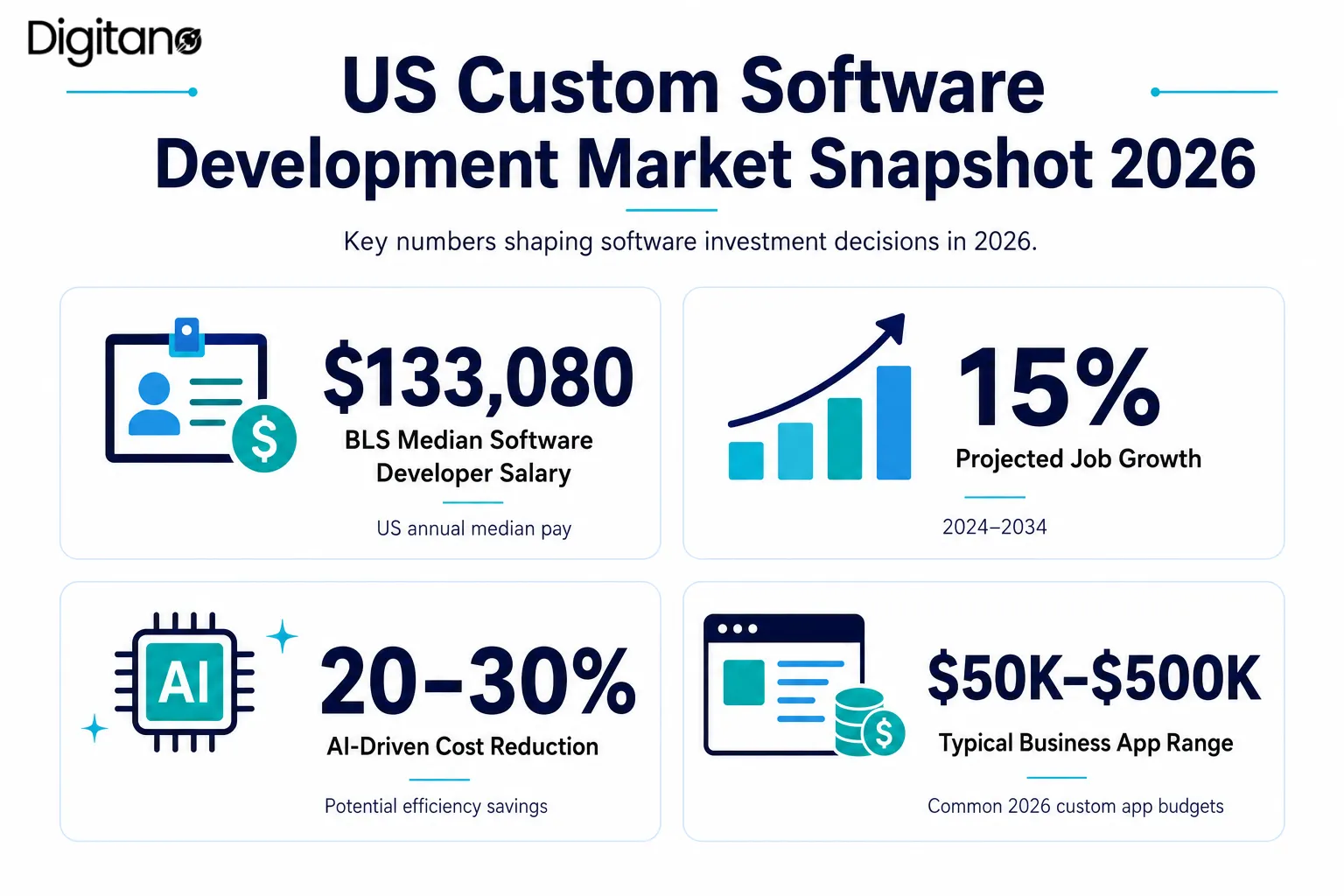
- BLS median software developer salary: $133,080/year (U.S. Bureau of Labor Statistics)
- Top 10 percent of US developers earn: $211,450+/year
- Software developer job growth 2024-2034: 15 percent projected (BLS Occupational Outlook)
- Total US openings per year: 130,000+ new positions
- Average enterprise custom software project: $400,000+ (Soltech 2026)
- AI-assisted development cost reduction: 20-30 percent per project (Soltech Research 2026)
The 4 Pricing Models US Agencies Use (And Which One Fits Your Project)
Not all pricing structures are equal. Here are the four models used by US custom software agencies in 2026:
1. Fixed-Price Contracts
Best for: Well-defined projects with clear requirements Range: $25,000 – $500,000+ (agreed upfront) Pros: Predictable budget, clear scope Cons: Any scope change requires renegotiation, often adds 20-40 percent
2. Time and Materials (T&M)
Best for: Evolving projects, ongoing product development Range: Billed by hour, typically $80-$275/hr Pros: Flexibility, pay only for actual work Cons: Less budget certainty, requires trust in agency
3. Dedicated Team Model
Best for: Long-term product development, MVP-to-scale journeys Range: $15,000-$50,000/month per full team Pros: Deep expertise, team learns your business Cons: Higher commitment, best for 6+ month engagements
4. Hybrid US Manager + Offshore Team
Best for: Budget-conscious US businesses wanting oversight Range: 30-50 percent cheaper than full US team Pros: Balances cost with communication Cons: Time zone coordination, requires strong PM
US vs Offshore: The Real Math on Development Costs
The biggest ongoing debate in custom software: hire US or go offshore? Here is the honest 2026 breakdown from Fullstack Labs and Adevs research.
Example project: 2,000-hour custom business application
| Model | Total Cost | Timeline | Communication | Risk Level |
|---|---|---|---|---|
| US-Based Agency | $260,000-$400,000 | 6-9 months | Same time zone, English-first | Low |
| US-Managed Nearshore (LATAM) | $130,000-$200,000 | 6-10 months | 1-3 hour time diff, English | Medium |
| Pure Offshore (India/Asia) | $60,000-$120,000 | 8-14 months | 10-12 hour time diff, English varies | High |
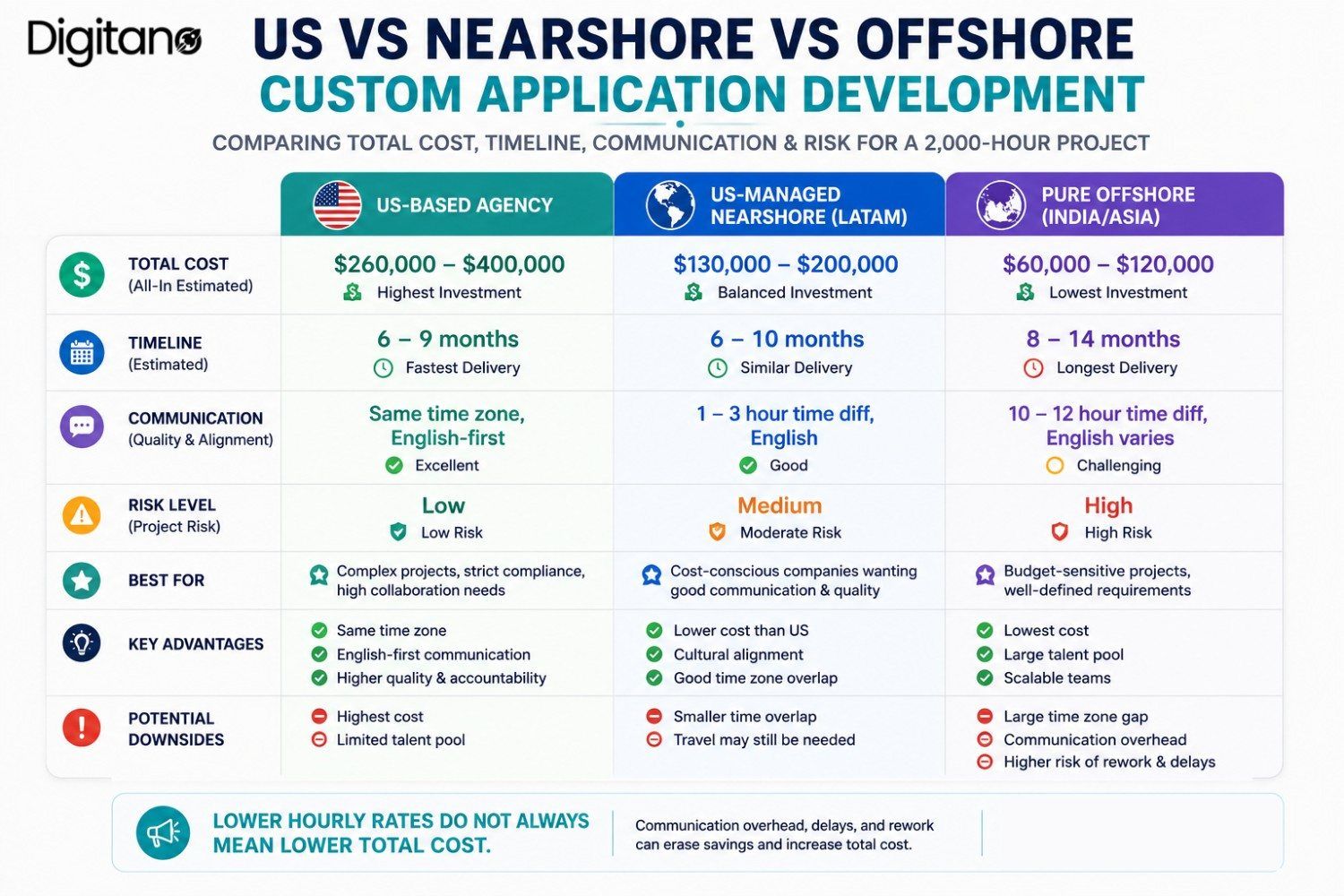
The honest truth: Pure offshore development frequently costs 40 to 60 percent less on paper but often ends up costing 20 to 40 percent more in total when you factor in rework, communication overhead, missed requirements, and post-launch quality issues. According to AVIBE 2026 research, lower hourly rates do not always mean a lower total cost.
At Digitano, we specialize in US-based custom application development with AI-assisted workflows that deliver enterprise quality at costs typically 15 to 25 percent below traditional US agencies. That model gives our clients the reliability and communication of US development with pricing closer to nearshore rates.
How to Actually Budget for a Custom Business Application in 2026
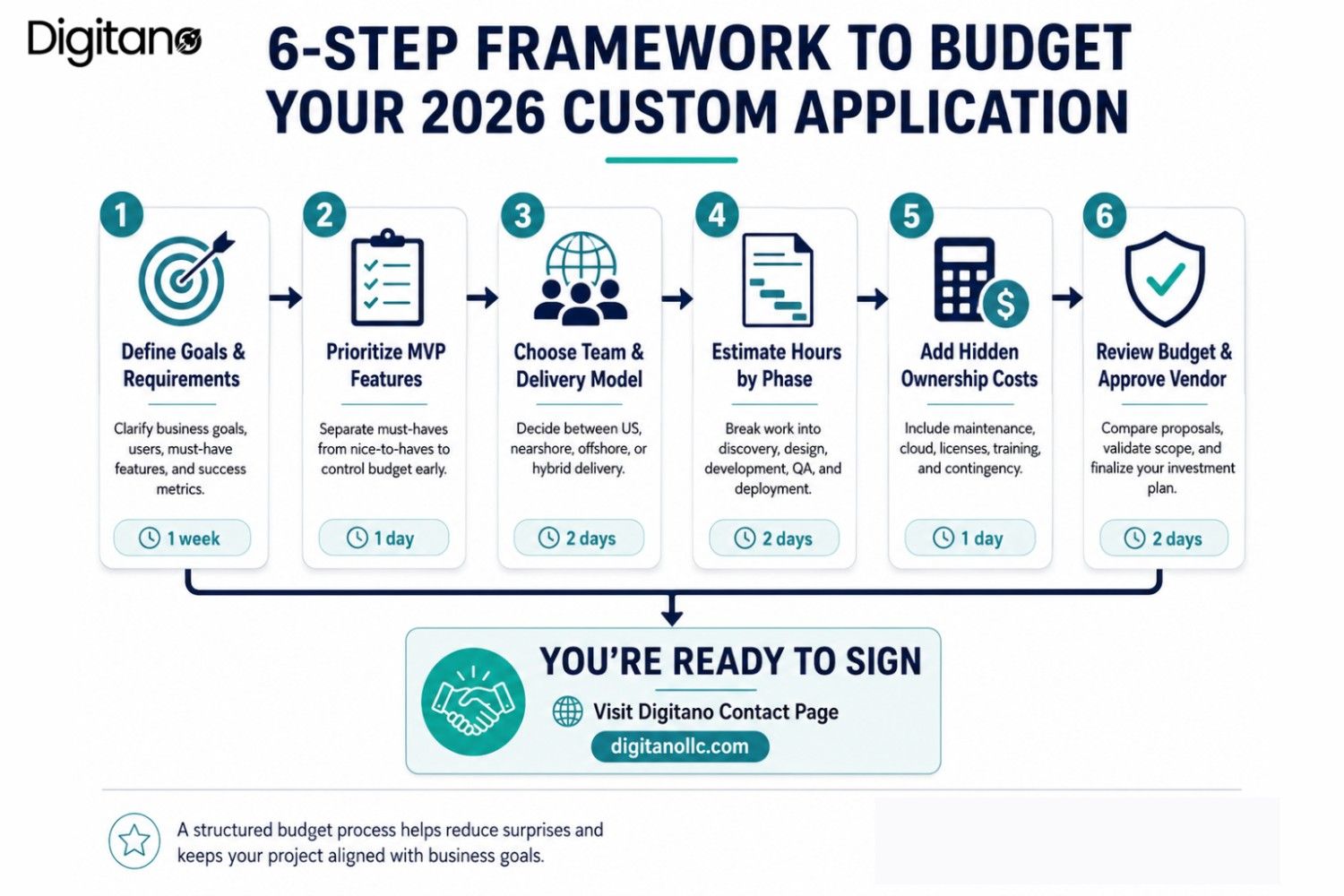
Based on the real 2026 market data, here is the practical budgeting framework we recommend at Digitano:
Step 1: Define Your Application Category Honestly
Using the cost ranges above, be honest about whether your project is Simple MVP, Small Business, Mid-Market, Complex Enterprise, or Large Enterprise. Most first-time buyers underestimate by one tier.
Step 2: Add 20 to 30 Percent Contingency
Every experienced project manager knows that unforeseen requirements emerge during development. A $200,000 budget should have $40,000 to $60,000 contingency built in from day one.
Step 3: Budget First-Year Total Ownership, Not Just Build
Add 40 to 60 percent to your build cost to cover Year 1 total ownership (maintenance, hosting, third-party licenses, training). A $200,000 build often becomes a $280,000-$320,000 Year 1 investment.
Step 4: Request Detailed Quotes From 3 US-Based Agencies
Get itemized breakdowns showing hours per phase, team composition, and post-launch support terms. Agencies unwilling to itemize are usually hiding markup or scope ambiguity.
Step 5: Validate the Team Before Signing
The single biggest predictor of project success is team quality. Ask for portfolio work in your industry, references from recent US clients, and direct access to the actual developers who will build your application (not just sales staff).
Step 6: Plan for AI-Assisted Development
In 2026, any agency not using AI-assisted development is 20 to 30 percent slower and more expensive than agencies that do. Ask specifically how AI is integrated into their workflow before signing.
Frequently Asked Questions
Q1: How much does it cost to build a custom business application in the US in 2026?
Custom business applications in the US typically cost $50,000 to $500,000 in 2026, depending on complexity. Simple MVPs start at $25,000, and enterprise-grade platforms often exceed $1,000,000.
Q2: How much do US software developers charge per hour in 2026?
US-based software developers charge $80 to $275 per hour in 2026, depending on seniority and specialization. Junior developers start at $80/hr, mid-level averages $120-$180/hr, and senior developers command $150-$275/hr for complex work.
Q3: How long does it take to build a custom business application?
Simple MVPs take 6 to 12 weeks, mid-size business applications take 3 to 8 months, and enterprise-grade systems can take 8 to 14+ months. AI-assisted development in 2026 has reduced timelines by 20 to 30 percent on comparable projects.
Q4: Should I hire a US company or outsource my custom app development?
For most US businesses, a US-based agency or US-managed hybrid team delivers the best ROI in 2026. Pure offshore development saves 40 to 60 percent on paper but often adds 20 to 40 percent in rework and communication costs.
Q5: What is the average cost of custom software in the USA?
The average cost of custom software in the USA in 2026 ranges from $50,000 to $300,000 for most business applications. Simple tools start at $10,000, while complex enterprise platforms exceed $500,000.
Q6: Is custom software more expensive than off-the-shelf solutions?
Custom software has a higher upfront cost but typically delivers 3-5x more value over 5 years for businesses with unique workflows. Off-the-shelf solutions cost less initially but lock you into their feature set and monthly licensing fees.
Q7: How does AI affect custom software development costs in 2026?
AI-assisted development workflows reduce project costs by 20 to 30 percent on average in 2026 by accelerating code generation, testing, and documentation. Agencies using AI-native workflows deliver faster and cheaper than traditional agencies.
Q8: What is the biggest hidden cost in custom software development?
Post-launch maintenance is the biggest hidden cost, typically 15 to 20 percent of the build cost annually. A $200,000 application requires $30,000 to $40,000 per year in ongoing maintenance and updates.
Q9: Do I need HIPAA or SOC 2 compliance for my business application?
HIPAA compliance is required for any application handling US health data. SOC 2 is needed if you handle customer data at scale. These add 20 to 40 percent to project costs but are non-negotiable in regulated industries.
Q10: Can I build a custom business application under $50,000?
Yes, simple MVPs and single-purpose internal tools can be built in the $25,000 to $50,000 range in 2026, especially with AI-assisted development. However, do not expect enterprise features, complex integrations, or heavy compliance requirements at this tier.
The Bottom Line
Building a custom business application in the US in 2026 costs between $25,000 for a simple MVP and $1,000,000+ for a large enterprise platform, with most typical business applications landing in the $75,000 to $300,000 range. The wide spread is not a mystery. It is the direct result of team seniority ($80-$275/hr), project complexity, integration requirements, compliance needs, and delivery model choices.
For US businesses budgeting a custom application in 2026, the smart approach is: define your project tier honestly, add 20 to 30 percent contingency, budget for first-year total ownership (build + 40 to 60 percent), request itemized quotes from three US-based agencies, and prioritize teams using AI-assisted development for genuine 20-30 percent cost efficiency.
At Digitano, our US-based development team specializes in AI-assisted custom application development that delivers enterprise-quality results at costs typically 15 to 25 percent below traditional US agencies. If you're planning a custom business application in 2026 and want a transparent, itemized quote based on your actual requirements, our team can help you scope, budget, and build with full visibility into every dollar.
For US businesses ready to move from planning to building, we typically start with a free 30-minute consultation to scope your project, validate your budget assumptions, and answer your specific technical questions. You can reach our team directly through the Digitano contact page.