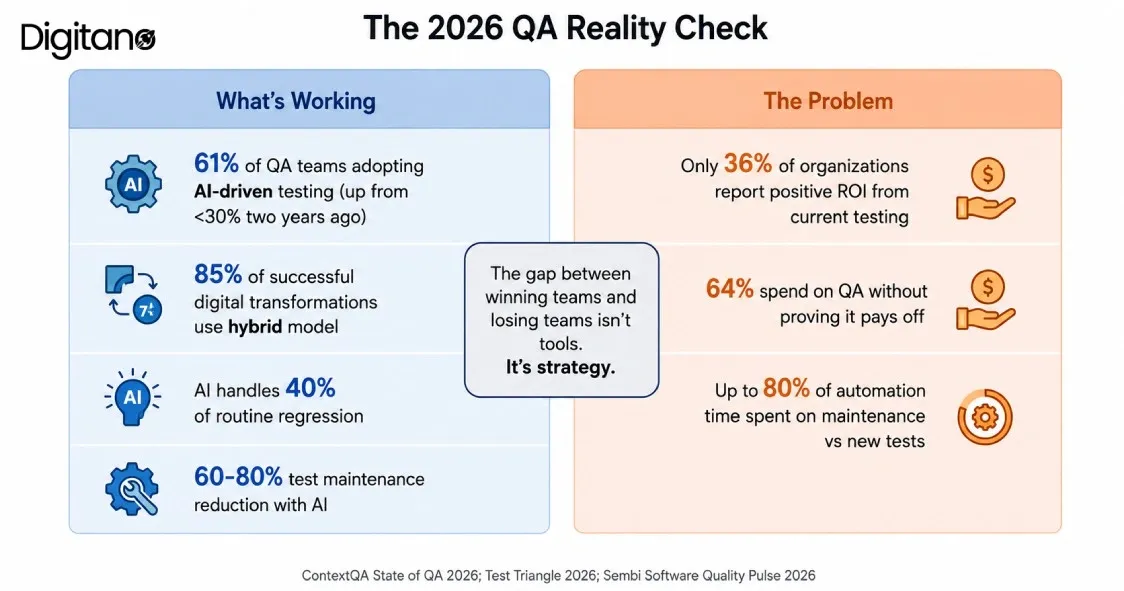
Here's a stat that should reframe how engineering leaders think about testing strategy in 2026: only 36% of organizations report positive ROI from their current testing approach, according to ContextQA's State of QA 2026 report. Nearly two-thirds of companies are spending real money on QA without being able to prove it's paying off. Meanwhile, 61% of QA teams have now adopted AI-driven testing, up from under 30% just two years ago. So the manual testing vs AI testing debate isn't really a debate anymore. It's a question of how to combine both effectively so you land in the profitable 36% rather than the loss-making 64%.
This guide walks through exactly when manual testing outperforms AI, when AI outperforms manual, and how the strongest US engineering teams in 2026 build hybrid strategies that capture the ROI both approaches offer. If you'd rather have an experienced team help you design a hybrid testing workflow for your organization, our digital marketing services and consulting work at Digitano LLC include this kind of technical strategy for teams serious about disciplined quality engineering.
The 2026 State of QA: Real Numbers on Where the Industry Actually Sits
Before jumping into strategy, let's ground the conversation in verifiable 2026 data from named sources:
- 53% of all software code is now AI-assisted or AI-generated (2026 Sembi Software Quality Pulse Report via Test Triangle)
- 61% of QA teams have adopted AI-driven testing in 2026, up from under 30% two years ago (ContextQA State of QA 2026)
- Only 36% of organizations report positive ROI from their current testing approach (ContextQA 2026)
- 85% of successful digital transformations by 2026 will rely on a hybrid model where manual oversight validates AI-generated outputs (Test Triangle 2026)
- AI-driven tools now handle 40% of routine regression testing (Test Triangle 2026)
- Teams can spend up to 80% of automation time on maintenance rather than creating new tests, per Selenium user research cited by Crosscheck
- 60-80% of production QA teams now use at least one AI-powered testing tool (up from around 21% in 2024)
The takeaway is unambiguous: the winning teams in 2026 aren't the ones going all-in on AI testing or all-in on manual testing. They're the ones building disciplined hybrid strategies that use each approach where it actually creates value.
When Manual Testing Genuinely Wins
Manual testing isn't going away. It's evolving into a higher-value strategic function. Here are the specific scenarios where manual testing outperforms AI in 2026, based on verified 2026 industry analysis:
1. Exploratory Testing (Where AI Fundamentally Can't Replicate)
Manual testers draw on experience, intuition, and creative thinking to probe the edges of applications. They notice friction that no automated test suite would catch: confusing microcopy, unclear affordances, unexpected behaviors that are technically "correct" but genuinely bad for users. As independent 2026 industry analysis confirms, AI tools consistently fail at understanding context, user intent, and business-critical nuances that determine true software quality.
2. Usability and User Experience Validation
AI can measure metrics. It can't measure how a workflow feels to real users. Whether an error message reads as helpful or condescending, whether a checkout process feels smooth or clunky, whether a new feature actually solves the user problem it was designed for. All of this requires human judgment grounded in real empathy and user context. This is genuinely one of manual testing's biggest advantages in 2026 and it isn't going away.
3. Small-Scale Projects and Rapidly Changing UIs
For small projects and interfaces still evolving quickly, manual testing offers a 50% faster turnaround compared to scripting automated suites, per Test Triangle's 2026 research. This is because there's no upfront script investment, and the tests adapt instantly to changes. Automating a UI that's going to be redesigned in three sprints is genuinely wasted effort.
4. Business Logic Validation
AI doesn't understand your business rules. When your product has a discount calculation that depends on loyalty tier, item count, holiday windows, and regional pricing rules, AI can generate a test that runs without errors. It can't verify that the answer is correct for a specific business context. Only human testers with domain expertise can validate business logic against real business requirements.
5. Ambiguous Requirements
Most real-world projects operate with ambiguous specifications, contradictory requirements from different stakeholders, and gaps that only become obvious during testing. Human testers ask clarifying questions, escalate ambiguities, and make judgment calls about how to interpret unclear specifications. AI can't do this reliably.
6. Validating AI-Generated Test Cases
This is the meta-category worth noting. AI can produce test cases that look valid but actually verify nothing meaningful. Every AI-generated test case needs human review to ensure it's testing what it appears to test. This is the primary safeguard against AI-generated test suites silently drifting into unreliability.
7. Security Testing and Adversarial Thinking
Penetration testing and threat modeling require creative, adversarial thinking that AI genuinely can't replicate. A skilled security tester actively tries to break your system in ways developers didn't anticipate. AI can run known-attack patterns, but the creative element behind identifying novel attack vectors remains meaningfully out of AI's reach.
When AI Testing Genuinely Wins
AI-powered testing has become one of the fastest-adopting product development categories, and the data on its wins is equally clear. Here are the scenarios where AI outperforms manual testing:
1. High-Volume Regression Testing
This is AI's home run. AI-powered testing tools reduce regression execution meaningfully. Real production data shows AI cutting regression execution from 6 hours to 2.5 hours in mature CI/CD environments. For large-scale regression suites that run on every commit, AI wins by orders of magnitude.
2. Self-Healing Test Maintenance
The biggest single ROI category. Traditional test automation traditionally required massive maintenance investment when UI elements change. Independent research shows teams can spend up to 80% of their automation time on maintenance rather than creating new tests. AI-powered self-healing tests automatically update selectors and test steps when UIs change, cutting test maintenance by 60-80% for many teams.
3. Visual and Cross-Browser Testing
AI-powered visual testing tools (like Applitools) detect meaningful visual differences across browsers, devices, and viewports that traditional pixel-comparison tools miss or flag as false positives. Testing across dozens of device and browser combinations is nearly impossible to do manually at scale. AI does it in minutes.
4. Test Data Generation
Creating realistic, diverse test data sets across many scenarios manually can take weeks. AI generates comprehensive test data in minutes, covering happy paths, edge cases, and boundary conditions that human testers often miss.
5. Test Case Generation from Requirements
AI reads requirements, user stories, or acceptance criteria and generates structured test cases automatically, including edge cases humans often miss. This can compress test case generation from days to hours for well-scoped features.
6. Predictive Defect Detection
AI analyzes production logs, code changes, and historical patterns to predict where failures are likely to occur before they happen. This proactive capability is genuinely something manual testing cannot do at scale.
7. Test Suite Optimization
AI identifies redundant tests, flaky tests, and outdated tests, helping teams maintain leaner, more reliable test suites. Over time this compounds into meaningful maintenance savings.
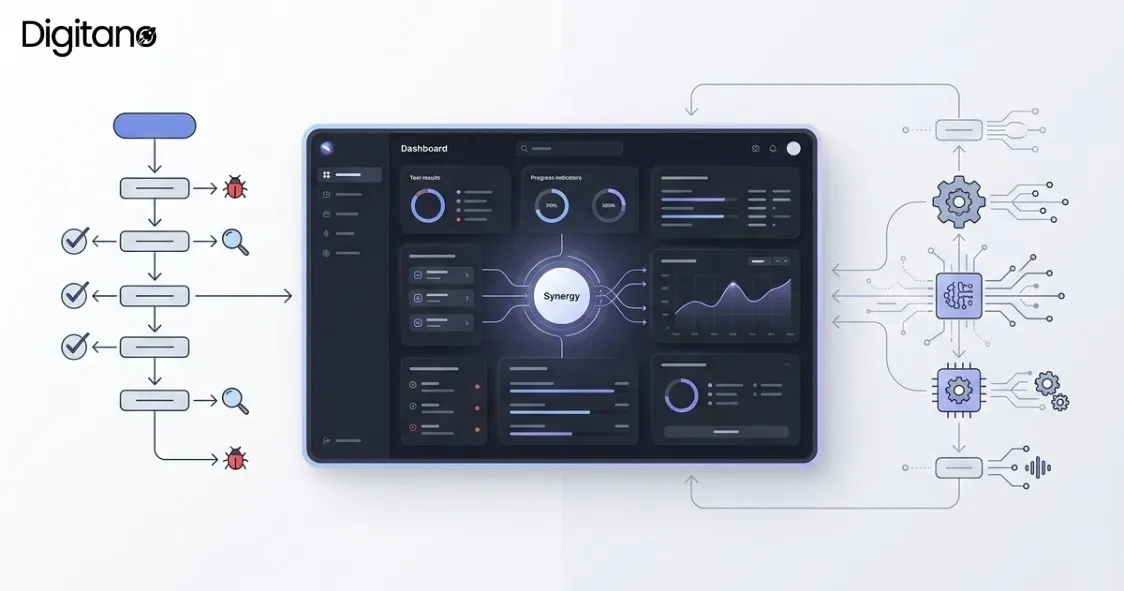
The Real Winner: The 60/40 Hybrid Strategy
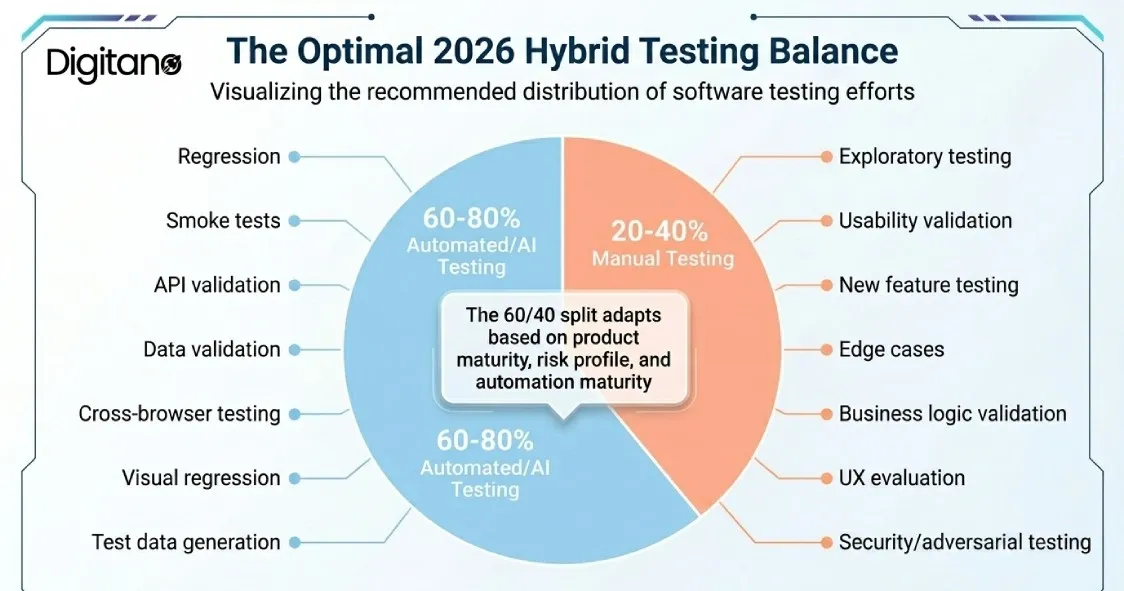
Based on 2026 industry consensus from multiple credible sources, the optimal balance for most engineering teams in 2026 is:
- 60-80% automated testing for regression, smoke tests, API validation, and data validation
- 20-40% manual testing for exploratory work, usability, new features, and edge cases
This split isn't arbitrary. It reflects what QASource's 2026 research identifies as the optimal balance for most enterprise engineering teams. The exact split depends on your product maturity, release frequency, risk profile, and automation maturity.
When to Adjust the Balance
The 60/40 baseline isn't one-size-fits-all. Here's when to shift the balance:
Shift Toward More Automation (70-90%) When:
- Your product is mature with stable requirements
- Release frequency is high (multiple deployments per week or day)
- Regression suite is large and running frequently
- Test coverage is a compliance requirement
- Your team has strong automation engineering skills
- CI/CD pipelines are mature and reliable
Shift Toward More Manual Testing (40-60%) When:
- Product is in early development or pre-product-market-fit
- UIs are changing rapidly (multiple redesigns per quarter)
- Business logic complexity is high
- User experience is a primary competitive differentiator
- New features are being explored and validated regularly
- Domain expertise is critical for validating correctness
The Break-Even Point Formula
The Test Triangle 2026 framework provides a useful decision framework: evaluate five factors before automating any specific workflow:
- Stability: Are requirements stable enough to justify automation investment?
- Frequency: Will this test run often enough to amortize automation cost?
- Risk: What's the business impact of a defect in this area?
- Maintenance cost: Can we sustain the automation over time?
- ROI: Does the automation math actually work over the expected lifetime?
If stability + frequency + risk all score high, automate. If uncertainty dominates, stay manual or hybrid.
Real-World Impact: What the Data Shows for Hybrid Teams
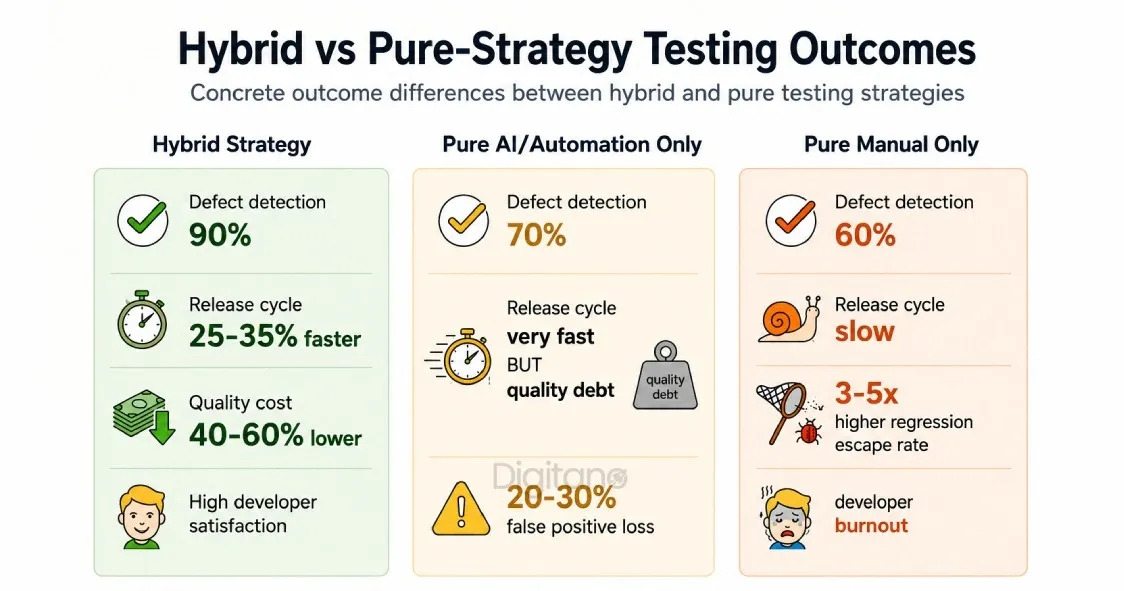
Here's what the numbers actually show for teams that adopt hybrid strategies vs teams that go all-in on one approach:
Teams using hybrid strategies:
- Meaningfully higher defect detection rates
- Faster release cycles (25-35% faster than manual-only teams)
- Lower total cost of quality (40-60% reduction reported by mature teams)
- Better developer satisfaction ratings
- Lower production incident rates
Teams going pure AI/automation-only:
- Higher initial productivity gains, but often lose 20-30% of that value to false positives
- Miss usability and edge case bugs
- Accumulate quality debt in non-automatable areas
- Struggle with novel features where AI has no training data
Teams going manual-only:
- Cannot keep pace with modern release cadences
- Experience burnout as engineering velocity increases
- Face regression escape rates 3-5x higher than hybrid teams
- Difficulty scaling with product growth
The Practical Framework: How to Build Your Hybrid Testing Strategy
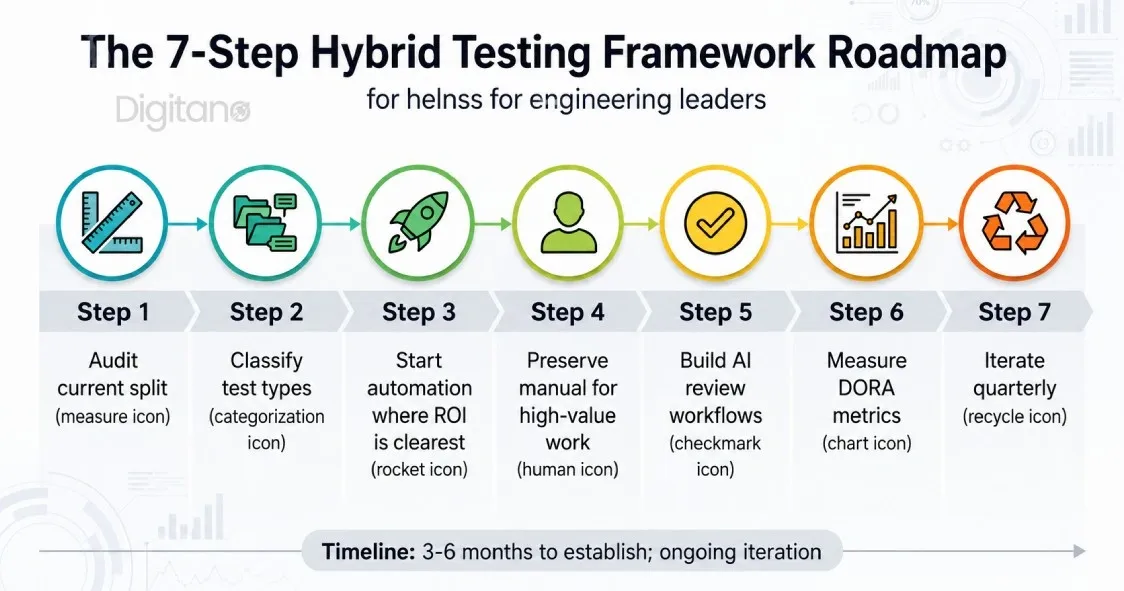
Based on what actually works for teams achieving the top 36% of positive-ROI testing programs, here's a practical 7-step framework:
Step 1: Audit Your Current Testing Split
Measure where you actually are today: what percentage of testing is manual vs automated? What percentage of automated tests are AI-augmented vs traditional scripted? Most teams significantly overestimate their automation coverage and underestimate their maintenance burden. Get the honest numbers first.
Step 2: Classify Your Test Types
Map every test in your suite into one of four categories:
- Automation-ready: stable requirements, high frequency, high risk (automate)
- Manual-required: exploratory, usability, novel features (manual)
- AI-ready: high-volume regression, self-healing candidates (AI)
- Hybrid: requires both manual validation and automation execution (hybrid workflow)
Step 3: Start Automation Where ROI Is Clearest
Regression testing is universally the highest-ROI automation target. Start there. Adding AI-powered self-healing capability to regression tests captures 60-80% maintenance reduction that compounds over time.
Step 4: Preserve Manual Testing for High-Value Work
Redirect your manual testers to the work only humans can do: exploratory testing, usability evaluation, business logic validation, edge case discovery, and validating AI-generated test outputs. This elevates the manual testing role rather than eliminating it.
Step 5: Build Review Workflows for AI-Generated Tests
Every AI-generated test case needs human review. This is genuinely one of the highest-leverage practices distinguishing high-performing hybrid teams from low-performing ones. Establish clear pull request workflows where AI-generated tests get reviewed before entering production test suites.
Step 6: Measure DORA Metrics Alongside Testing Metrics
The four DORA metrics (deployment frequency, lead time for changes, change failure rate, mean time to recovery) are the outcome metrics that matter. Testing metrics that don't correlate with DORA improvements aren't actually improving your business.
Step 7: Iterate the Balance Quarterly
The 60/40 balance shifts as products mature, teams change, and AI capabilities evolve. Review the split every quarter. If your test escape rate is climbing, add manual exploratory testing. If maintenance overhead is climbing, evaluate more AI-powered self-healing options.
Common Mistakes Teams Make with Hybrid Testing
Based on patterns from 2026 industry analysis:
- Automating everything that can be automated. Just because a test can be automated doesn't mean it should be. Automation has real maintenance costs. Test Triangle's 2026 research is clear: "Automating everything is naive. Automating strategically is leadership."
- Skipping human review of AI-generated tests. This is genuinely the most common 2026 mistake. AI-generated tests can silently drift into unreliability if not reviewed. Every one needs human validation before production.
- Treating manual testers as second-class citizens. Manual testers who focus on exploratory testing, usability, and validation of AI outputs deliver higher-value work than automation engineers doing rote scripting. Compensate and retain them accordingly.
- Ignoring the Selenium 80% maintenance trap. Teams still using traditional Selenium automation without AI-powered self-healing spend up to 80% of their automation time on maintenance. That's a crushing ROI problem.
- Chasing "coverage" without measuring outcomes. Test coverage percentages don't equal quality. Defect escape rates, MTTR, and production incident frequency do. Focus on outcome metrics.
- Not investing in tester upskilling. Modern testers need to understand AI capabilities, prompt engineering fundamentals, and automation frameworks. Teams that don't invest in this training create capability gaps.
- Underestimating validation of AI-embedded product features. If your product includes AI features (recommendation engines, LLM integrations), you need specific testing tools that validate non-deterministic outputs, bias, and adversarial input resistance.
The Evolving Role of the QA Engineer
Here's the honest reality about 2026 QA careers: manual-only roles are shrinking, but hybrid QA roles combining manual expertise with automation skills remain strong. The key is evolving from execution to strategy.
For manual testers, this means:
- Learn one automation framework (Playwright or Cypress recommended)
- Learn basic programming (Python or JavaScript sufficient)
- Develop expertise in AI test validation and prompt engineering
- Focus on strategic testing planning, not just execution
- Position yourself as the human validation layer for AI-augmented workflows
The teams that recognize manual testers as strategic partners rather than commodity execution resources are the ones capturing the best hybrid ROI in 2026.
Frequently Asked Questions
Q1: When should I use manual testing vs AI testing?
Use manual testing for exploratory work, usability evaluation, small projects with rapidly changing UIs, business logic validation, ambiguous requirements, security testing, and validating AI-generated test cases. Use AI testing for high-volume regression, self-healing automation, cross-browser testing, test data generation, and predictive defect detection. Most teams should aim for a 60-80% AI-automated and 20-40% manual split.
Q2: What percentage of testing should be automated in 2026?
Based on 2026 industry consensus, most modern product teams should aim for 60-80% automated testing (regression, smoke, API, data validation) with 20-40% manual testing (exploratory, usability, new features, edge cases). The exact split depends on product maturity, release frequency, risk profile, and team capability. Startups and early-stage products lean toward more manual testing; mature enterprises lean toward more automation.
Q3: Is manual testing dead in 2026?
No. Manual testing is evolving into a higher-value strategic function. According to Test Triangle's 2026 research, 85% of successful digital transformations will rely on hybrid models where manual oversight validates AI-generated outputs. Manual-only roles are shrinking, but hybrid manual + automation expertise is one of the most valuable QA skill combinations available today.
Q4: How do I calculate the ROI of hybrid testing?
Compare total cost of quality (prevention + appraisal + internal failure + external failure) between your current approach and a hybrid strategy. Mature hybrid teams typically report 40-60% reduction in total cost of quality, 25-35% faster release cycles, and 60-90% reduction in production defects. However, only 36% of organizations report positive ROI from current testing, suggesting most teams have significant room for hybrid strategy improvement.
Q5: What tools should I use for hybrid testing?
For automated/AI testing, popular 2026 tools include Katalon, Mabl, Applitools, testRigor, and Playwright. For manual testing management, TestQuality, TestRail, and Xray are widely used. The most important criterion isn't the tool itself but whether it supports both AI-generated and human-crafted tests within unified workflows.
Q6: Will AI replace QA engineers?
No, but roles are evolving. AI amplifies human expertise rather than replacing it. Manual-only execution roles are shrinking, but strategic QA roles combining manual expertise with automation and AI skills are growing. Workers with AI skills command significant salary premiums. The profession is being elevated, not eliminated.
Q7: What's the biggest mistake teams make with hybrid testing?
Skipping human review of AI-generated test cases. This is genuinely the most common 2026 mistake, and it looks like productivity in the short term while silently accumulating quality debt that becomes visible only after production incidents. Every AI-generated test needs human validation before entering production test suites.
The Bottom Line
The manual testing vs AI testing debate is largely resolved in 2026: the strongest engineering teams don't choose one. They combine both strategically, with roughly 60-80% AI-automated testing for high-volume regression work and 20-40% manual testing for exploratory, usability, and validation work only humans can do effectively.
The teams achieving positive ROI from testing (currently only 36% of organizations) share three common traits: they automate strategically where it clearly pays off, they preserve manual testing for high-value work only humans can do, and they build disciplined review workflows to catch AI-generated test drift before it reaches production. The 2026 winning strategy isn't more AI or more manual testing. It's smarter combinations of both, measured against outcome metrics that actually correlate with business results.
For organizations that need help designing hybrid testing strategies, building the AI-augmented workflows that capture real ROI, or transitioning existing manual QA teams into strategic hybrid roles, contact Digitano LLC. We help engineering teams move beyond debates about which approach is better into disciplined, measurable quality engineering practices that ship better software and reduce operational costs at scale.