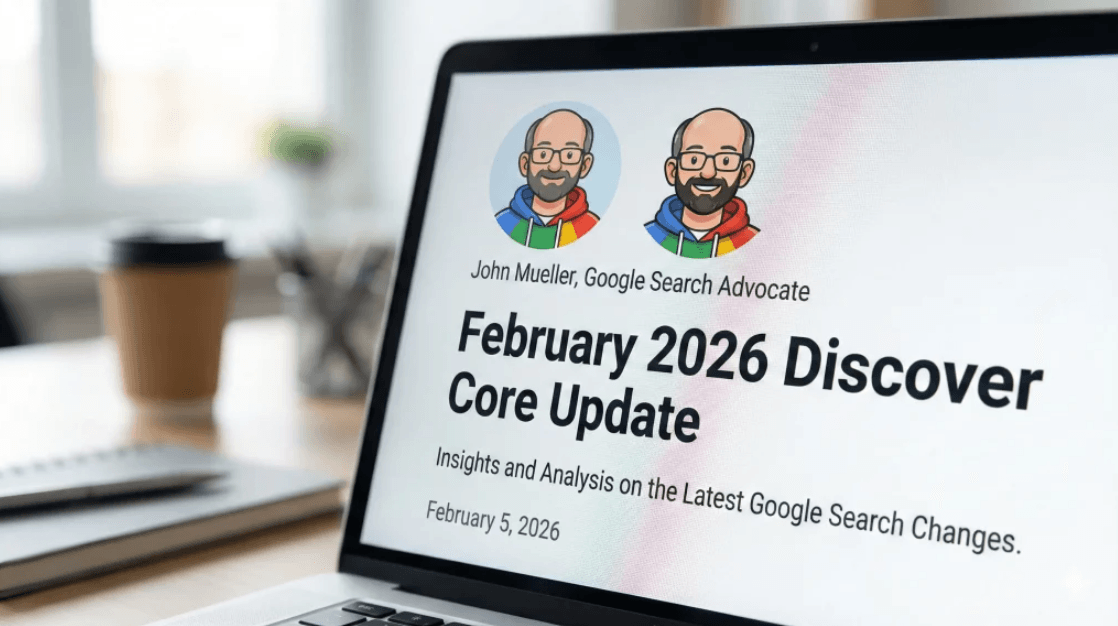
"The February 2026 Google Core Update focused on Discover traffic, emphasizing local relevance, credible content, and engaging visuals. Sites may see traffic fluctuations, but consistent monitoring and small optimizations help maintain visibility. Aligning Discover optimization with long-term SEO strategies ensures sustained growth and improved user engagement."
Key Takeaways
- On February 5, 2026, Google started releasing a core update that was centered on Discover.
- Rather than traditional search rankings, this update focuses on how content shows up in Google Discover.
- According to Google, its goals are to increase local relevance, lessen sensational headlines, and present more in-depth, unique content.
- During rollout, traffic volatility in Discover is normal and does not always indicate a penalty.
- Measured monitoring and content improvement, not last-minute changes, are the best course of action.
Introduction
Google announced the February 2026 Discover core update on February 5, 2026. This change to the search algorithm is not common. It focuses on the way articles appear in Google Discover, the customized feed that appears on mobile devices and in the Google app.
This differentiation is important for site owners and marketers. You are probably experiencing the effects of this update rather than a more general problem with search visibility if your Discover traffic is changing but your search rankings stay the same.
Google has presented the update as an improvement to the Discover experience. Its main goals are to display more locally relevant content, lessen sensational and deceptive headlines, and highlight in-depth, unique coverage from websites with topic-level expertise.
What Is Google Discover?
Google Discover is a feed of customized content. Users do not type a query, in contrast to traditional search. Rather, Discover presents articles, videos, and other content according to location, engagement behavior, browsing habits, and interests.
For instance, Discover might display destination guides or airline updates without the user having to actively search if they regularly read travel-related content. Like new planting guides might show up in a user's feed automatically if they follow gardening creators.
This is why Discover traffic behaves differently from search traffic:
- Personalization: Each user’s feed is unique.
- Freshness: Timely and trending topics often perform well.
- Engagement signals: Click-through rate, dwell time and interaction patterns appear to influence visibility.
Discover is less about keyword targeting and more about relevance to user interests.
What Google Confirmed About the Update
Google's official announcement states that the February 2026 update has a number of improvements:
- Displaying more regionally relevant content to users from domestic websites
- Cutting down on clickbait and sensational content in Discover
- Displaying more timely, unique, and in-depth content from websites with subject-matter expertise
- Maintaining customization according to user preferences
Google also mentioned that during rollout, Discover traffic may fluctuate. There may be increases at some sites, decreases at others, and no change at all at many.
Over time, the rollout will spread to other regions after starting with English-speaking users in the US.
Discover Traffic Impact
Discover volatility is evident in early industry observations. It's critical to responsibly interpret these changes.
The following are typical, quantifiable symptoms:
1. Unexpected Increases or Declines
While search traffic stays constant, publishers may observe significant spikes or dips in Discover traffic.
2. Shifts in CTR
While click-through rates may fluctuate, impressions may remain consistent. This frequently has to do with the clarity of the headline or the way the image is presented.
3. Topic-Level Modifications
While some categories may become more visible, others may become less so. For instance, regional or local news coverage might get better.
4. Local or Country Effects
Depending on the users' geographic alignment, websites catering to global audiences may undergo modifications.
During rollout fluctuations are common. Until the update stabilizes completely it is too soon to declare any movements permanent.
Which Sites May See More Volatility?
Stronger movement may be observed by specific publisher types:
- News and trending-topic publishers
- Lifestyle and entertainment sites
- Publishers relying heavily on curiosity-driven headlines
- International sites targeting audiences outside their primary country
However, volatility does not automatically signal a quality issue. Before settling core updates, often recalibrate systems.
Monitoring Checklist
The objective for the next two to four weeks is to observe trends without drawing hasty judgments. Launch the Discover report in Google Search Console. Zoom in after taking a look at the general trend. Which pages saw a decrease in impressions and which saw an increase? It is already a clue if the movement is focused on a single subject or content format.
Next, rather than responding to a single day, compare week after week. Even when everything is fine, Discover can swing hard. Take note of the timing and see if performance changed immediately following any recent changes you made to your templates, headlines, or featured images. Your best-performing Discover pages should receive the same treatment. Do they have a more focused topic, better imagery, or a clearer headline style?
Lastly, avoid major overhauls and instead conduct small tests. Try making a few headlines clearer, updating a few featured images, and verifying that the pages that are most important load quickly on mobile devices. Keep a record of your changes so you can later relate results to actions.
What to Do Now
Constant refinement is the most secure method.
Enhance Your Headlines
Make sure your titles are accurate and descriptive. Steer clear of overstated assertions and ambiguous language.
Strengthen Imagery
Make sure the photos are large enough to accommodate Discover previews, of good quality, and suitable.
Improve the Clarity of the Topic
Keep your attention on each article. Coherence and depth are important.
Encourage local relevance
Link content to regional context when appropriate.
Enhance the On-Page Experience
Engagement is supported by readable formatting, quick load times, and few intrusive elements.
Show Off Your Expertise
Credibility is strengthened by the openness of the author and regular topical coverage.
These actions are in line with both Discover optimization and more general SEO principles.
What NOT To Do
Avoid common mistakes during updates:
- Do not panic rewrite entire sections of content.
- Do not delete pages without clear evidence.
- Do not shift toward clickbait to recover traffic.
- Do not over-optimize for assumed algorithm signals.
- Do not implement sweeping sitewide changes without diagnosing patterns first.
Stability and analysis are more effective than reactive action.
Adapting SEO Strategy for Discover
Discover optimization complements traditional SEO, but it requires additional attention to engagement and presentation.
Key adjustments include:
- Publishing fresh content when it adds value
- Building strong topical clusters
- Maintaining consistent publishing cadence
- Using high-quality visuals
- Designing clean, mobile-first layouts
- Avoiding aggressive ad placements
Discover rewards content that feels editorially trustworthy and aligned with user interests.
Confirmed vs Observed
To keep expectations balanced:
Confirmed by Google:
- Rollout began February 5, 2026
- Focus on local relevance
- Reduction of sensational content
- Greater emphasis on topic-level expertise
- Potential Discover traffic fluctuations
Observed Across Industry:
- Increased volatility in trend-heavy niches
- Greater sensitivity to headline style
- More pronounced geographic segmentation
Observations may continue to evolve as the rollout completes.
Final Strategy
A recurring theme is reinforced in the February 2026 Discover core update: content that is helpful, reliable, and well-presented works best.
Discover is evolving into a more organized and curated recommendation surface rather than taking the place of search. Long-term gains are probably in store for marketers who make investments in originality, clarity, mobile experience, and real expertise.
Align Discover optimization with long-term SEO principles rather than focusing on temporary solutions. Create content that is consistent in value, dependable, and applicable. This method lessens reliance on volatility-driven reactions and is consistent across updates.
Discover is going to reward content that is worth exploring.