What Is ERP and MES Integration?
Before diving into the benefits and challenges, it's important to establish exactly what these two systems do — and why connecting them is such a significant decision.
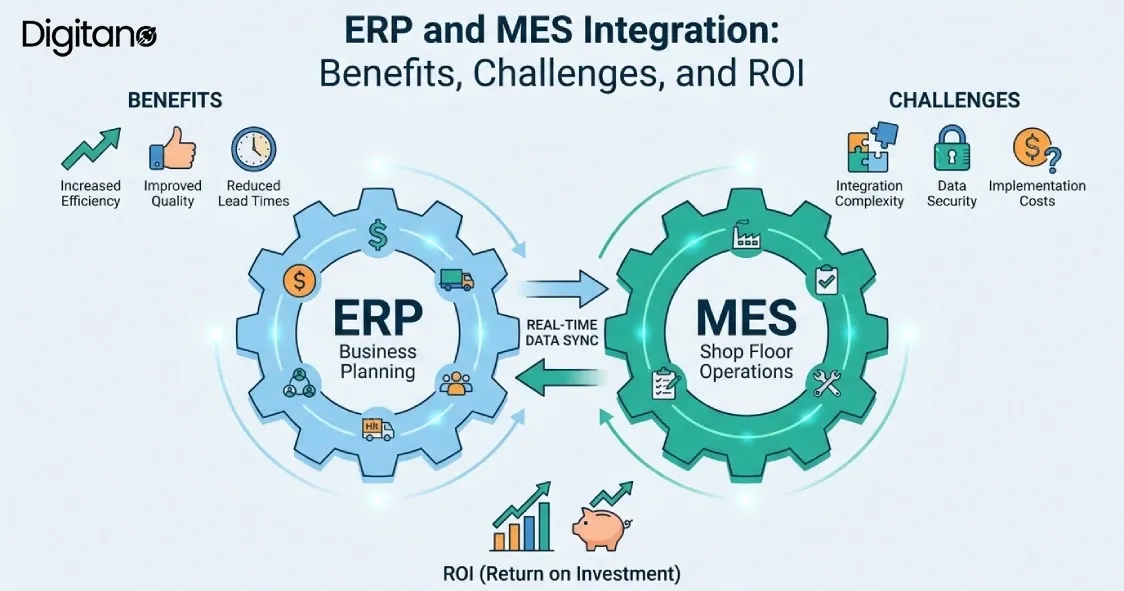
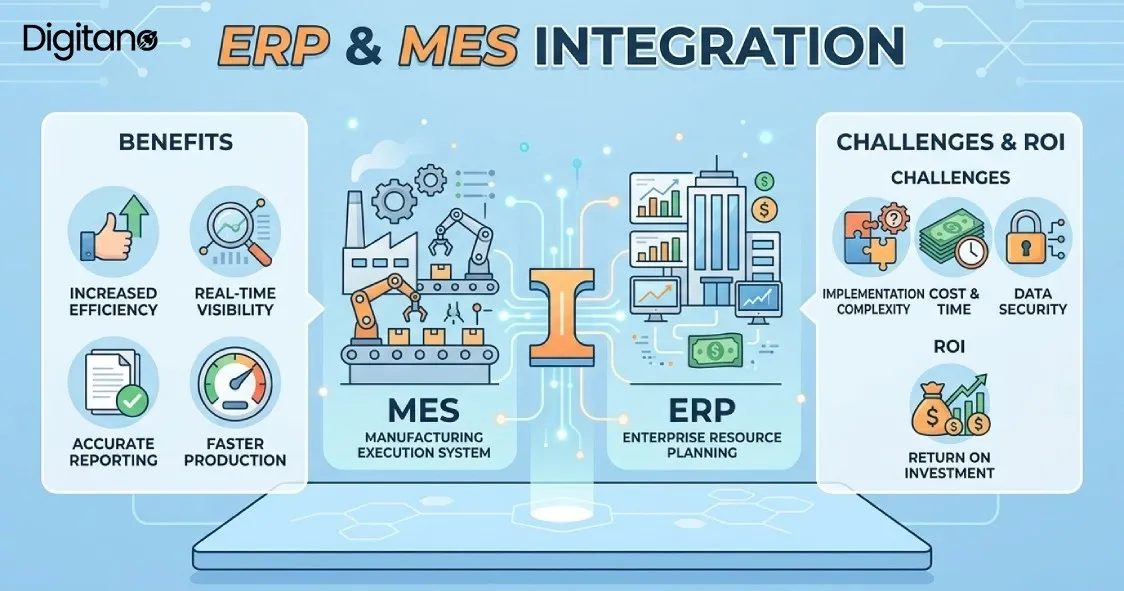
Enterprise Resource Planning (ERP) is the backbone of your entire business. It unifies core functions — finance, procurement, human resources, inventory management, supply chain, and customer orders — into one centralized system. Think of ERP as the business brain: it plans, forecasts, and allocates resources across the entire organization.
Manufacturing Execution Systems (MES), on the other hand, live on the shop floor. MES tracks and controls manufacturing processes in real time — from raw material intake to finished goods. It monitors machine performance, worker assignments, quality checks, work-in-progress, and production yields, minute by minute.
The gap between these two systems is where inefficiency hides.
Without integration, ERP plans production based on assumptions and scheduled reports. MES executes production based on what's actually happening on the floor. When those two realities don't communicate, manufacturers end up with mismatched inventory counts, reactive quality control, missed delivery windows, and decisions made on stale data.
ERP-MES integration closes this gap by creating a continuous, bidirectional data flow between shop floor execution and enterprise planning. ERP issues production orders; MES executes and reports back actual output, consumption, and quality in real time. The result is a closed loop that makes the entire manufacturing operation smarter, faster, and more accurate.
Why Integration Matters in 2025
The manufacturing technology landscape has shifted dramatically in the past five years. Industry 4.0 — characterized by IoT sensors, digital twins, AI-driven analytics, and cloud connectivity — has raised the bar for what manufacturers can and should know about their operations at any given moment.
The numbers tell the story clearly:
- The global MES market was valued at $15 billion in 2024 and is projected to reach $39 billion by 2034, growing at a CAGR of 10.2%, driven by Industry 4.0 adoption and the demand for real-time production visibility.
- 54% of U.S. manufacturers have already integrated MES with ERP systems, with approximately 46% now deploying AI-enhanced MES modules.
- According to a Forrester study, an investment in an industry cloud implementation solution (combining MES and ERP capabilities) can project a net present value of $2.6 million with an ROI of nearly 283% over three years.
- PwC research identifies modernizing data and eliminating data silos as a top priority for manufacturing CIOs in 2024, placing ERP-MES integration squarely at the center of digital transformation roadmaps.
For manufacturers still running disconnected systems, the competitive disadvantage is no longer theoretical — it's measurable.
Key Benefits of ERP and MES Integration
1. Real-Time Data Visibility Across the Enterprise
Perhaps the most immediate and impactful benefit of integration is the elimination of information latency. In a disconnected environment, managers wait for end-of-shift reports or manual data entries before understanding what actually happened on the production floor. By the time decisions are made, the situation has already changed.
With MES-ERP integration, real-time production data from the shop floor feeds directly into enterprise systems. Managers can monitor production progress, detect bottlenecks, and adjust schedules dynamically — often before a problem escalates into a costly delay.
Example: A manufacturer can detect a production delay on the shop floor via MES and instantly update delivery schedules in ERP to align with revised timelines, proactively communicating with customers rather than reacting to missed deadlines.
2. Dramatically Improved Inventory Management
Inventory is one of the largest cost centers in manufacturing. Overstocking ties up capital; understocking halts production lines. Both outcomes are expensive.
MES tracks real-time material consumption and inventory levels on the shop floor. When integrated with ERP, this data feeds directly into procurement and inventory planning modules, enabling just-in-time replenishment rather than periodic manual reordering.
Industry data from CodeIT shows integration delivers a 20% increase in inventory and material control accuracy. A global automotive manufacturer documented a 15% reduction in inventory holding costs after aligning raw material purchases with actual, real-time production needs through MES-ERP integration.
3. Optimized Production Scheduling
ERP-driven production plans are only as good as the data they're built on. Without MES feedback, planners schedule based on theoretical machine capacity and assumed output rates. Reality on the shop floor — unplanned downtime, tooling changes, material defects — rarely matches the plan.
Integration makes ERP production plans dynamic. When MES detects unplanned machine downtime or a quality exception, it feeds that information back to ERP, which automatically reschedules downstream work orders and updates customer delivery commitments.
This continuous adjustment loop reduces cycle time variation and improves on-time delivery rates — two metrics that directly affect customer satisfaction and revenue.
4. Enhanced Quality Control and Compliance
Quality issues are far less expensive to catch in production than after shipment. MES collects detailed quality data at every step of the manufacturing process — raw material inspection, in-process checks, final testing. When this data flows into ERP, it creates end-to-end traceability that is essential for regulated industries like pharmaceuticals, aerospace, and food and beverage.
Benefits include:
- 75% reduction in manual QA inspection efforts through automated data collection and exception-based alerting.
- Automated generation of compliance reports, batch records, and audit trails — replacing hours of manual documentation.
- Real-time alerts when quality parameters deviate, enabling corrective action before defective product advances down the line.
For manufacturers in FDA-regulated industries, this traceability capability is not a luxury — it's a regulatory necessity.
5. Reduced Manual Data Entry and Human Error
In disconnected environments, data must be entered twice — once into MES and once into ERP. This duplication is time-consuming and error-prone. A single transposition in a materials consumption record can cascade into inaccurate inventory counts, incorrect cost reporting, and flawed production scheduling.
Integration eliminates this duplication entirely. Data entered or captured by MES flows automatically into ERP. According to industry benchmarks, this single change delivers:
- 85% reduction in manual data collection and analysis effort
- 40% reduction in manufacturing data errors
- 70% increase in the accuracy of shift KPIs
6. Stronger Financial Visibility and Cost Accounting
ERP handles financial reporting, but manufacturing cost accuracy depends entirely on the quality of production data. Without MES integration, actual labor hours, machine utilization, scrap rates, and energy consumption are estimated or reported manually — often with significant variance from reality.
MES feeds precise, real-time cost data into ERP's accounting modules, enabling accurate job costing, tighter variance analysis, and more reliable margin reporting. This is particularly valuable for contract manufacturers and companies bidding on new business, where accurate cost models are a competitive differentiator.
Real-World Examples of ERP-MES Integration
Automotive Manufacturing: Reducing Inventory Costs and Improving Line Efficiency
Toyota Industries Corporation's global operations serve as a well-documented example of the power of integrated enterprise systems. The company implemented Microsoft Dynamics 365 to unify finance, HR, supply chain, and manufacturing operations globally, achieving real-time analytics across facilities and enabling modular customization at regional levels.
On a more granular level, global automotive suppliers have used MES-ERP integration to:
- Synchronize just-in-time (JIT) component delivery with actual line consumption tracked by MES, reducing buffer inventory by 15–20%.
- Automatically trigger purchase orders when MES detects component depletion below threshold, eliminating both stockouts and overstock situations.
- Feed actual cycle times and machine utilization data from MES into ERP's capacity planning module, improving schedule accuracy by over 25%.
Pharmaceutical Manufacturing: Compliance, Traceability, and Batch Quality
The pharmaceutical industry is where the ROI of MES-ERP integration is most clearly quantifiable, because the cost of non-compliance is so high. FDA regulations under 21 CFR Part 11, Good Manufacturing Practice (GMP) standards, and international regulatory bodies all require complete, unalterable production records.
Rockwell Automation's FactoryTalk PharmaSuite MES, integrated with SAP ERP, has been deployed by pharmaceutical manufacturers to establish what the industry calls a "digital manufacturing core." The integration enables:
- Electronic batch records (EBR) that are automatically populated from MES data and pushed to ERP for archiving, eliminating paper-based documentation that historically took hours per batch.
- Real-time deviations captured in MES automatically create quality notifications in ERP, triggering investigation workflows without manual intervention.
- Material genealogy traceability from raw ingredient lot to finished product batch — critical for recall management and regulatory audits.
One pharmaceutical manufacturer reported reducing batch release time by 35% after integration, because compliance documentation was generated automatically rather than assembled manually after production.
Food and Beverage: Traceability, Yield, and Waste Reduction
In food processing, margin pressure is intense and regulatory requirements around traceability are tightening. A major baking mix manufacturer implemented Plex MES integrated with their ERP platform, automating work-in-process management and enhancing cross-functional performance across their facilities.
The results included:
- Full ingredient lot traceability from supplier delivery through finished goods, enabling one-step recall isolation instead of facility-wide shutdowns.
- Automated yield reporting that identified waste accumulation points invisible to the previous manual reporting system.
- Reduction in production reporting lag from hours to seconds, enabling the operations team to respond to yield deviations in real time rather than the following day.
For protein processors — poultry, meat, egg — where yield differences of fractions of a percent translate to millions of dollars annually, MES data feeding directly into ERP's cost accounting module has proven to be a significant profit driver.
Electronics Manufacturing: Dynamic Scheduling and Customer Commitments
Consumer electronics manufacturers face some of the most volatile demand environments in industry. Product lifecycles are short, customer delivery windows are tight, and component supply chains are unpredictable.
A consumer electronics firm documented by Dassault Systèmes uses MES-ERP integration to dynamically reschedule production runs when unplanned machine downtime occurs. Rather than discovering the delay at end-of-shift and scrambling to communicate with customers, the integration immediately updates ERP's order management module with revised completion times, enabling proactive customer communication and logistics rescheduling.
Common Challenges of ERP-MES Integration
Integration delivers substantial benefits — but it is not a plug-and-play exercise. Understanding the most common challenges allows manufacturers to plan for them, rather than being derailed by them.
1. Data Standardization and Format Mismatches
ERP systems and MES platforms are built by different vendors, often at different times, using different data models and communication protocols. A part number in ERP might be structured differently from the same part in MES. Timestamps might use different formats. Units of measure may not align.
Before integration can work reliably, manufacturers must invest in a data harmonization exercise — mapping how data elements in each system correspond to each other, and establishing a common standard for the integrated flow. This is unglamorous work that is frequently underestimated in project plans.
Mitigation: Conduct a thorough data audit before integration begins. Use middleware platforms with data transformation capabilities (such as iPaaS solutions) to handle format translation automatically rather than relying on manual clean-up.
2. Legacy System Incompatibility
Many manufacturing facilities — particularly brownfield operations — run ERP or MES platforms that are decades old. Older systems may lack the APIs or modern integration interfaces needed for real-time data exchange. Forcing real-time integration onto a system built for batch reporting can introduce instability and performance issues.
Mitigation: Assess system compatibility early. In some cases, a middleware layer (message broker or integration platform) can act as a translator between old and new systems. In others, the ROI calculation may support upgrading the older system as part of the integration project.
3. Redundant Data and Process Ownership Conflicts
ERP and MES often handle overlapping functional areas — inventory management, production orders, quality records. When both systems maintain the same data, the question of which system is the "system of record" must be answered before integration is designed. Without a clear answer, both systems may update the same record simultaneously, creating conflicts.
Mitigation: Define clear data ownership rules before integration architecture is finalized. As a general principle, MES should own real-time shop floor data (actual production, actual consumption, machine states) and ERP should own business planning data (orders, forecasts, financial records). The integration layer moves data between these domains in a defined, governed direction.
4. System Downtime Risk During Deployment
Integrating two production-critical systems carries inherent risk. A misconfigured integration that goes live during peak production can disrupt operations in ways that are difficult and expensive to recover from.
Mitigation: Design integration deployments with staged rollouts. Pilot the integration on a single production line or facility before full rollout. Plan deployment windows during scheduled maintenance downtime. Maintain fallback procedures that allow operations to continue manually if the integration experiences an issue during launch.
5. Change Management and User Adoption
Technology implementations fail more often because of people than because of software. Shop floor supervisors who have operated with manual reporting for years may resist new workflows. ERP planners accustomed to weekly production reports may struggle to trust — or act on — real-time data.
Mitigation: Involve end users in integration design from the beginning. Train early and train practically — using real scenarios from the users' own workflows. Identify internal champions in both the IT and operations teams who can support peers through the transition.
6. Ongoing Maintenance and Version Management
ERP and MES vendors release software updates on different cycles. An update to one system can break integration points built around the previous version — a phenomenon known as "integration rot."
Mitigation: Build integration using standardized APIs and modern integration platforms (rather than hard-coded, point-to-point connections) that are easier to update. Establish a testing protocol that validates integration functionality before any system update is applied to production.
Measuring ROI: What the Numbers Say
Return on investment from ERP-MES integration comes from multiple sources simultaneously — cost reduction, efficiency gains, quality improvements, and revenue protection. Here is a structured view of the ROI categories manufacturers can expect:
Direct Cost Reduction
| ROI Driver | Documented Impact |
|---|---|
| Reduction in manual data collection | Up to 85% reduction in labor hours |
| Inventory holding cost reduction | 10–20% reduction documented in automotive |
| Scrap and rework reduction | Varies; typically 10–25% improvement |
| Compliance documentation labor | 30–50% reduction in regulated industries |
| QA inspection efficiency | Up to 75% reduction in manual inspection effort |
Operational Efficiency Gains
| Efficiency Driver | Documented Impact |
|---|---|
| Shift KPI accuracy | 70% improvement |
| Setup time optimization | 17.5% improvement |
| Planning and scheduling efficiency | 70% reduction in planning challenges |
| Manufacturing data error rate | 40% reduction |
| Work sequence control efficiency | 17.5% increase |
Strategic and Revenue Impact
These are harder to quantify but often represent the largest financial benefit:
- Faster order fulfillment through accurate, real-time production status translates to higher on-time delivery rates and stronger customer retention.
- Better capacity planning enables more reliable customer commitments and reduced expediting costs.
- Recall containment in food and pharma — full traceability can limit the scope of a product recall from facility-wide to specific lot numbers, saving millions.
- Faster response to market demand — dynamic production scheduling based on real shop floor data enables manufacturers to take on new orders with confidence.
According to a Forrester study, manufacturers investing in integrated industry cloud solutions (combining MES and ERP capabilities) have documented an average NPV of $2.6 million and ROI of 283% over three years. While individual results vary based on company size, complexity, and baseline efficiency, integration projects that are properly scoped and executed consistently deliver positive ROI within 18–36 months.
Integration Methods: Which Approach Is Right for You?
There is no single right way to integrate ERP and MES. The best method depends on your system landscape, budget, IT capability, and how tightly you need the two systems coupled.
Point-to-Point API Integration
Direct API connections between ERP and MES are built by developers who understand both systems' data models. This approach gives manufacturers full control over exactly what data is exchanged and how.
Best for: Organizations with mature IT teams and relatively simple system landscapes. Works well when both systems are modern and well-documented.
Risks: Brittle — every system upgrade can require re-work. Becomes difficult to maintain as complexity grows.
Middleware / Integration Platform (iPaaS)
Integration Platform as a Service tools (such as MuleSoft, Dell Boomi, or Microsoft Azure Integration Services) sit between ERP and MES, handling data translation, routing, and transformation. Rather than connecting systems directly, everything goes through the middleware layer.
Best for: Complex environments with multiple systems, legacy platforms, or plans to add additional integrations in the future. Easier to maintain and update than point-to-point.
Risks: Adds a third system to manage; requires integration platform expertise.
Native / Pre-Built Connectors
Major ERP vendors (SAP, Oracle, Microsoft Dynamics) and leading MES platforms offer pre-built connectors for common integration scenarios. SAP, for example, offers native integration capabilities between SAP S/4HANA and its MES/MOM solutions.
Best for: Organizations running both ERP and MES from vendors in the same ecosystem, or from vendors with established partnerships.
Risks: May not accommodate highly customized workflows; can constrain architecture choices.
Batch Integration
Data is synchronized between ERP and MES on a scheduled basis (hourly, end-of-shift, daily) rather than in real time. This is the least technically demanding option.
Best for: Low-volume manufacturers or scenarios where real-time data isn't operationally required.
Risks: Introduces the data latency that real-time integration is designed to eliminate. Not suitable for high-velocity production environments.
Best Practices for a Successful ERP-MES Integration
Based on documented implementation experience across automotive, pharmaceutical, food, and electronics manufacturing, the following practices consistently distinguish successful integrations from troubled ones:
Start with a defined scope. Integration projects fail when the scope expands mid-execution. Define the specific data flows, business processes, and systems that will be integrated in Phase 1 — and hold that line until go-live.
Map data before writing code. Spend time on data harmonization before any technical development begins. Identify every data element that will flow between systems, confirm how it is structured in each system, and define the transformation logic required.
Define system-of-record ownership. For every data domain that both systems touch, decide which system owns it. Document this. Enforce it in the integration architecture.
Pilot on a single line or cell. Before full deployment, run the integration live on a single production line in a controlled environment. Validate that real-time data flows as designed, that error handling works, and that operations staff can function normally.
Involve operations, not just IT. The most technically correct integration is worthless if production supervisors don't trust the data it produces. Bring operations leads into the project from the start — in requirements definition, UAT, and training.
Plan for version management. Establish a testing checklist that validates integration points before any ERP or MES software update is applied to production. This prevents "integration rot" from breaking live operations silently.
Measure before and after. Define your baseline KPIs — inventory accuracy, data entry hours, defect escape rate, on-time delivery — before the project begins. Measure them again at 6, 12, and 24 months post-go-live. This is how you demonstrate ROI and justify the next phase of investment.
Frequently Asked Questions
Q1: What is the difference between ERP and MES?
ERP manages business-level functions — finance, procurement, HR, inventory planning, and customer orders — across the entire enterprise. MES manages real-time shop floor execution — tracking actual production, machine states, worker assignments, and quality data at the point of manufacture. ERP plans; MES executes.
Q2: How long does ERP-MES integration take to implement?
Timeline varies significantly with scope and complexity. A focused integration covering production order synchronization and inventory updates for a single facility can be completed in 3–6 months. Enterprise-wide integrations across multiple facilities typically take 12–24 months. Phased approaches that deliver value incrementally are generally recommended over big-bang deployments.
Q3: What is the typical ROI timeline for ERP-MES integration?
Most manufacturers see positive ROI within 18–36 months of full deployment. Forrester research cites a potential 283% ROI over three years for manufacturers implementing integrated industry cloud solutions. Direct cost savings from reduced manual data entry and inventory optimization often pay back initial integration costs within the first year.
Q4: Do small and mid-size manufacturers benefit from MES-ERP integration?
Absolutely. Cloud-based MES solutions have dramatically reduced the cost and complexity of integration for smaller manufacturers. The ROI drivers — reduced manual data entry, better inventory control, faster quality response — scale down proportionally but remain highly relevant for operations with 50–500 employees.
Q5: What ERP systems are most commonly integrated with MES?
SAP S/4HANA, Oracle ERP Cloud, and Microsoft Dynamics 365 are the most widely deployed ERP platforms in manufacturing and have the largest ecosystems of MES integration tools, connectors, and implementation partners. Mid-market ERP platforms such as Infor and SYSPRO also offer documented MES integration pathways.
Q6: How does MES-ERP integration support regulatory compliance?
In regulated industries (pharmaceuticals, medical devices, food and beverage), MES captures the production event data required for traceability and batch records. When integrated with ERP, this data flows automatically into quality management and document control modules, eliminating manual compilation of compliance records, reducing audit preparation time, and creating an unalterable digital audit trail.
The Bottom Line
ERP and MES integration is not a technology initiative — it is a manufacturing strategy. When executed well, it transforms a collection of functional silos into a single, intelligent operating system: one that plans with the precision of real-world data, executes with full visibility, and learns continuously from the feedback loop between shop floor and enterprise.
The evidence is compelling. The market is moving decisively in this direction — with 54% of U.S. manufacturers already integrated and the global MES market on a trajectory to triple in size by 2034. For manufacturers who haven't yet made this connection, the question is no longer whether to integrate, but how to do it right.
The benefits are real. The ROI is measurable. The competitive cost of inaction is growing every year.