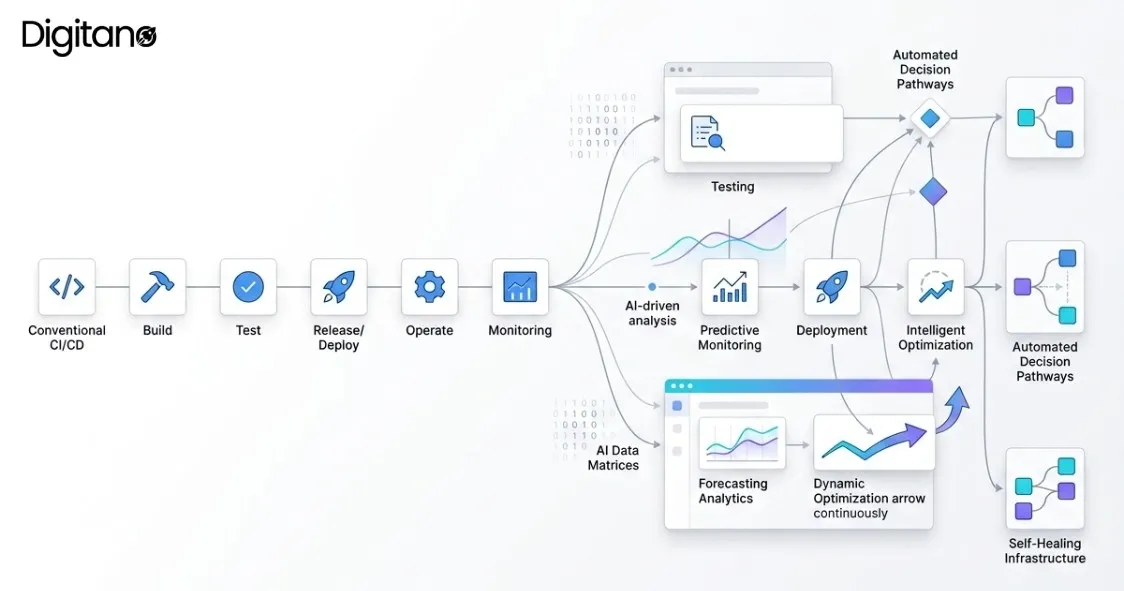
Here's a stat that should change how engineering leaders think about AI adoption in 2026: 72% of high-maturity DevOps organizations report deeply embedded AI practices, compared to just 18% of low-maturity counterparts, according to Perforce's 2026 State of DevOps Report analyzing over 800 IT professionals. That gap isn't a coincidence. It's the difference between teams that treat AI as a tool sitting on top of their existing engineering practices and teams that have built the disciplined foundations AI actually requires to deliver value. So when you're asking "is your DevOps team ready for AI", you're really asking whether you have the operational maturity to capture AI's benefits or whether you'll join the 88% of AI pilots that never reach production.
This guide walks through the specific readiness signals, warning signs, and practical steps engineering leaders need to know in 2026, backed by real data from primary sources. If you'd rather have an experienced team help you assess your DevOps readiness or build the AI-ready foundations your organization needs, our digital marketing services and consulting work at Digitano LLC include this kind of technical strategy for organizations serious about AI transformation.
Why DevOps Maturity Determines AI Success
Before jumping into the signs, let's ground the conversation in real 2026 data on why maturity matters more than tool selection:
- 70% of organizations indicate DevOps maturity meaningfully influences their AI success (Perforce 2026 State of DevOps)
- 72% of leaders in high-maturity organizations report deeply embedded AI practices vs. 18% at low-maturity organizations (Perforce 2026)
- 88% of AI pilots fail to reach production, with failures clustering on governance, data-readiness, and observability gaps (IDC research cited by GoGloby 2026)
- 83% of organizations plan to deploy autonomous agents, but only 1 in 3 say their infrastructure is ready (Cisco 2025 AI Readiness Index)
- 95% of enterprise generative AI pilots fail to deliver measurable ROI (MIT NANDA research 2026)
- PwC's 2026 AI Performance Study shows roughly 20% of companies capture nearly 74% of AI's economic gains (GoGloby 2026 data)
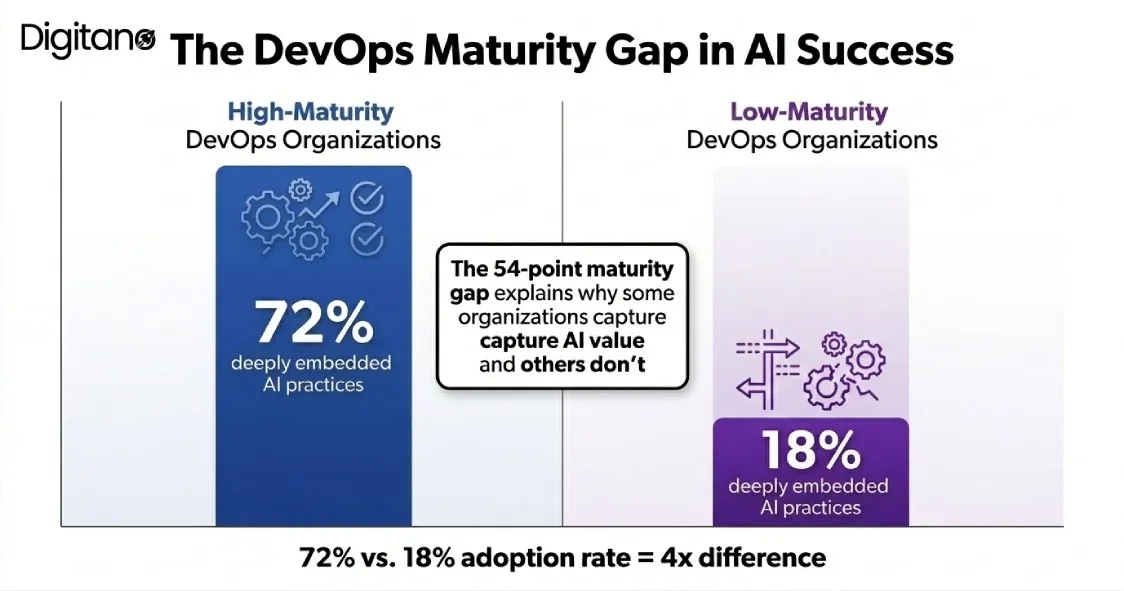
The takeaway is direct: AI tools amplify what already exists. If your DevOps practices are strong, AI makes them stronger. If they're weak, AI amplifies the weaknesses at higher velocity.
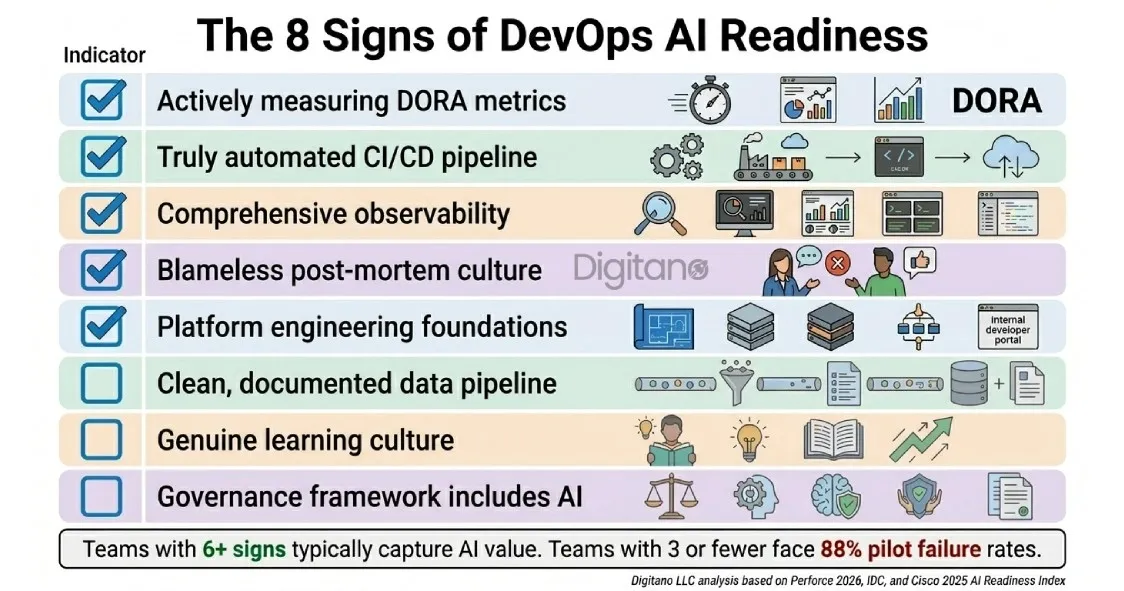
The 8 Key Signs Your DevOps Team Is Ready for AI
Let me get specific about what "ready" actually looks like based on 2026 industry benchmarks.
You're Actively Measuring DORA Metrics
The four DORA (DevOps Research and Assessment) metrics are the standard measure of engineering performance:
- Deployment frequency
- Lead time for changes
- Change failure rate
- Mean time to recovery (MTTR)
If your team can't answer "what's our current deployment frequency?" or "what's our change failure rate this quarter?" you don't have the visibility AI needs to add value. AI tools optimize what you can measure. If you can't measure it, AI can't improve it.
Ready signal: You track DORA metrics monthly, review them in leadership meetings, and set improvement targets tied to them.
Your CI/CD Pipeline Is Truly Automated
Automation is the foundation for AI augmentation. Teams still doing manual deploys, manual test runs, or manual environment setups will struggle to bolt AI on top of workflows that fundamentally aren't automated.
The 2026 benchmark: GitOps adoption reached 80% with 93% user satisfaction, signaling that infrastructure-as-code and pipeline-as-code have moved from optional to standard.
Ready signal: All production deployments happen through automated pipelines. No manual "deploy day" activities. Every change flows through the same reviewed, tested, automated path.
You Have Comprehensive Observability
You can't fix what you can't see. AI can't detect anomalies in metrics you don't collect, correlate incidents across services you don't trace, or predict failures in systems you don't monitor.
The 2026 observability baseline for AI readiness includes:
- Structured logging across all services
- Distributed tracing (OpenTelemetry has become the emerging standard)
- Real-time metrics with alerting
- Application performance monitoring (APM)
- Business metrics integrated with technical metrics
Ready signal: You can trace a user complaint from the customer support ticket, through the frontend, backend services, database calls, and infrastructure metrics, all in one interface, within minutes.
Your Team Practices Blameless Post-Mortems
This one is cultural, but it's foundational for AI adoption. AI systems will make mistakes. AI-generated code will introduce bugs. AI-driven decisions will occasionally be wrong. Teams that punish humans for mistakes will punish them harder for AI-augmented mistakes, killing adoption in a quarter.
Ready signal: When incidents happen, your team focuses on "what did our system allow?" rather than "who caused this?" Post-mortems produce specific process changes, not disciplinary actions.
You Have Platform Engineering Foundations
Platform engineering has become the meta-discipline that makes cloud-native, DevOps, and AI adoption all work together. Rather than every product team building its own infrastructure expertise, mature organizations build internal developer platforms that provide self-service tools with governance built in.
The Perforce 2026 report specifically identifies platform engineering as one of the top three predictors of AI adoption success.
Ready signal: Your product engineers use standardized deployment, monitoring, and infrastructure tools without needing to be Kubernetes experts. A dedicated platform team handles the underlying infrastructure.
Your Data Pipeline Is Clean and Documented
AI is a data-hungry technology. Poor data quality kills AI initiatives faster than any other factor.
Ready signal:
- Your data pipeline has clear ownership
- Data lineage is documented (you can trace data from source to consumption)
- Data quality is measured and monitored
- Personally identifiable information (PII) is properly classified and protected
- Data governance policies exist and are enforced
Without these, AI initiatives fail regardless of how good your models or tools are.
Your Team Has Genuine Learning Culture
AI moves fast. The tools, techniques, and best practices that work today will evolve within months. Teams that don't have a genuine learning culture will fall behind quickly.
Ready signal: Your team dedicates time to learning (typically 10-20% of weekly capacity), has budget for training and conferences, actively contributes to internal or external knowledge sharing, and treats "the way we've always done it" as a reason to question the approach rather than defend it.
Your Governance Framework Includes AI Considerations
This is the 2026 differentiator. Organizations that already have governance frameworks (change management, security review, compliance oversight) are meaningfully better positioned to add AI-specific governance on top.
Ready signal: You have documented policies for how AI-generated code is reviewed, how AI-driven decisions are audited, how models are versioned and deployed, and how AI outputs are validated before consequential actions. These aren't optional in 2026 with expanding regulatory requirements.
The Warning Signs Your DevOps Team Is NOT Ready for AI
Being honest about what's not working is just as important as recognizing readiness. Here are the specific 2026 warning signs.
Warning Sign #1: You're Deploying Once a Month or Less
If your team deploys monthly, quarterly, or (worse) on-demand only, AI won't fix your deployment velocity. It will just make you generate code faster that then queues up waiting to be deployed. Fix deployment cadence first.
Warning Sign #2: Your Test Automation Coverage Is Under 60%
AI-generated code will still introduce bugs. If you don't have automated test coverage catching regressions, AI amplifies your quality problems rather than solving them. Get to 70%+ coverage on business-critical paths before adding AI to the pipeline.
Warning Sign #3: Your Team Firefights More Than Two Weeks Per Month
Teams stuck in constant incident response can't absorb new tools or practices. AI adoption requires learning capacity your team doesn't have if they're spending most weeks on production issues.
Warning Sign #4: Your Change Failure Rate Is Above 20%
The DORA benchmarks put elite teams under 5% change failure rate. If you're above 20%, your system stability doesn't support AI-augmented deployment velocity. Fix the fundamentals first.
Warning Sign #5: Nobody Owns Observability
If observability is "everyone's job" or worse "the SRE team's problem," AI can't reliably improve anything. Ownership and consistent instrumentation are prerequisites.
Warning Sign #6: Your Team Fears Executive Blame for Failures
Cultural issues here kill AI adoption faster than technical gaps. If engineers hide mistakes to avoid consequences, they'll hide AI-augmented mistakes too. This creates governance and safety problems that compound.
Warning Sign #7: You Have No Clear AI Governance Policy
Adopting AI without governance policy is legally and operationally risky in 2026. Enterprise AI regulations (EU AI Act now in force, US state-level regulations emerging) mean AI use without governance creates compliance exposure.
Warning Sign #8: Your Team Uses AI But Nobody Knows the Impact
This is genuinely the most common 2026 issue. Engineers use ChatGPT, GitHub Copilot, or Claude Code informally, but leadership has no visibility into what's being generated, reviewed, or shipped. This "shadow AI" creates governance gaps that will bite hard when something goes wrong.
The Real-World Impact: What "AI-Ready" Actually Looks Like
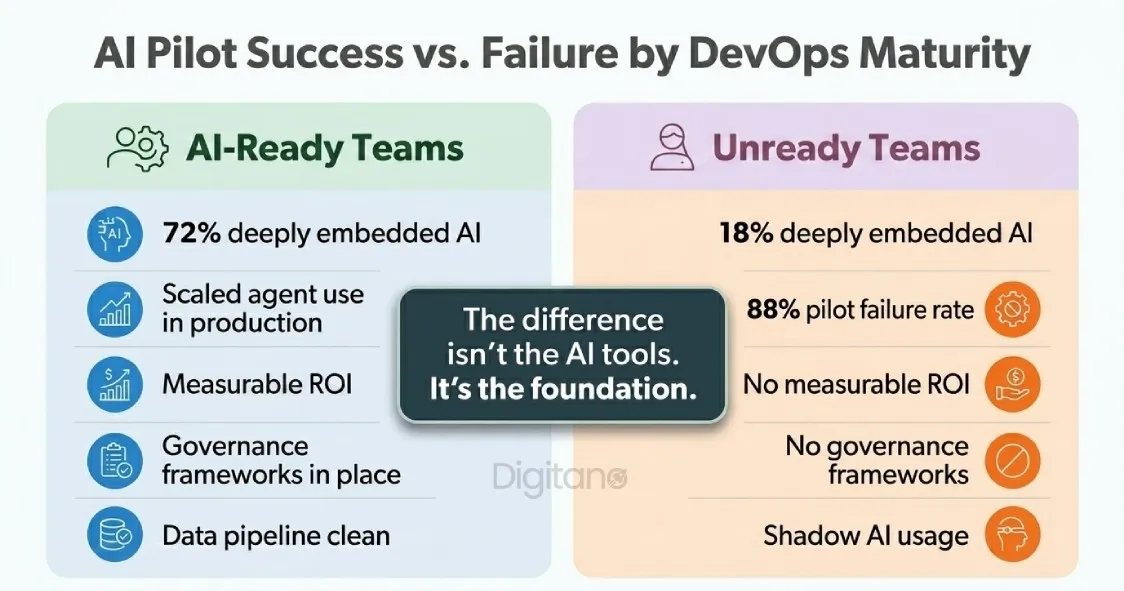
Let me make this concrete with 2026 industry data on what happens when AI-ready DevOps teams deploy AI vs. what happens when unready teams try.
Real Example: High-Maturity Team AI Adoption
According to McKinsey's 2026 AI research cited by GoGloby, technology functions with mature DevOps practices lead in scaled agent deployment. Specifically:
- Software engineering teams see the highest scaled agent use for code review, ticket triage, and pipeline optimization
- IT operations teams successfully deploy AI for incident detection, root cause analysis, and remediation automation
- Service operations teams achieve measurable improvements in customer support workflow through AI
These teams share the DevOps maturity signs above. Their AI adoption succeeds because the foundation was already in place.
Real Example: Low-Maturity Team AI Adoption Failure
The IDC research on 88% AI pilot failure identifies specific patterns:
- Failures cluster in organizations with governance gaps
- Data-readiness issues (dirty data, unclear ownership) are the second most common failure driver
- Observability gaps make it impossible to measure whether AI is actually working
Teams that try to leapfrog to AI without building the DevOps foundation typically produce impressive demos and failed production deployments.
The Framework: How to Move From Unready to AI-Ready
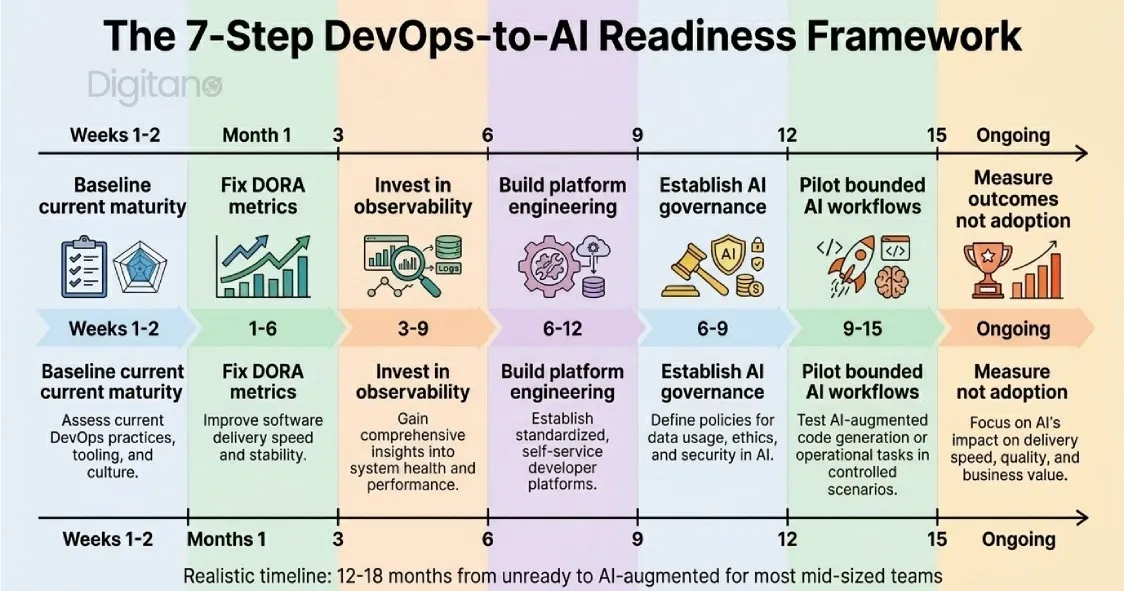
Based on what works for teams that successfully transition to AI-augmented DevOps, here's a practical seven-step framework.
Step 1: Baseline Your Current Maturity
You can't improve what you don't measure. Start with a genuine self-assessment against the 8 readiness signs and 8 warning signs above. Be brutally honest. Teams that score their own readiness generously tend to fail predictably.
Consider using structured self-assessment frameworks like Coder's AI Maturity Curve self-assessment or Larridin's maturity model for a more formal benchmark.
Step 2: Fix DORA Metrics First
Before adding AI, get to at least "high performer" DORA metrics: deployment frequency at least weekly, lead time under one week, change failure rate under 15%, MTTR under one day. Teams below these thresholds don't have the operational discipline to benefit from AI.
Step 3: Invest in Observability
Get to comprehensive observability coverage across your production systems. This is a 3-6 month investment for most teams, and it's non-negotiable for AI success.
Step 4: Build Platform Engineering
Consolidate infrastructure expertise into a dedicated platform team. Give product teams self-service infrastructure tools with governance built in. This is one of the highest-ROI investments in DevOps maturity.
Step 5: Establish AI Governance Policy
Document your policies before adopting AI at scale:
- How AI-generated code is reviewed
- Which AI tools are approved for which use cases
- How AI outputs are validated before production
- Data handling and PII policies for AI tools
- Audit trails and compliance requirements
Step 6: Pilot AI in Bounded, Measurable Workflows
Start where the GoGloby 2026 research shows AI succeeds first: repetitive, bounded, measurable workflows with short feedback loops. Ticket triage, code review, internal search, and operations coordination consistently succeed. Don't start with something novel or high-risk.
Step 7: Measure Outcomes, Not Adoption
Track whether AI actually improves your DORA metrics, incident rates, and business outcomes. The Larridin 2026 AI Maturity Guide specifically warns that most AI readiness assessments measure the wrong things: they check whether you have a strategy and governance framework, but not whether AI produces results.
Focus on:
- Business impact measurement (revenue, cost savings, customer outcomes)
- Adoption breadth (what percentage of engineers actively use AI)
- Fluency depth (how effectively they use it)
- Workflow integration (whether AI is embedded in core processes)
Common Mistakes Engineering Leaders Make
Based on 2026 industry analysis, here are the patterns that consistently cause AI adoption to fail:
- Adopting AI tools before fixing DevOps fundamentals. AI amplifies existing capabilities. Weak foundations get amplified as weakness.
- Confusing "our engineers use ChatGPT" with "we have adopted AI." Individual tool usage without governance, measurement, or integration doesn't count.
- Skipping governance because "we'll add it later." Retrofitting governance is exponentially harder than building it in from the start.
- Focusing on tools instead of workflows. The tool doesn't matter if the workflow it plugs into is broken.
- Not budgeting for training. Engineers need real time to learn AI-augmented workflows. Expecting them to pick it up "on the side" produces surface-level adoption.
- Measuring adoption (licenses purchased) instead of outcomes (business impact). Cisco's 2025 AI Readiness Index specifically warns that license counts and usage dashboards don't equal scaled adoption.
- Trying to leapfrog maturity. You can't skip the DevOps foundation and jump to agentic AI. Sequential maturity development is what works.
Frequently Asked Questions
Q1: How do I know if my DevOps team is ready for AI?
Assess against the 8 readiness signs: DORA metrics measurement, CI/CD automation, comprehensive observability, blameless post-mortem culture, platform engineering, clean data pipeline, learning culture, and AI governance framework. Teams scoring 6 or more of these signs are typically ready. Teams with 3 or fewer face high probability of joining the 88% of AI pilots that fail to reach production.
Q2: What are the biggest warning signs that a DevOps team can't adopt AI yet?
Monthly-or-less deployment frequency, test coverage under 60%, constant firefighting, change failure rate above 20%, no observability ownership, blame culture, no AI governance policy, and shadow AI usage that leadership can't see. Any three of these signal you need to fix DevOps fundamentals before adopting AI at scale.
Q3: How long does it take to go from unready to AI-ready?
Realistically 12 to 18 months for most mid-sized teams. Fixing DORA metrics takes 3 to 6 months, building observability takes 3 to 6 months (often in parallel), platform engineering takes 6 to 12 months, and establishing governance is a 3 to 6 month effort. These phases overlap, but the transformation requires sustained investment.
Q4: Do we need to hire an AI specialist to be ready for AI?
Not necessarily for adoption. Most 2026 AI-augmented DevOps work uses existing tools (GitHub Copilot, Claude Code, Cursor, AI-powered CI/CD tools) that don't require model engineering expertise. What you need is engineering leadership that understands how to integrate AI into existing workflows and governance around AI usage. Specialized AI/ML engineers are needed for building custom AI features into your products, which is a different question.
Q5: How much does DevOps AI transformation cost?
Tool licensing typically runs $50-$200 per developer per month for AI coding assistants. Platform engineering investment ranges from 1 to 5 dedicated engineers depending on organization size. Training budget of $2,000-$5,000 per engineer per year is realistic. The bigger cost is usually the leadership time to set direction and the platform investment to enable safe AI adoption.
Q6: What's the biggest mistake engineering leaders make with AI adoption?
Trying to leapfrog maturity development. Teams that skip DevOps fundamentals and try to jump directly to AI-augmented development typically produce impressive pilots and failed production deployments. The 88% AI pilot failure rate isn't because AI is hard. It's because most organizations lack the operational foundation AI needs.
The Bottom Line
Determining whether your DevOps team is ready for AI in 2026 comes down to honest assessment against specific, measurable readiness signals. The Perforce 2026 State of DevOps Report's finding that 72% of high-maturity organizations have deeply embedded AI practices vs. just 18% of low-maturity counterparts isn't a coincidence. It's what happens when AI is layered onto strong foundations vs. weak ones.
The teams that succeed with AI in 2026 aren't the ones with the most expensive tools or the newest AI models. They're the ones that built the DevOps foundations first: DORA metrics they actually measure, automated pipelines they trust, observability they invest in, platform engineering that scales, governance that protects, and cultures that learn. AI amplifies what already exists. Build the right foundations and AI accelerates real business impact. Try to shortcut them and you'll join the majority of pilots that never reach production.
For engineering leaders who need help assessing DevOps AI readiness, building the platform engineering and governance foundations that make AI adoption succeed, or turning AI experimentation into measurable business outcomes, contact Digitano LLC. We help teams move from AI experimentation into disciplined, measurable AI-augmented engineering practices that produce real results.