The AI-powered software testing landscape has changed more in the last 18 months than in the previous 10 years combined. Gartner formally renamed its 2026 Peer Insights category from "AI-Augmented Software Testing Tools" to "Transitioning to Agentic Software Quality Assurance Platforms," which tells you something important about where the industry is headed: not just tools that add AI features to existing testing workflows, but genuinely autonomous agents that generate, execute, and maintain tests with human oversight rather than human authorship. For engineering leaders trying to make a real vendor decision, the question isn't whether to adopt AI-powered testing in 2026. It's which of the top AI-powered software testing companies 2026 actually deserves the investment.
This guide walks through the specific companies worth watching in 2026, honest pricing, real strengths and tradeoffs, and how to match a tool to your team's actual testing needs. If you'd rather have an experienced team help you evaluate testing vendors or build an AI-augmented QA workflow, our digital marketing services and consulting work at Digitano LLC include this kind of technical strategy for organizations navigating the modern testing tool landscape.
The Three Categories You Need to Understand First
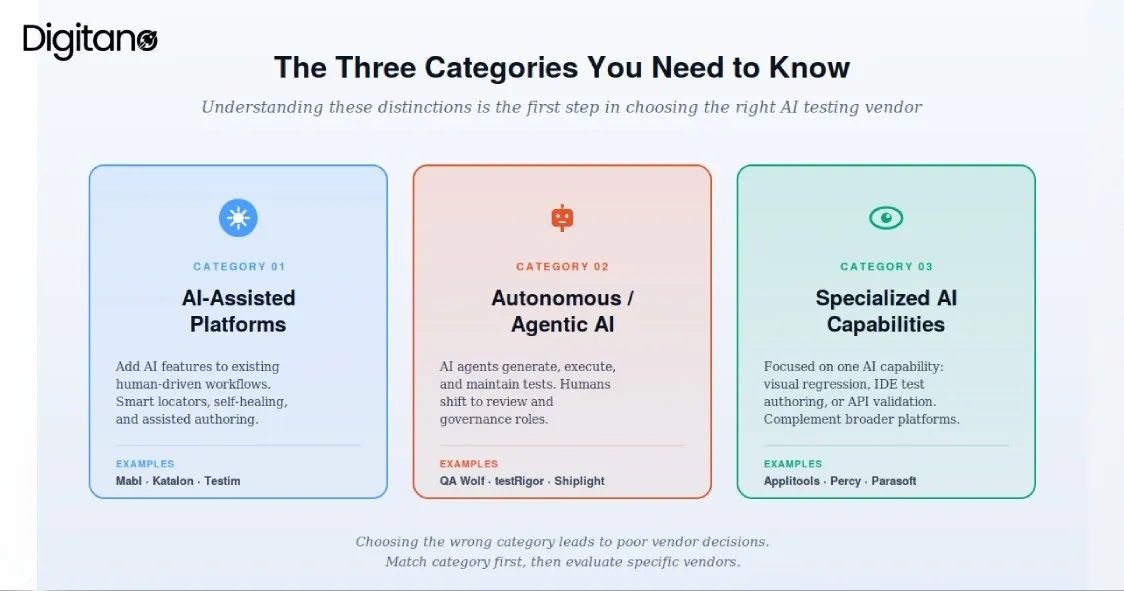
Before evaluating specific vendors, it's worth understanding that AI testing tools genuinely fall into three different categories, and they operate on fundamentally different models. Confusing these leads to bad purchasing decisions.
- AI-assisted platforms. Add AI features (smart locators, self-healing selectors, assisted authoring) to an existing human-driven testing workflow. Examples include Mabl, Katalon, and Testim. They reduce friction in a process you already have.
- Autonomous or agentic AI testing. Systems that generate and maintain test coverage themselves from user intent or observed application behavior, with humans in review rather than authoring roles. Examples include QA Wolf, testRigor, and Shiplight AI. They change the operating model of your QA function.
- Specialized AI capabilities. Tools focused on a specific AI-powered capability like visual regression testing (Applitools, Percy) or IDE-integrated test authoring (various copilots). They complement rather than replace broader test automation platforms.
The tool that's right for a five-person startup is almost never the tool that's right for a Fortune 500 enterprise. Getting the category right is the first step in getting the vendor right.
The Best AI-Powered Software Testing Companies in 2026
1. Katalon
Katalon has quietly become one of the most consistently recommended platforms in the 2026 AI testing space, particularly for teams with mixed technical skill levels. Its AI Assistant supports test creation across web, mobile, API, and desktop applications under a single platform, meaning teams don't have to fragment their testing across multiple tools.
Why it's worth watching: Katalon offers no-code test creation for manual testers alongside code extension for SDETs, meaning it accommodates diverse team compositions without requiring everyone to work in the same paradigm. Its multi-channel coverage (web, mobile, API, desktop) is unusually broad.
Real pricing: Team Edition Standard runs $167 per seat per month billed annually, or $185 billed monthly. A package offer brings the first annual purchase of five seats to $67 per seat per month. Enterprise Edition is sales-led with a free trial available.
Best for: Growing engineering teams with mixed technical skill levels that need broad platform coverage across web, mobile, API, and desktop testing.
2. Mabl
Mabl focuses on low-code intelligent end-to-end testing with built-in analytics. Its AI-powered test creation, execution, and maintenance features are specifically designed to reduce the technical overhead of maintaining large test suites.
Why it's worth watching: Mabl's built-in analytics for test insights and performance monitoring is meaningfully more integrated than most competitors. The self-healing feature genuinely reduces the maintenance burden that traditional test suites carry.
Best for: Teams that want a mature, established low-code E2E testing platform with strong analytics and don't need heavy customization or code-level access to test scripts.
3. Applitools
Applitools remains the clear leader in AI-powered visual testing. Its Visual AI technology detects meaningful visual differences across browsers, devices, and viewports that traditional pixel-comparison tools miss or flag as false positives.
Why it's worth watching: Independent industry consensus places Applitools as best-in-class for visual regression testing specifically. Its ability to distinguish meaningful visual changes from ignorable rendering differences saves significant human review time.
Best for: Teams where visual consistency across many browsers, devices, and viewports is business-critical, and where visual regression bugs have real user-facing impact.
4. TestRigor
testRigor has built its reputation on plain-English test creation, allowing non-technical stakeholders to write tests in natural language rather than code. This meaningfully changes who can contribute to test coverage on a team.
Why it's worth watching: For organizations where product managers, designers, or business analysts want to contribute to testing without learning a scripting language, testRigor's plain-English approach has the lowest barrier to entry in the entire space.
Best for: Product-led teams, agencies, and organizations where non-technical stakeholders need to contribute to test coverage.
5. Tricentis (Testim, Tosca, and NeoLoad)
Tricentis is the enterprise-grade suite in the AI testing space, combining test automation, test management, and performance testing under unified governance. Testim, one of its core products, is built around AI smart locators that self-heal when the UI shifts.
Why it's worth watching: For enterprises with regulated workflows, many teams, and sprawling application landscapes, Tricentis trades single-purpose simplicity for the breadth and control that enterprise QA leaders need when standardizing across an organization.
Real pricing: Not publicly published. Plans are quote-based and arranged through sales.
Best for: Enterprise QA leaders standardizing testing across many teams, regulated industries, and large application portfolios.
6. Sauce Labs
Sauce Labs has evolved from its origins as a cloud device farm into a broader AI-augmented testing platform. Its combination of real device and browser access with AI-powered test insights has kept it competitive with newer entrants.
Why it's worth watching: For teams that need to test across a wide range of real devices, browsers, and operating systems, Sauce Labs' cloud infrastructure remains one of the strongest options, and its AI features are increasingly mature.
Best for: Teams shipping cross-platform products (web plus iOS plus Android) that need extensive device and browser coverage.
7. BrowserStack
BrowserStack provides the execution layer for modern QA stacks with cloud access to 30,000+ real iOS and Android devices, cross-browser testing, and accessibility testing with screen readers.
Why it's worth watching: BrowserStack's device coverage is difficult to match with self-hosted infrastructure. For teams that need to verify their product works on a specific device combination for a real customer complaint, BrowserStack is often the fastest path to that answer.
Best for: Teams that need extensive real-device testing coverage without maintaining their own device labs.
8. QA Wolf
QA Wolf represents a genuinely different model: instead of selling a testing tool, they sell a fully managed QA service where a dedicated team writes, maintains, and executes your test coverage. Their platform generates deterministic Playwright code that your team owns.
Why it's worth watching: For engineering teams that don't want to build a QA function in-house, QA Wolf removes the testing burden entirely while still providing you the underlying test code. Their coverage guarantee is unusually strong in the industry.
Best for: Fast-growing engineering teams that want comprehensive test coverage without building an internal QA organization.
9. Shiplight AI
Shiplight AI is a newer entrant specifically designed for engineering teams using AI coding agents (Claude Code, Cursor, GitHub Copilot, Codex). Tests live as YAML in your git repository, providing genuine transparency and eliminating vendor lock-in.
Why it's worth watching: Native MCP (Model Context Protocol) integration means Shiplight AI works directly alongside AI coding agents like Claude Code, which is genuinely differentiated in 2026. Tests reviewed in pull requests fit naturally into modern engineering workflows.
Best for: Engineering teams that heavily use AI coding agents and want their test coverage to fit into standard git-based development workflows.
10. LambdaTest with KaneAI and HyperExecute
LambdaTest has evolved from its cross-browser testing origins into an AI-augmented platform with KaneAI (AI test authoring) and HyperExecute (accelerated test execution). Its combination of cross-browser access with AI features makes it a genuinely competitive option.
Why it's worth watching: LambdaTest's aggressive pricing combined with genuine AI capabilities makes it accessible to smaller teams that might not afford Sauce Labs or BrowserStack at full scale.
Best for: Cost-conscious teams that need cross-browser coverage plus AI-augmented testing without enterprise-tier pricing.
11. Functionize
Functionize has built its platform around AI-powered test generation and self-healing automation, targeting enterprise teams specifically. Its intelligent test authoring reduces the technical barrier to creating comprehensive test coverage.
Best for: Enterprise teams that want strong AI-powered test authoring without moving to a fully managed service.
12. Parasoft SOAtest
Parasoft SOAtest is now AI-augmented and streamlines API, web service, and microservice testing. It supports 120+ protocols and message formats, making it particularly strong for API-heavy architectures.
Why it's worth watching: SOAtest's AI features include natural language test generation, smart parameterization, and machine learning-driven test impact analysis. Its agentic AI assistant helps create and maintain tests without scripting, and it specifically validates AI-driven systems with non-deterministic outputs.
Best for: Enterprise teams with API-heavy architectures, particularly those testing AI-driven systems or complex microservice ecosystems.
The Emerging Trend: Agentic AI Testing Platforms
Gartner's decision to reframe its 2026 category as "Transitioning to Agentic Software Quality Assurance Platforms" isn't just semantic. It reflects a genuine shift in how leading vendors are positioning their products.
The traditional AI-augmented model assumes a human writes tests with AI assistance. The agentic model assumes an AI agent authors, executes, and maintains tests continuously, with humans in a governance and review role rather than authoring roles.
The practical implications for buyers in 2026:
- Vendor claims about "AI-augmented" versus "agentic" or "autonomous" testing matter. These describe genuinely different operating models, not marketing variants.
- Human review workflows matter more, not less, in agentic testing. When agents author tests independently, the review process is the primary quality safeguard.
- Test transparency and code ownership matter more. Agentic platforms that generate proprietary tests you can't audit or export create real vendor lock-in risk.
- Deterministic test generation is a legitimate differentiator. Tools that generate reliable code (like Playwright or Selenium) that runs consistently across environments outperform tools that generate non-deterministic AI-driven executions.
How Much Do AI-Powered Testing Tools Actually Cost?
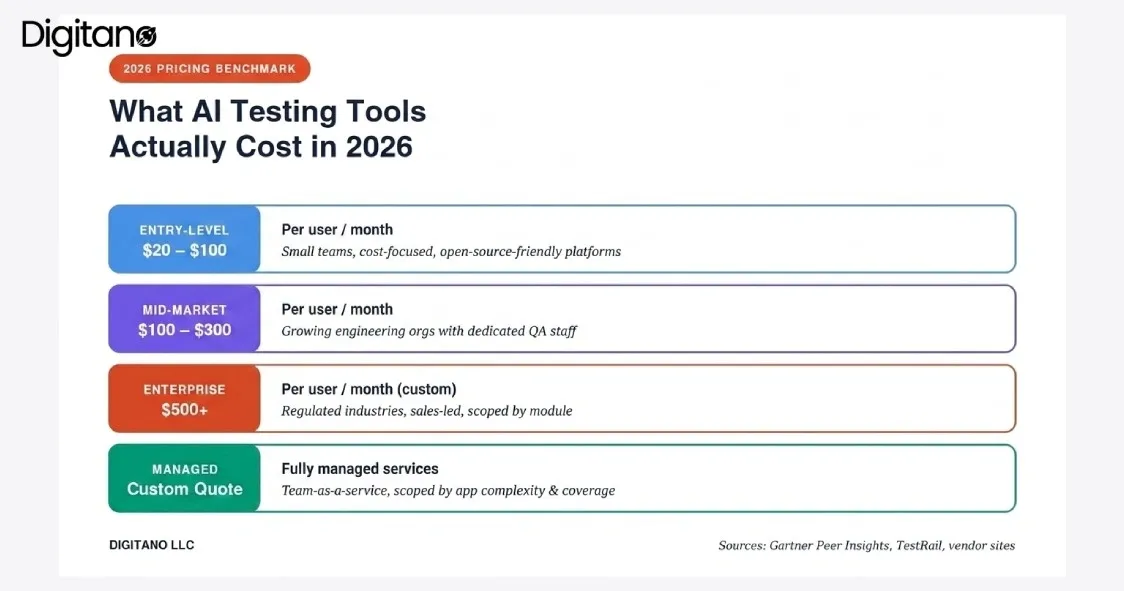
Being honest about pricing helps engineering leaders set realistic budget expectations:
- Entry-level ($20-$100/user/month): TestGrid Manual Testing at $19/month, LambdaTest starter plans, and free tiers from open-source alternatives (Playwright, Selenium with AI plugins) cover basic needs for small teams.
- Mid-market ($100-$300/user/month): Katalon at $167/seat/month, Applitools at $969/month for teams. Suitable for growing engineering organizations with dedicated QA staff.
- Enterprise ($500+/user/month or custom): Tricentis, Functionize, and Parasoft SOAtest at enterprise tiers. Sales-led pricing typically scoped by module and user count.
- Fully managed services (quote-based): QA Wolf, some Shiplight AI configurations. Cost varies by application complexity and coverage requirements.
- Open-source alternatives (free plus infrastructure): Playwright, Selenium with AI plugins. Cost efficiency for cost-conscious teams, but requires internal expertise to implement AI features effectively.
Common Mistakes When Choosing an AI Testing Vendor
Based on repeated patterns from independent industry analysis in 2026:
- Confusing AI-augmented with agentic testing. These operate on fundamentally different models. Buying an AI-augmented tool when you actually need agentic capabilities (or vice versa) creates workflow friction.
- Prioritizing the "coolest" AI features over deterministic reliability. A tool that generates flaky, non-deterministic tests is worse than a tool with fewer AI features but reliable execution.
- Ignoring test ownership and code transparency. Tools that generate proprietary tests you can't audit or export create vendor lock-in that limits future flexibility.
- Underestimating human review workflow requirements. Every AI-augmented and agentic platform still requires human review. Budget for reviewer time, not just tool licensing.
- Choosing on price alone. The cheapest option often costs more once you factor in ongoing maintenance, false-positive review time, and vendor lock-in risk.
- Assuming enterprise tools serve small teams well. Enterprise QA suites are optimized for large-scale governance, not small-team productivity. Small teams often do better with focused, opinionated tools.
- Failing to plan for validating AI-embedded product features. If your product has AI features (recommendation engines, LLM integrations), you need testing tools that validate non-deterministic outputs, not just deterministic ones. Not every vendor does this well.
Practical Guidance for Choosing an AI Testing Vendor
For engineering leaders serious about making the right vendor choice:
- Categorize your needs first. Are you looking for AI-assisted (reducing friction in existing workflow), autonomous/agentic (changing the operating model), or specialized capabilities (visual, API, mobile-specific)?
- Understand your team's technical composition. Mixed technical teams often do better with platforms like Katalon that accommodate both code and no-code contributors. Fully technical teams often prefer transparency-focused platforms like Shiplight AI or QA Wolf's owned-code model.
- Prioritize deterministic test generation. Non-deterministic tests that pass or fail randomly are worse than no tests at all.
- Verify code ownership and export capability. You should be able to export your test suite and run it independently of the vendor's platform. Vendor lock-in on tests you can't export is a real risk.
- Evaluate human review workflow support. How does the tool make it easy for humans to review AI-generated tests? Pull request integration, YAML transparency, and clear diff views all matter.
- Trial before committing. Free trials, proof-of-concept implementations, and pilot programs are legitimate ways to verify vendor claims before committing to a full deployment.
- Plan for AI feature validation if applicable. If your product includes AI features, verify the testing vendor can validate non-deterministic outputs, bias, and adversarial input resistance.
Frequently Asked Questions
Q1: Which AI testing tool is best for small businesses?
For small businesses, cost-effective options like Katalon (with its five-seat introductory pricing), LambdaTest, or open-source alternatives (Playwright, Selenium with AI plugins) provide meaningful AI capabilities without enterprise tier pricing. testRigor is particularly good if your team includes non-technical stakeholders who want to contribute to testing.
Q2: What's the difference between AI-augmented and agentic AI testing?
AI-augmented tools add AI features to an existing human-driven testing workflow (examples: Mabl, Katalon, Testim). Agentic AI testing platforms have AI agents that generate, execute, and maintain tests themselves with humans in review roles rather than authoring roles (examples: QA Wolf, testRigor, Shiplight AI). These are fundamentally different operating models.
Q3: How much do enterprise AI testing tools cost?
Enterprise-tier tools like Tricentis, Functionize, and Parasoft SOAtest are typically sales-led with custom pricing based on modules and user count. Realistic ranges start around $500 per user per month and scale meaningfully higher for large deployments. Mid-market tools like Katalon at $167 per seat per month provide meaningful AI capabilities at more accessible pricing.
Q4: Are open-source AI testing tools reliable in 2026?
Yes, particularly for teams with internal expertise. Playwright and Selenium with AI plugins are gaining significant traction as cost-effective alternatives to commercial suites. The tradeoff is that you're responsible for integrating AI features and maintaining the infrastructure, which requires more in-house capability than turnkey commercial platforms.
Q5: What's the biggest mistake when choosing an AI testing vendor?
Choosing based on impressive AI demos rather than practical requirements. A tool with fewer AI features but reliable deterministic test generation, transparent code ownership, and strong human review workflow support delivers more real-world value than a flashy AI-driven platform that produces flaky, non-deterministic tests.
Q6: Which AI testing companies are Gartner leaders in 2026?
Gartner's 2026 Peer Insights category "Transitioning to Agentic Software Quality Assurance Platforms" includes platforms like Katalon, Tricentis, Sauce Labs, BrowserStack, Perfecto by Perforce, UiPath Test Suite, Parasoft SOAtest, and others. Rankings shift over time, so consulting the latest Gartner report for your specific evaluation is worthwhile.
The Bottom Line
The best AI-powered software testing companies to watch in 2026 aren't all trying to solve the same problem. Katalon leads the mid-market for mixed-skill teams, Mabl remains a strong low-code E2E option, Applitools dominates visual testing, testRigor changes who can contribute to testing with its plain-English approach, and enterprise leaders like Tricentis serve regulated, sprawling application landscapes. Newer entrants like QA Wolf, Shiplight AI, and Functionize represent genuinely different operating models worth evaluating for teams ready to move beyond traditional AI-augmented testing into agentic AI QA.
The right vendor for your organization depends on your team's technical composition, your application's complexity, your testing budget, and whether your product includes AI features that need validation. Matching those requirements to the vendor category first, then to the specific tool, produces meaningfully better outcomes than choosing based on marketing.
For organizations that need help evaluating testing vendors, building AI-augmented QA workflows, or navigating the emerging agentic testing landscape, contact Digitano LLC. We help engineering teams turn the productivity potential of modern AI testing into reliable, sustainable engineering practices.