AI-powered software testing has genuinely transformed how quality assurance operates in 2026. Independent industry data shows that 67 percent of QA teams now use at least one AI-powered testing tool, up from just 21 percent in 2024. These tools reduce test maintenance by 60 to 80 percent, catch 30 to 50 percent more bugs than pure manual testing, and cut QA costs by 40 to 60 percent. On paper, it looks like AI is well on its way to making human testers obsolete. But that's not what's actually happening in the real world of production software delivery. The human expertise in AI software testing turns out to be more critical than ever, precisely because AI's limitations become dangerous when teams treat AI as a replacement rather than an amplifier.
This guide walks through what AI genuinely does well in software testing, where human expertise remains irreplaceable, and why the most effective QA teams in 2026 are building hybrid workflows rather than choosing between the two. If you'd rather have an experienced team help you build safer AI-augmented testing workflows for your product, our digital marketing services and consulting work at Digitano LLC include this kind of technical strategy for organizations navigating the new AI-driven QA landscape.
The 80/20 Reality of AI-Powered Testing
The most useful framework for understanding AI in software testing comes from independent industry analysis in 2026: the 80/20 rule of AI-assisted QA. AI genuinely gets you 80 percent of the way there in about 20 percent of the time it would take a human team alone. That's a real productivity gain worth capturing.
But the remaining 20 percent of quality still requires human attention, and that 20 percent is where production incidents, security breaches, and bad user experiences live. This isn't a small footnote; it's the critical portion of quality assurance where AI's limitations become genuinely dangerous when unaddressed.
The teams shipping the most reliable software in 2026 aren't the ones that adopted AI most aggressively. They're the ones that understood which 80 percent of QA work AI should handle and which 20 percent required human expertise, then designed workflows around that distinction deliberately.
What AI Genuinely Does Well in Software Testing
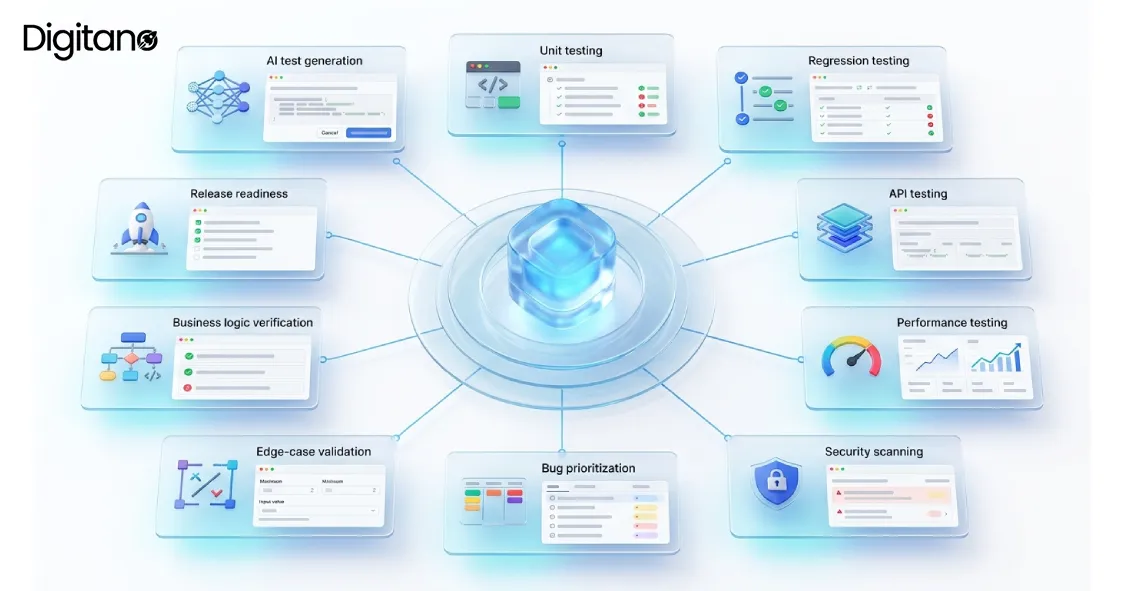
Before making the case for human expertise, being honest about AI's real strengths matters. AI tools deliver measurable value across several categories:
- Automated test case generation. AI reads requirements, user stories, or code and generates structured test cases automatically, including edge cases humans often miss.
- Self-healing test automation. When UI elements change, AI updates selectors and test steps automatically instead of breaking the entire suite. This alone has cut regression maintenance by 60 to 80 percent for many teams.
- Regression testing at scale. Real production data shows AI reducing regression execution from 6 hours to 2.5 hours in mature CI/CD environments.
- Visual testing. AI-powered tools like Applitools catch visual regressions across thousands of browser and device combinations more reliably than manual review.
- Test data generation. Creating realistic test data sets across diverse scenarios that manual generation would take weeks to produce.
- Predictive defect detection. AI analyzes production logs, code changes, and historical patterns to predict where failures are likely to occur.
- Test suite optimization. AI identifies redundant tests, flaky tests, and outdated tests, helping teams maintain leaner, more reliable test suites.
These are legitimate, meaningful capabilities. The productivity gains are real. The problem isn't that AI is failing; it's that these capabilities cover the deterministic, repeatable portion of testing while missing the judgment-heavy portion where humans still lead.
Where Human Expertise Remains Irreplaceable
Here's where the data gets interesting. Multiple independent industry sources in 2026 consistently identify the same categories where AI genuinely can't replace human expertise. These aren't philosophical arguments; they're operational realities.
1. Business Logic Validation
AI doesn't understand your business rules. When your product has a discount calculation that depends on loyalty tier, item count, holiday windows, and regional pricing rules, an AI-generated test can verify that the code runs without errors. It can't verify that the discount is correct for a specific business context, because it doesn't know what "correct" means in your business.
Independent industry analysis specifically calls out this scenario: "Is this discount calculation correct for a loyalty member buying 3 items on a holiday?" AI can generate a test that runs. Only a human tester with domain expertise can validate whether the answer is right.
2. Exploratory and Usability Testing
AI excels at pattern recognition and repetitive test execution. But independent 2026 research consistently confirms that AI fails at understanding context, user intent, and business-critical nuances that determine true software quality.
A human tester exploring a new feature notices friction that no automated test would catch: confusing microcopy, unclear affordances, unexpected behavior that's technically "correct" but genuinely bad for users. AI can generate test cases against your requirements. Only a human can identify that a form field labeled "Customer ID" should probably say "Customer Number" because your users don't know what an ID is.
3. UX and User Sentiment Evaluation
This ties directly to exploratory testing but deserves its own emphasis. AI can measure metrics; it can't measure feeling. Whether a workflow feels smooth, whether an error message feels helpful or condescending, whether a feature actually solves the user problem it was designed for, all require human judgment grounded in real user context.
4. Security Testing and Threat Modeling
Penetration testing and threat modeling require creative, adversarial thinking that current AI can't replicate. A skilled security tester actively tries to break your system in ways the developers didn't anticipate. AI can run known-attack patterns and check for common vulnerabilities, but the human creative element behind identifying novel attack vectors remains meaningfully out of AI's reach.
5. Validating AI Itself
This is the meta-category that's grown most dramatically in 2026. When your product embeds an AI agent, a recommendation engine, or an LLM-driven feature, you're no longer testing fixed logic; you're evaluating behavior that shifts with data, context, and model updates. Validating these systems requires techniques traditional QA never needed: checking outputs across a distribution of acceptable answers rather than one correct value, auditing models for bias and fairness, and stress-testing guardrails against adversarial inputs like prompt injection.
Ironically, the more AI gets embedded in products, the more human QA expertise is needed to validate those AI systems responsibly.
6. Risk Analysis and Test Prioritization
Deciding which tests to run, in what order, and with what depth requires strategic judgment about business risk. What's the cost of a failure in this feature? Which regressions would be catastrophic vs. minor? What test coverage do we actually need for this release cycle?
AI can suggest priorities based on historical patterns; it can't factor in the specific business context, competitor pressures, or regulatory obligations that inform strategic testing decisions.
7. Handling Ambiguous or Poorly Specified Requirements
AI can generate tests from clear requirements. But most real-world projects operate with ambiguous specifications, contradictory requirements from different stakeholders, and gaps that only become obvious during testing. Human testers ask clarifying questions, escalate ambiguities, and make judgment calls about how to interpret unclear specifications. This is not a task AI has demonstrated the ability to perform reliably.
8. Validation of AI-Generated Test Cases
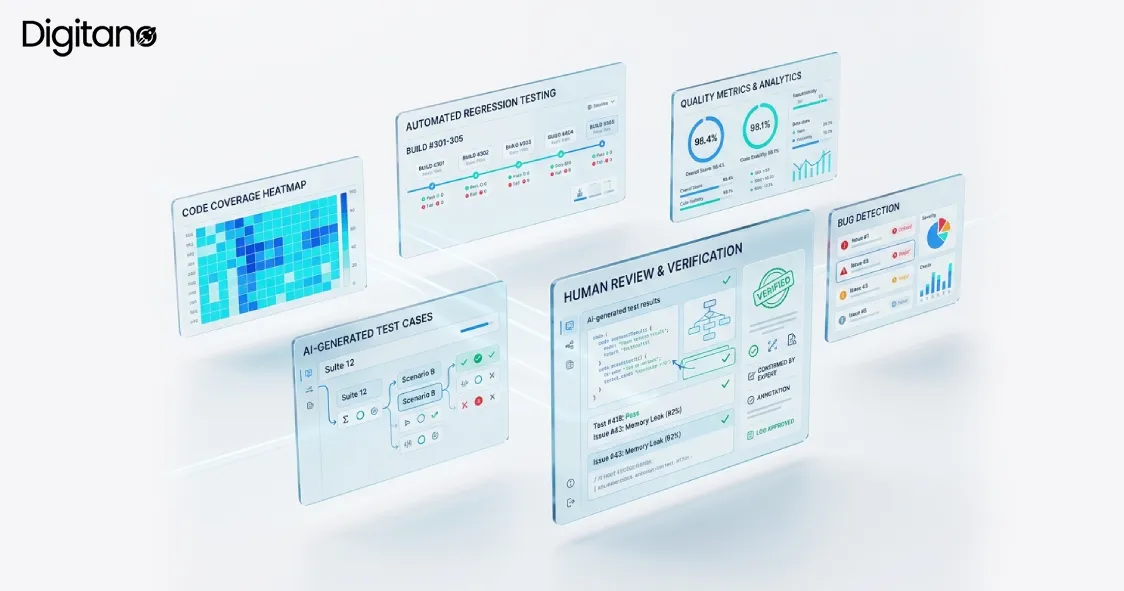
Perhaps the most important category, and the one many teams underestimate. Every AI-generated test case needs human review. AI can produce false positives (tests that seem valid but test nothing meaningful), miss domain-specific business logic, or misinterpret ambiguous requirements. Without human validation, AI-generated test suites can accumulate significant quality debt that only becomes visible after production incidents.
The Real Risk: AI Hallucinations in Testing
One specific limitation deserves separate attention because it's genuinely dangerous: AI hallucination. AI models sometimes generate incorrect or misleading outputs with high confidence, and in a testing context, this can produce test cases that appear valid but actually verify nothing meaningful. Worse, they can pass consistently while masking real defects underneath.
Independent 2026 research notes that AI in QA is probabilistic, not deterministic. The same AI system asked to generate a test case for the same feature can produce different outputs on different runs. This is a fundamental characteristic of large language models, not a bug to be fixed with better prompting.
The practical implication: without human oversight, AI-generated test suites can silently drift into unreliability. A test that passes today because AI generated it might be verifying nothing meaningful, and no automated system can catch that. Only human review of test intent and coverage can.
The Optimal 2026 QA Model: Human-in-the-Loop
Based on 2026 industry consensus across multiple independent sources, the optimal QA strategy in 2026 is AI-augmented testing rather than AI-replaced testing. The clear pattern:
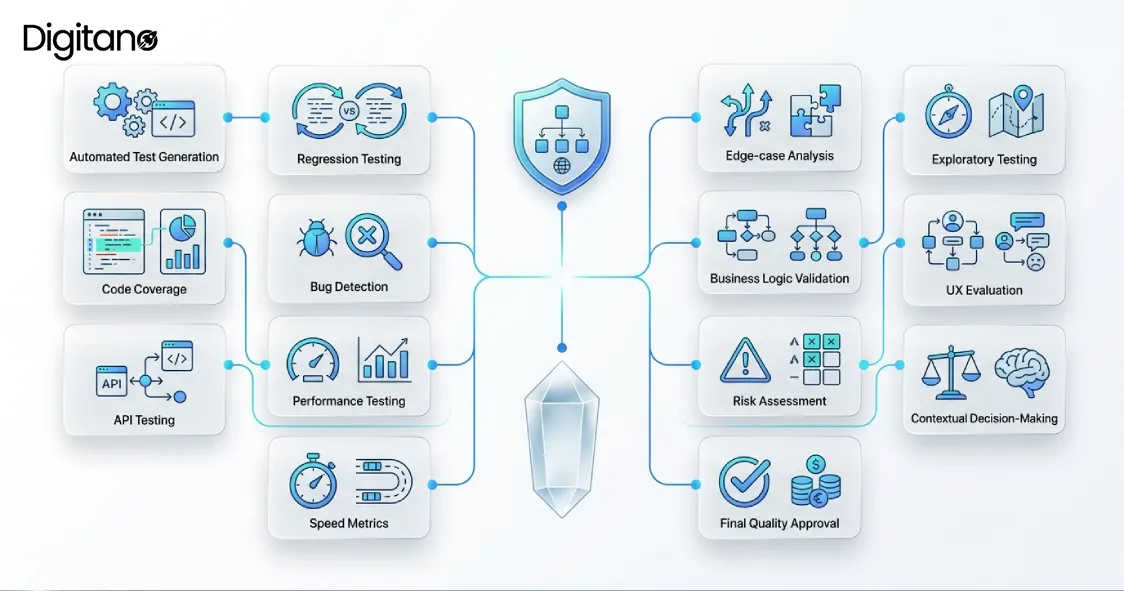
- AI handles: regression testing, visual testing, test data generation, self-healing automation, test suite maintenance, defect prediction, and pattern-based test case generation
- Human testers focus on: exploratory testing, usability evaluation, business logic validation, security testing, AI validation, risk analysis, and reviewing AI-generated test cases
This division isn't a permanent boundary; it will shift as AI capabilities evolve. But in 2026, it's the empirically supported pattern for teams delivering high-quality software.
Organizations that implement this hybrid approach report stronger defect detection rates and fewer production incidents than those relying on AI alone. The teams treating AI as an amplifier of human expertise consistently outperform teams treating AI as a replacement for critical thinking.
How QA Roles Are Actually Evolving
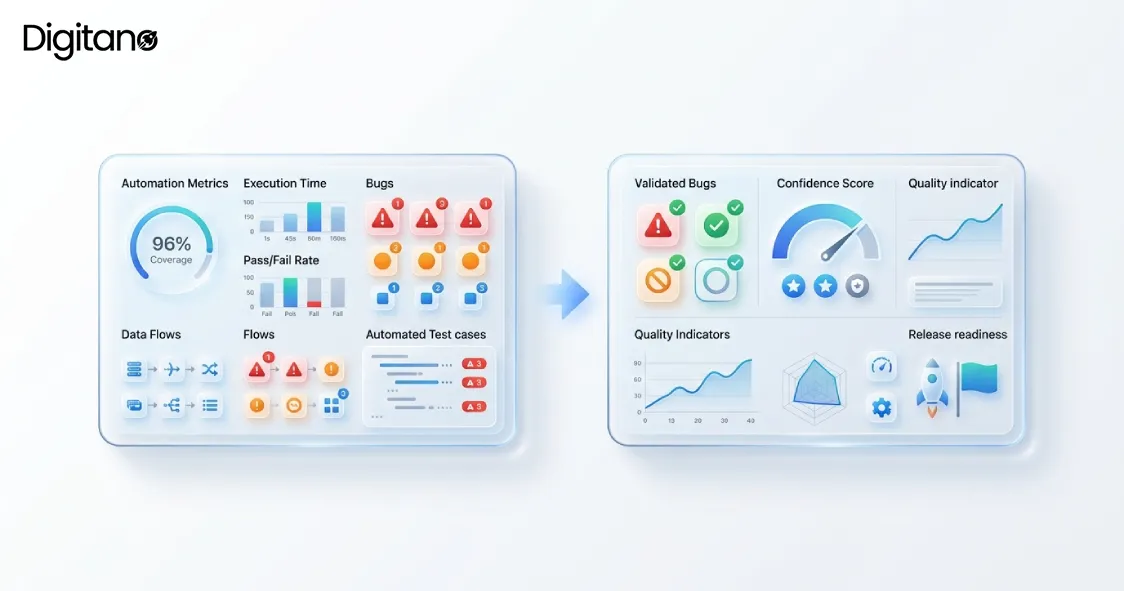
The shift isn't from "human testers" to "no human testers." It's from human testers doing repetitive work to human testers doing higher-value work. Modern QA roles in 2026 focus on:
- Defining quality objectives at a strategic level, then designing the AI-augmented workflows to achieve them
- Overseeing AI-generated results and validating them against business context AI can't see
- Ensuring automated decisions align with business priorities and user needs
- Building closed-loop AI systems where agents author, execute, and analyze tests autonomously, but with human governance keeping them reliable and aligned with real-world requirements
- Validating AI-embedded product features using techniques traditional QA never needed
- Leading test strategy across increasingly complex, multi-team, multi-product organizations
The role has evolved from "person who runs tests" to "person who ensures the entire quality system works." This is a legitimate elevation of the profession, not a threat to it.
Common Mistakes Teams Make With AI-Powered Testing
Based on patterns from 2026 industry analysis:
- Adopting AI without understanding its probabilistic nature. Teams treating AI outputs as deterministic will build systems that quietly become unreliable over time.
- Skipping human review of AI-generated test cases. This is arguably the most dangerous mistake because it looks like productivity while actually accumulating test debt.
- Assuming AI can handle business logic validation. AI doesn't know your business. Domain-specific testing still requires domain expertise.
- Treating AI as a QA staff replacement. The teams that laid off QA staff to "let AI handle it" have generally regretted the decision within 6-12 months of production incidents.
- Ignoring the AI validation dimension. As products embed more AI features, the QA burden to validate those AI systems grows. Teams that haven't planned for this face significant technical debt.
- Using AI for basic autocomplete without unlocking deeper capabilities. Many teams are technically using AI-powered tools without capturing most of the productivity benefit those tools can deliver.
- Failing to invest in testing team skill development. Modern QA requires understanding both traditional testing expertise and AI capabilities and limitations. Teams that don't invest in this training create capability gaps.
Practical Guidance for Building a Hybrid Testing Strategy
For organizations serious about combining AI capability with human expertise effectively:
- Start with risk-based test allocation. Use AI for high-volume, low-complexity verification (regression testing, cross-browser testing, basic UI validation). Reserve human testers for complex, business-critical, or ambiguous scenarios.
- Require human review of AI-generated tests. Every AI-generated test case needs a human review step before merging into production test suites. This isn't optional; it's the primary safeguard against silent test drift.
- Invest in tester upskilling. Modern testers need to understand AI capabilities, limitations, and prompt engineering fundamentals to work effectively with AI tools. This is now table-stakes for a QA professional in 2026.
- Build feedback loops between AI and human review. When human testers identify issues AI missed, feed those patterns back into your prompt engineering or model tuning process to improve AI performance over time.
- Establish governance for AI-generated code and tests. Document policies for how AI outputs are reviewed, validated, and approved. Without governance, AI-generated content can enter production without appropriate quality controls.
- Plan for validating AI features in your product. If your product includes AI capabilities, dedicate specific human QA expertise to validating those features against acceptable behavior distributions, bias, and adversarial inputs.
- Measure quality outcomes, not just AI adoption. Some teams celebrate adoption metrics (percentage of tests generated by AI) without measuring whether those tests actually catch defects. Focus on outcome metrics like defect detection rates and production incident frequency.
Frequently Asked Questions
Q1: Will AI replace QA engineers?
No. Independent 2026 industry consensus is clear on this: AI will automate repetitive tasks, but human expertise remains essential for strategic testing, business validation, exploratory testing, security testing, and AI validation. The role is evolving toward higher-value work, not disappearing.
Q2: What can AI do better than human testers in software testing?
AI genuinely outperforms humans in high-volume, repetitive tasks: regression testing execution, visual testing across many browser/device combinations, generating basic test data, self-healing automation when UI elements change, and predicting where defects are likely based on historical patterns. These are legitimately meaningful productivity gains.
Q3: What can't AI do in software testing?
AI struggles with tasks requiring judgment, context, or creativity: exploratory testing, usability evaluation, business logic validation, security threat modeling, handling ambiguous requirements, understanding user sentiment, and validating AI-generated outputs against business context. These require human expertise.
Q4: Is it safe to use AI-generated test cases in production?
Only with human review. AI can produce false positives (tests that seem valid but test nothing meaningful) and miss domain-specific business logic. Every AI-generated test case needs human validation before entering production test suites. Skipping this review accumulates test debt that only becomes visible after production incidents.
Q5: How is the QA role changing in 2026?
The shift is from testers doing repetitive execution work to testers doing higher-value strategic work: defining quality objectives, overseeing AI-generated results, validating AI-embedded product features, and building governance systems for AI-augmented QA workflows. The profession is being elevated, not eliminated.
Q6: What's the biggest mistake teams make with AI-powered testing?
Skipping human review of AI-generated test cases. This looks like productivity in the short term while silently accumulating quality debt that becomes visible only after production incidents. Every AI output in a testing context needs human validation to ensure it's actually testing what it appears to test.
The Bottom Line
AI-powered software testing is genuinely transformative, and the productivity gains are real. But the 2026 data is clear: human expertise remains essential precisely because AI's limitations are dangerous when unaddressed. The teams shipping the highest-quality software aren't the ones that replaced human testers with AI. They're the ones that treat AI as an amplifier of human expertise, using it aggressively for the deterministic 80 percent of testing while reserving human judgment for the critical 20 percent where business context, user experience, security, and validation of AI itself all live.
For organizations building modern QA strategies that combine the productivity of AI with the judgment of human expertise, contact Digitano LLC. We help teams build hybrid testing workflows that capture real AI productivity gains while maintaining the human oversight that ensures quality software actually ships.