The mobile app development world has changed more between 2024 and 2026 than in the previous five years combined. AI has moved from a nice-to-have feature inside apps to a core layer of how apps are built. Cross-platform frameworks are no longer a compromise. On-device machine learning is turning smartphones into private, offline-capable AI assistants. And the entire global mobile app market is on track to reach roughly $935 billion by the end of 2026. If you are a founder, product manager, or engineering leader trying to understand where the future of mobile app development 2026 is actually heading, this guide walks you through the ten trends that matter, backed by real numbers, honest tradeoffs, and specific frameworks you can act on.
At Digitano LLC, we work with US businesses on mobile-adjacent strategy every day, including the marketing and analytics infrastructure that ships alongside modern mobile apps. Our digital marketing services and PPC management services integrate the kind of mobile-app growth, attribution, and user acquisition work that turns a great app into a successful business.
The Big Picture: Mobile App Industry Numbers to Know for 2026
Before diving into specific trends, here are the 2026 industry numbers every founder and engineering leader should know:
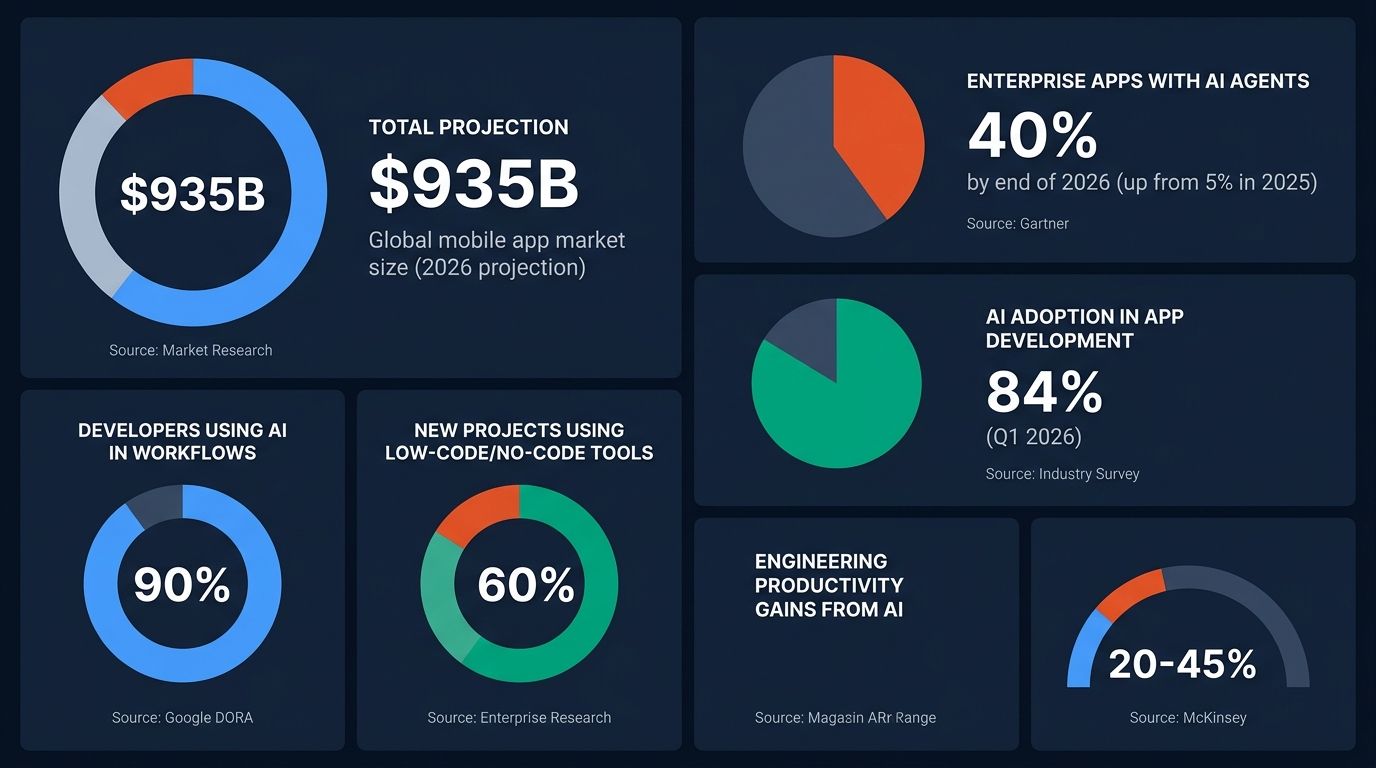
- The global mobile app market is projected to reach approximately $935 billion by end of 2026, growing steadily from previous years.
- Gartner projects 40 percent of enterprise apps will include task-specific AI agents by end of 2026, up from less than 5 percent in 2025. That is an eightfold increase in a single year.
- Google's DORA research found 90 percent of developers now use AI in their workflows, with over 80 percent reporting productivity gains.
- However, roughly 30 percent of developers have little or no trust in AI-generated code, and AI adoption correlates with increased delivery instability if pipelines aren't disciplined.
- AI-assisted coding is reducing development timelines by 15 to 20 percent across teams that use it well.
- McKinsey data shows AI tooling delivers 20 to 45 percent productivity gains for engineering teams.
- AI adoption in app development sits at approximately 84 percent as of Q1 2026.
- Low-code and no-code tools now power over 60 percent of new app projects.
- App spending reached $41 billion in a single quarter in early 2026.
- Over 1 billion people are expected to use AI in 2026, the majority through mobile apps.
On-Device AI Is Now the Default, Not the Exception
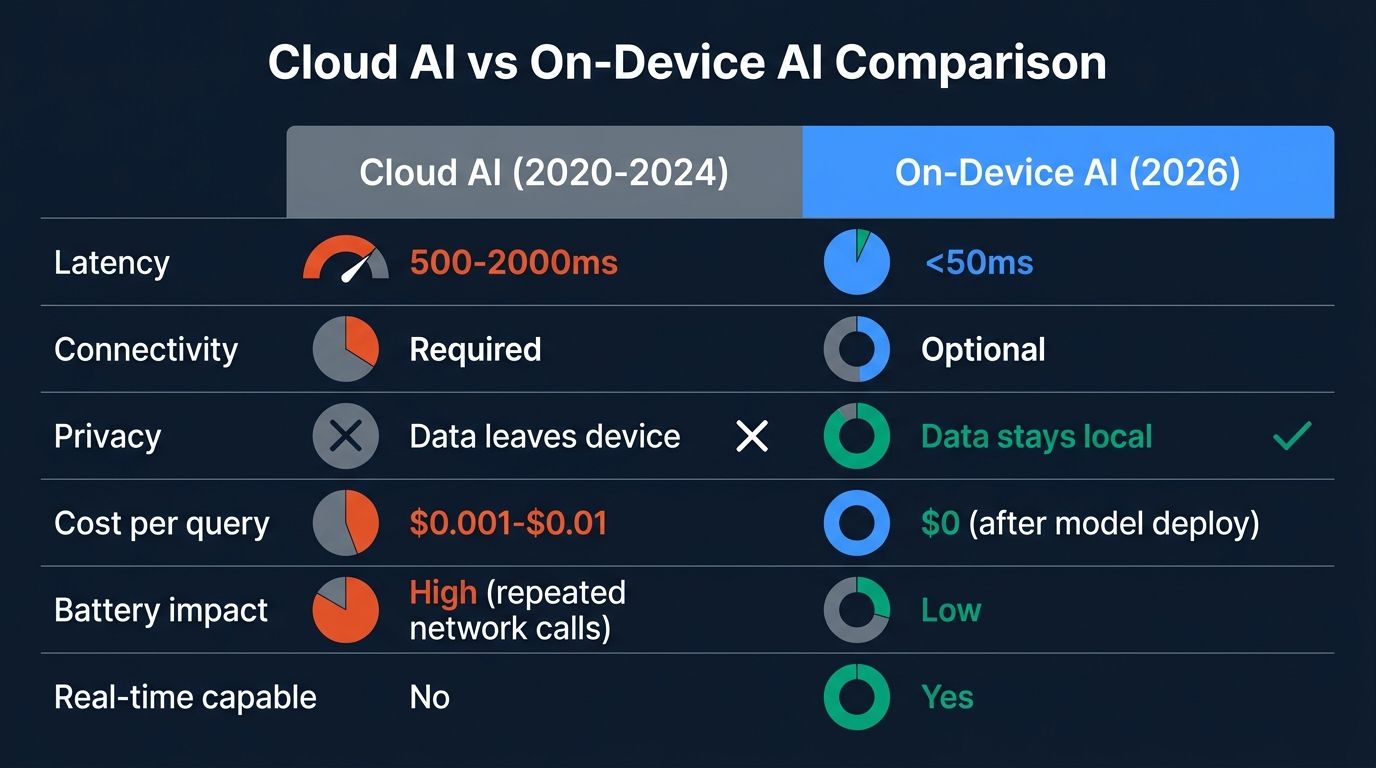
The single biggest shift shaping the future of mobile app development in 2026 is the move from cloud-based AI inference to on-device machine learning. In previous years, an AI-powered app worked like this: user data got sent to a remote server, waited for inference, and the result came back. This meant latency, connectivity requirements, and real privacy concerns.
In 2026, the intelligence stays on the device itself. Apple's Neural Engine, Google's Tensor chips, and Qualcomm's on-device AI processors mean models now run directly on the phone's silicon. The result:
- Zero latency for AI features (no server round-trip)
- Data stays on the device (major privacy win)
- Works offline or with limited connectivity
- Reduced infrastructure costs for app developers
- Better battery efficiency than repeated network calls
Real-world examples deploying on-device AI in 2026:
- Google Photos does real-time image recognition and search entirely on-device
- Apple Journal uses on-device analysis for context-aware writing prompts
- Duolingo runs personalized learning models on-device to adjust difficulty in real-time
- Nothing OS Essential Space processes voice commands and context locally without cloud dependency
- Firebase ML Kit now supports on-device model deployment as a standard feature for third-party developers
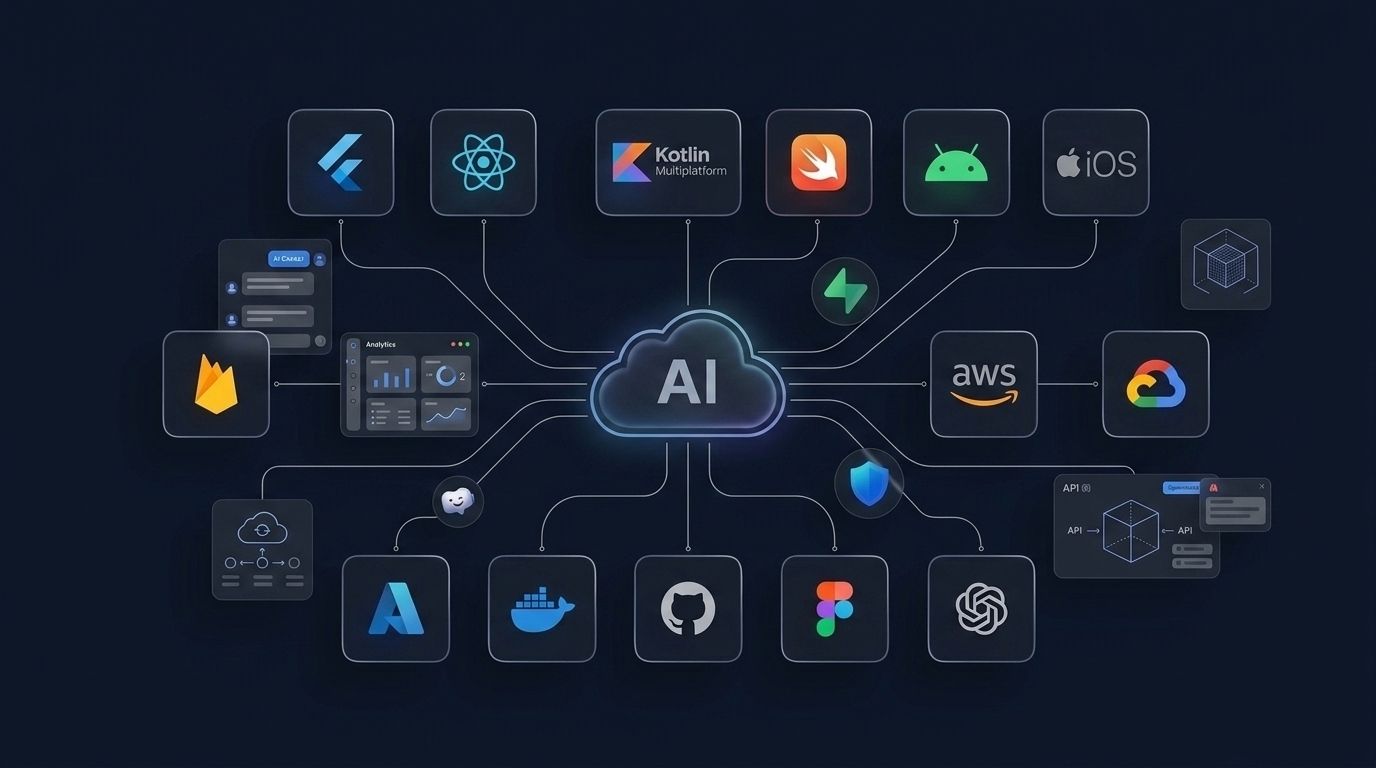
The tools that matter: Core ML for iOS, TensorFlow Lite for Android, MediaPipe for real-time processing, and LangChain-powered recommendation layers integrated with on-device models.
Cross-Platform Development Has Officially Won (Flutter Leads)
The "native vs cross-platform" debate that dominated mobile architecture decisions for over a decade is effectively over in 2026. For the vast majority of business applications, cross-platform is now the smart choice.
The data behind the shift:
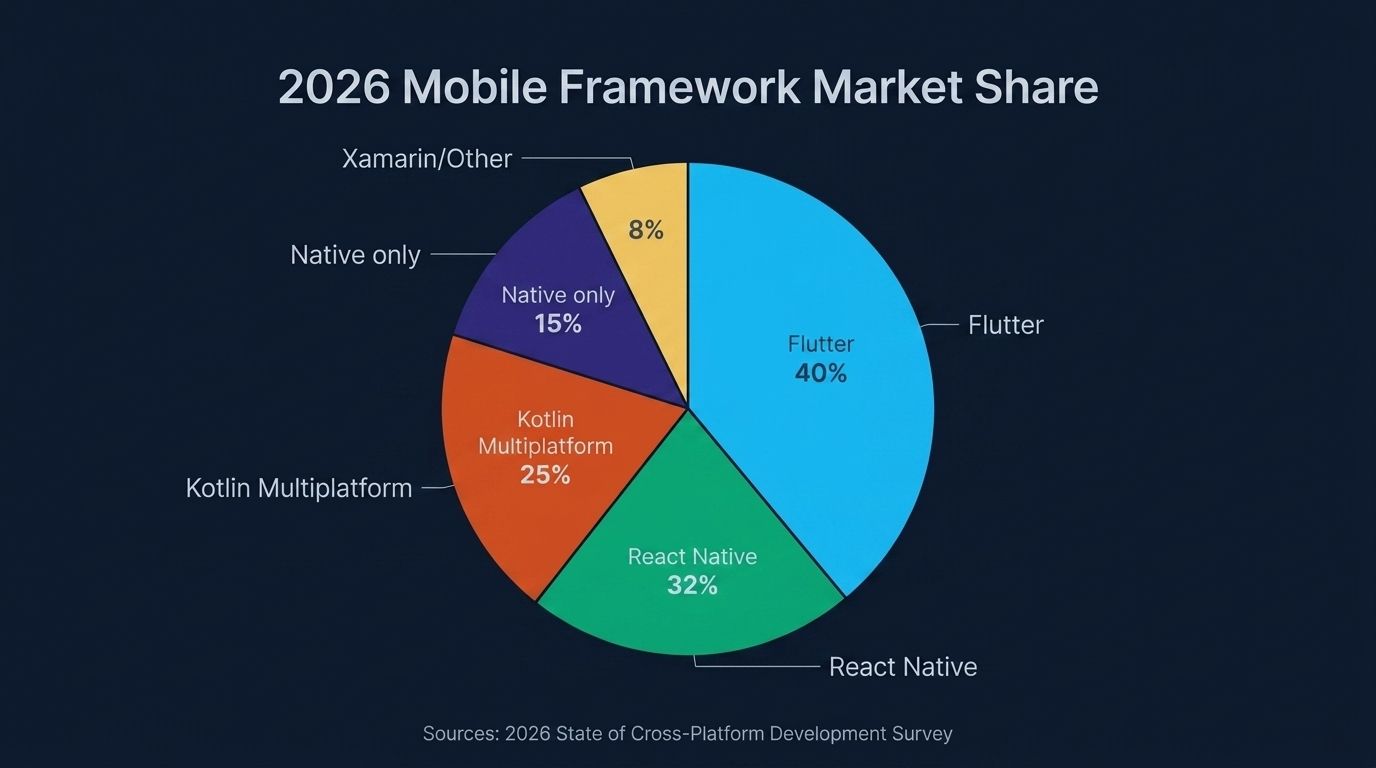
- Flutter holds 40+ percent market share in cross-platform frameworks as of 2026, having overtaken React Native.
- Building separate iOS and Android codebases takes 30 to 40 percent longer to ship.
- Cross-platform delivers no performance advantage in 90 percent of use cases.
- Kotlin Multiplatform is emerging as a third serious contender with over 25 percent adoption among enterprise teams.
Why Flutter took the lead:
- Single codebase for iOS, Android, web, and desktop
- Better performance than earlier cross-platform tools
- Strong Google backing and active investment
- Growing widget library and third-party ecosystem
- Genuine hot-reload speeding up developer iteration
React Native remains completely viable, particularly for teams with existing JavaScript expertise, mature enterprise apps built on the framework, or teams heavily using React on the web.
Kotlin Multiplatform is worth watching for enterprise teams already invested in Kotlin.
Which framework to choose in 2026:
- Flutter: Best for new mobile-first apps, startups, and teams starting fresh
- React Native: Best for JavaScript-heavy teams and web-mobile hybrid workflows
- Kotlin Multiplatform: Best for enterprise teams with existing Kotlin/Java infrastructure
Native iOS or Android: Only for platform-specific apps (gaming, ARKit-heavy apps, or very deep OS integrations)
AI-Assisted Development Is Standard (But Trust Is Still Growing)
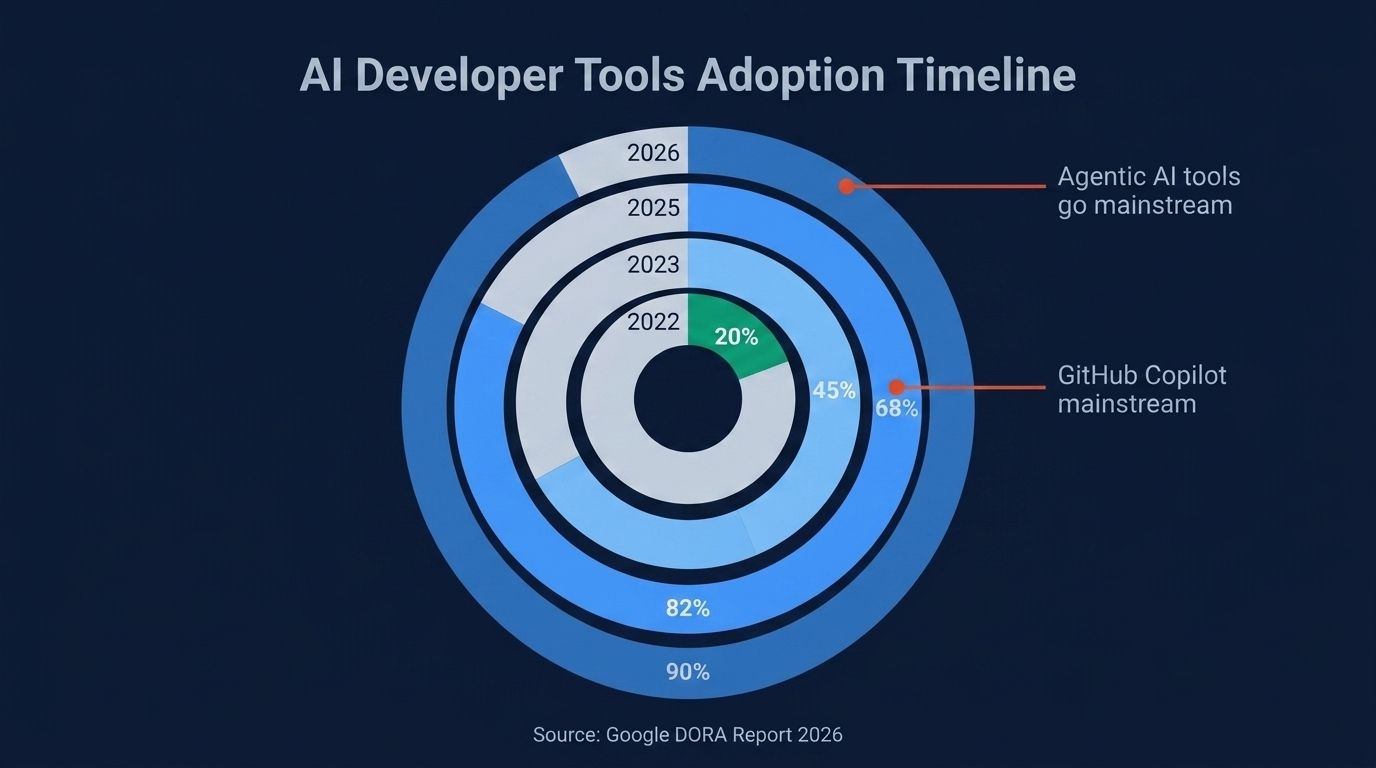
Ninety percent of mobile developers now use AI coding tools in their workflows according to Google's DORA research. This is the fastest technology adoption cycle in software history. But the data also reveals something important: adoption doesn't automatically mean success.
What the DORA data shows:
- 90 percent of developers use AI coding tools
- 80+ percent report productivity gains
- Delivery instability increases with AI adoption on undisciplined teams
- 30 percent of developers have little or no trust in AI-generated code
- Teams that pair AI with strong review pipelines see 15-20 percent faster shipping
- Teams that don't see quality degradation and more production incidents
The tools winning in 2026:
- GitHub Copilot Workspace: Now agentic, reads codebases, resolves dependencies
- Cursor: AI-native code editor with strong context awareness
- Claude Code: Terminal-based AI agent for full development workflows
- Replit Agent: Complete app scaffolding and deployment
- Windsurf: Team-focused AI coding environment
The critical mistake to avoid: Teams that adopt AI tools without disciplined code review processes ship faster but ship worse code. Google's own guidance is blunt: the same AI tool that compounds a disciplined team's output will accelerate a fragmented team's technical debt. Fix your review pipeline before you scale AI tooling.
Super Apps Are Expanding Beyond Asia
Super apps (single platforms that combine messaging, payments, shopping, ride-hailing, and dozens of other services) have dominated Asian mobile markets for years. In 2026, they are genuinely reaching the West.
Real-world super app examples in 2026:
- WeChat (China): Over 1.3 billion monthly active users, integrated payments, shopping, government services, mini-apps ecosystem
- Grab (Southeast Asia): Ride-hailing, food delivery, digital wallet, financial services
- Paytm (India): Payments plus insurance, travel, entertainment, banking
- Rappi (Latin America): Delivery plus banking plus streaming
- X (formerly Twitter, US): Adding payments, video calling, and job listings in an attempted super app pivot
- Meta (US): WhatsApp expanding into business services, payments, and marketplace integration
Why super apps matter for founders in 2026:
- Higher engagement: Users spend 3-5x more time per day in super apps than single-purpose apps
- Better monetization: Multiple revenue streams from one user relationship
- Mini-app ecosystems: Third-party developers build on top, increasing platform lock-in
- Data advantage: Cross-service data enables better personalization
The US market opportunity: Most US markets don't have a dominant super app yet. The window for building category-specific mini-super-apps (finance-focused, health-focused, work-focused) is open in 2026 in ways it won't be in 2028.
Privacy-First Architecture Is a Competitive Advantage
Apple's App Tracking Transparency, Google's Privacy Sandbox, GDPR in Europe, and state-level privacy laws in California, Virginia, Colorado, Connecticut, Utah, and other US states have permanently changed the mobile app data landscape.
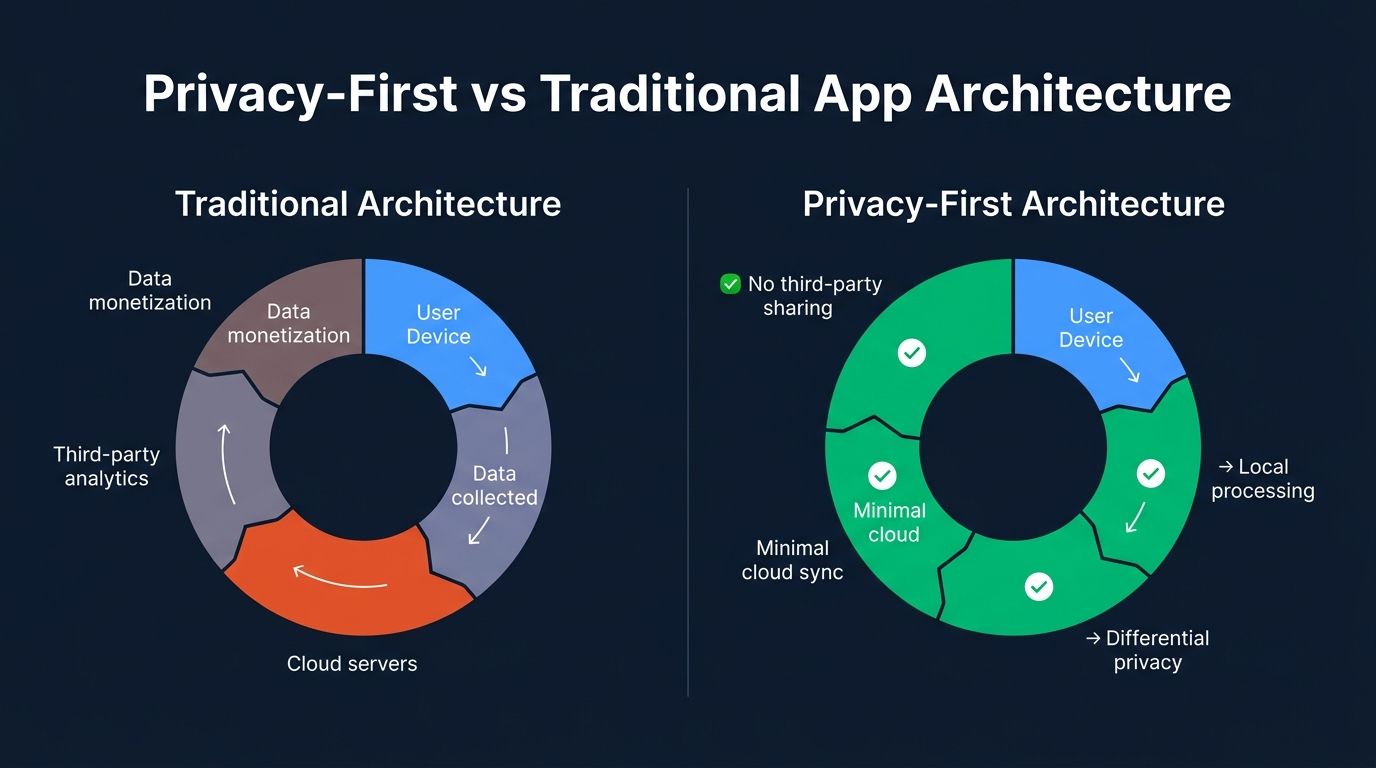
Apps that adopt privacy-first architecture in 2026 gain:
- Higher App Store rankings (Apple actively favors privacy-forward apps)
- Better user trust and reviews
- Lower legal/compliance risk
- Reduced infrastructure costs (less data to store, secure, and audit)
- Better performance (less data collection = smaller data pipelines)
The privacy-first stack for 2026:
- On-device processing for any sensitive data (biometrics, health, financial)
- Differential privacy for aggregate analytics that don't expose individuals
- Encrypted local storage using Apple's Data Protection API or Android's EncryptedSharedPreferences
- Zero-knowledge proofs for authentication where possible
- Minimum data collection principle: collect only what you actually need
Real-world examples:
- Signal: End-to-end encryption is the entire product
- DuckDuckGo Browser: On-device tracker blocking without data collection
- Apple's Journal app: All prompts generated from on-device analysis, nothing leaves the phone
- Proton Mail app: Zero-knowledge encryption architecture
5G Optimization Unlocks New App Categories
5G subscriber counts have grown dramatically in 2026:
- 2.9 billion global 5G subscribers
- 394 million in India, projected to cross 1 billion by 2031
- US 5G penetration at approximately 65 percent of all mobile connections
The bandwidth and low-latency capabilities of 5G unlock app categories that weren't practical before:
- Cloud gaming apps like Xbox Cloud Gaming, GeForce Now, and Netflix Games streaming console-quality games
- Real-time AR experiences with 4K video streaming and multi-user collaboration
- Telehealth with reliable video quality for medical consultations
- Autonomous fleet management apps that require real-time vehicle telemetry
- Live commerce with immersive video shopping experiences
- Remote industrial control for manufacturing and logistics
What this means for developers:
- Design apps that gracefully scale from 4G to 5G rather than requiring 5G
- Consider new features only possible at 5G bandwidth (real-time collaboration, cloud rendering)
- Test on real 5G networks, not just simulators (real-world latency varies significantly)
AR, VR, and Spatial Computing Move From Novelty to Utility
Augmented reality and spatial computing were experimental in 2022. By 2026, they're genuinely useful for specific business categories.
Where AR/VR is genuinely working in 2026:
- Retail: IKEA Place lets users visualize furniture in their home; Sephora Virtual Artist lets users try on makeup; over 90 percent of major US retailers have some form of AR shopping feature
- Real estate: Zillow 3D Home tours, virtual property walkthroughs, Matterport integrations
- Education: Anatomy apps for medical students, mechanical engineering simulations
- Manufacturing: AR-powered instruction manuals for equipment repair
- Healthcare: Surgical training, physical therapy exercise guidance
- Fitness: Immersive workout experiences (Supernatural, Les Mills VR)
The devices that matter:
- Apple Vision Pro: Premium spatial computing device
- Meta Quest 3 and Quest Pro: Mainstream VR/AR
- Google Glass Enterprise: B2B AR for workflow enhancement
- Smartphone AR (ARKit and ARCore): Reaching billions of devices
The reality check: Most consumer AR/VR apps still struggle with retention. Business applications where AR/VR replaces something more expensive or dangerous (training, repair, visualization) show much stronger sustained engagement.
Voice-First and Conversational UI Are Replacing Traditional Navigation
Voice interfaces and conversational AI are moving from "assistant" apps to core navigation methods in mainstream apps.
Real-world implementations:
- Duolingo Max: Full conversation practice with AI in target language
- ChatGPT app: Voice-first mobile experience with real-time dialogue
- Perplexity Voice: Voice-driven search and research
- Notion AI: Voice-driven note taking and document generation
- Instacart: "Order what I usually get" voice-driven shopping
Why this matters for developers:
- Voice adds accessibility (huge for users with mobility limitations)
- Voice interfaces work in contexts where touch doesn't (driving, cooking, exercising)
- Users increasingly expect voice options in complex workflows
- Multimodal input (voice + touch + camera) is becoming standard
Wearables and Connected Device Integration
The wearables ecosystem in 2026 has genuinely matured. Apps that treat wearables as a companion rather than an afterthought are winning.
Real-world integration examples:
- WHOOP, Oura, and Apple Fitness+: Deep health data integration across the day
- Strava: Multi-device workout tracking across watches, cycling computers, cars
- Insulin management apps: Direct integration with continuous glucose monitors
- Sleep tracking: Multi-device data from mattress sensors, watches, phones
- Enterprise IoT apps: Direct control of connected industrial equipment
Key wearable platforms in 2026:
- watchOS 12: Increasingly independent from iPhone, running full apps standalone
- Wear OS 6: Google Pixel Watch and Samsung Galaxy Watch ecosystem
- Fitbit (owned by Google): Health and fitness focus
- Third-party ecosystems: Oura, WHOOP, Garmin, all with growing app SDKs
Foldable Devices Change UI Design
Foldable phones represent 12+ percent of premium smartphone sales in 2026 (up from 3 percent in 2023). This is finally a category worth designing for.
Real foldable devices to design for:
- Samsung Galaxy Z Fold and Flip series: Largest foldable ecosystem
- Google Pixel Fold: Google's flagship foldable
- Huawei Mate X series: Popular in Asian markets
- Motorola Razr foldables: Flip-style rebirth
What developers need to think about:
- Continuity: App state should preserve when device folds/unfolds
- Multi-window: Fold-out mode enables true side-by-side apps
- Aspect ratios: Support both narrow (folded) and wide (unfolded) layouts
- Camera interfaces: Fold-based camera positioning creates unique UI opportunities
- Gesture design: Fold gestures can trigger app actions
What This Means for Founders and Product Leaders in 2026
Not every trend requires investment. Here's the honest priority framework:
Must-do priorities in 2026:
- Adopt AI in your development workflow with disciplined code review
- Build cross-platform (Flutter unless you have a specific reason otherwise)
- Design privacy-first architecture from day one
Should-consider priorities: 4. Add on-device AI capabilities where they matter for your app 5. Optimize for 5G-enabled experiences if your users are on 5G networks 6. Plan for wearable integration if health, fitness, or productivity is core
Watch-and-wait priorities: 7. AR/VR unless your business genuinely benefits from it 8. Voice interfaces unless your use case is naturally voice-driven 9. Super app strategy unless you have platform-level ambitions 10. Foldable-specific design unless you're targeting premium Android markets
Real-World Cost Benchmarks for Mobile App Development in 2026
Honest 2026 pricing you can build a budget around:
- MVP mobile app (single platform, basic features): $30,000: $75,000
- Cross-platform MVP with AI features: $50,000: $120,000
- Mid-complexity commercial app: $100,000: $300,000
- Enterprise-grade app with complex integrations: $250,000: $750,000+
- Super-app-style platform: $500,000: $2M+ initial build
AI development multiplier:
- Teams using AI coding tools well: -15 to -20 percent on development timeline (savings)
- Teams using AI tools without discipline: +10 to +20 percent on total cost (rework)
Common Mistakes Founders Make in 2026
- Chasing every trend at once instead of matching investment to business need
- Building native iOS + Android when cross-platform would work fine (30-40% cost/time waste)
- Skipping privacy engineering until legal requires it (10x more expensive to retrofit)
- Adopting AI tools without pipeline discipline (Google DORA data is clear this hurts more than helps)
- Copying Asian super app models without accounting for Western regulatory and cultural differences
- Building for foldables before your core app works on standard devices
- Ignoring wearables when your app category (health, fitness, productivity) naturally benefits
- Over-investing in AR/VR in categories where it doesn't drive business value
Frequently Asked Questions
Q1: What is the biggest trend in mobile app development in 2026?
AI integration is the single biggest trend, both inside apps (with 40 percent of enterprise apps including AI agents by end of 2026 according to Gartner) and in how apps get built (90 percent of developers now use AI coding tools per Google DORA research). Everything else is a subset of this shift.
Q2: Which framework is best for mobile app development in 2026?
For new projects, Flutter has become the dominant choice with 40+ percent market share among cross-platform frameworks. React Native remains viable for JavaScript-heavy teams, and Kotlin Multiplatform is emerging as a strong enterprise option. Native iOS or Android is only justified for platform-specific apps (gaming, deep OS integration).
Q3: How much does it cost to build a mobile app in 2026?
Costs range widely by complexity. A basic MVP runs $30,000-$75,000 for a single platform, cross-platform MVPs with AI features run $50,000-$120,000, mid-complexity commercial apps run $100,000-$300,000, and enterprise-grade apps with complex integrations run $250,000-$750,000+. Teams using AI development tools well can reduce timelines by 15-20 percent.
Q4: Is native or cross-platform mobile development better in 2026?
For 90 percent of business use cases, cross-platform (particularly Flutter) is the right choice. It delivers no performance disadvantage for typical business apps while saving 30-40 percent on development time. Native development is only justified for platform-specific requirements: high-performance gaming, deep AR integration, or heavy OS-level features.
Q5: Are super apps coming to the US market?
The window is open in 2026 but no dominant US super app has emerged yet. X (formerly Twitter), Meta (via WhatsApp), and a few fintech platforms are attempting super app strategies. Category-specific mini-super-apps (finance, health, work) are more likely to succeed in the US than general-purpose super apps due to regulatory and cultural differences.
Q6: How important is on-device AI vs cloud AI in 2026?
On-device AI is now the preferred architecture for any AI feature involving user data, real-time responsiveness, or offline capability. Cloud AI is still appropriate for very large models, aggregated learning, or capabilities that require server-side data. Most successful 2026 apps use a hybrid approach: sensitive/real-time processing on-device, aggregate learning in the cloud.
Q7: Should I invest in AR/VR mobile features in 2026?
Only if your business genuinely benefits. AR/VR shows strong retention in specific verticals (retail visualization, real estate, medical training, manufacturing) but weak retention in general consumer apps. If you're building a fitness app, an e-commerce app in a visual category, or a professional training app, AR/VR investment likely makes sense. For most other categories, it doesn't.
The Bottom Line
The future of mobile app development in 2026 is defined by AI integration as a core architectural layer, cross-platform dominance led by Flutter, on-device machine learning as the privacy-preserving default, and a growing set of specialized capabilities (5G, AR/VR, voice, wearables, foldables) that matter for specific verticals. Teams that fund three things well in 2026 (AI tooling with disciplined pipelines, cross-platform frameworks, and privacy engineering) will build faster, ship cleaner, and reach more users than teams chasing every emerging trend.
If you're building a mobile app and need help with the marketing, analytics, user acquisition, or growth strategy that sits around it, contact Digitano LLC. We help US businesses turn great mobile apps into successful mobile products through paid advertising, SEO, analytics infrastructure, and growth strategy that actually converts.