Let me start with a number that changes how you should think about software architecture in 2026: Gartner projects that more than 95% of new digital workloads will be deployed on cloud-native platforms by 2028, up from just 40% in 2021. Meanwhile, IDC forecasts worldwide public cloud end-user spending to reach $1.135 trillion in 2026. The question isn't whether cloud-native application development is the future. It's whether your organization is capturing the benefits others are already banking, or watching competitors ship faster and scale better because they made the move earlier.
This guide walks through exactly what cloud-native application development is, why it delivers measurably better outcomes than traditional development, and what US businesses need to know before adopting it. If you'd rather have an experienced team help you evaluate cloud-native architecture for your organization, our digital marketing services and consulting work at Digitano LLC include this kind of technical strategy for organizations serious about modernization.
What Is Cloud-Native Application Development?
Let's start with a straightforward definition, since this term gets used loosely. Cloud-native application development means building applications specifically designed to run on cloud infrastructure from day one, rather than simply moving traditional applications to a cloud provider (which is called "lift and shift").
Cloud-native applications typically share five core characteristics defined by the Cloud Native Computing Foundation (CNCF):
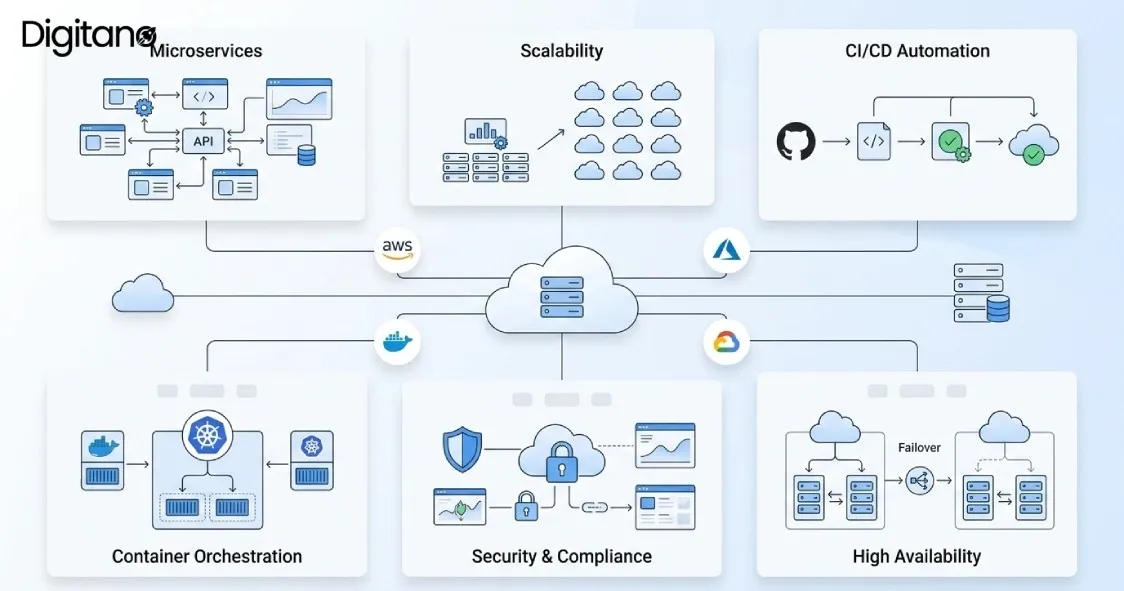
- Containers. Applications are packaged into lightweight, portable containers (usually via Docker) that run identically across any environment.
- Microservices architecture. Instead of one large monolithic codebase, applications are broken into small, independent services that communicate over APIs.
- Container orchestration. Kubernetes or similar platforms automatically manage container deployment, scaling, and healing.
- Continuous integration and continuous deployment (CI/CD). Code changes flow from development to production through automated pipelines that test and deploy multiple times per day.
- Declarative APIs and infrastructure as code. Infrastructure is defined in version-controlled code rather than manually configured.
The distinction from "cloud-based" is important: a traditional application running on AWS EC2 is cloud-based but not cloud-native. A containerized microservices application running on Kubernetes with automated CI/CD pipelines is cloud-native. The architectural difference is what unlocks the benefits below.
The State of Cloud-Native Adoption in 2026
Before jumping into benefits, let's ground the conversation in real, sourced adoption data:
- 95%+ of new digital workloads will run on cloud-native platforms by 2028, per Gartner's cloud-native forecast
- $1.135 trillion in projected worldwide public cloud spending for 2026 (IDC forecast)
- Over 66% of SMBs will adopt cloud-native technologies by 2026, per Coherent Market Insights industry research
- $15.06 billion current cloud-native software market size, projected to reach $124.37 billion by 2033 at 35.2% CAGR (Coherent Market Insights)
- 95% of organizations use containers in production according to the CNCF 2024 Annual Survey
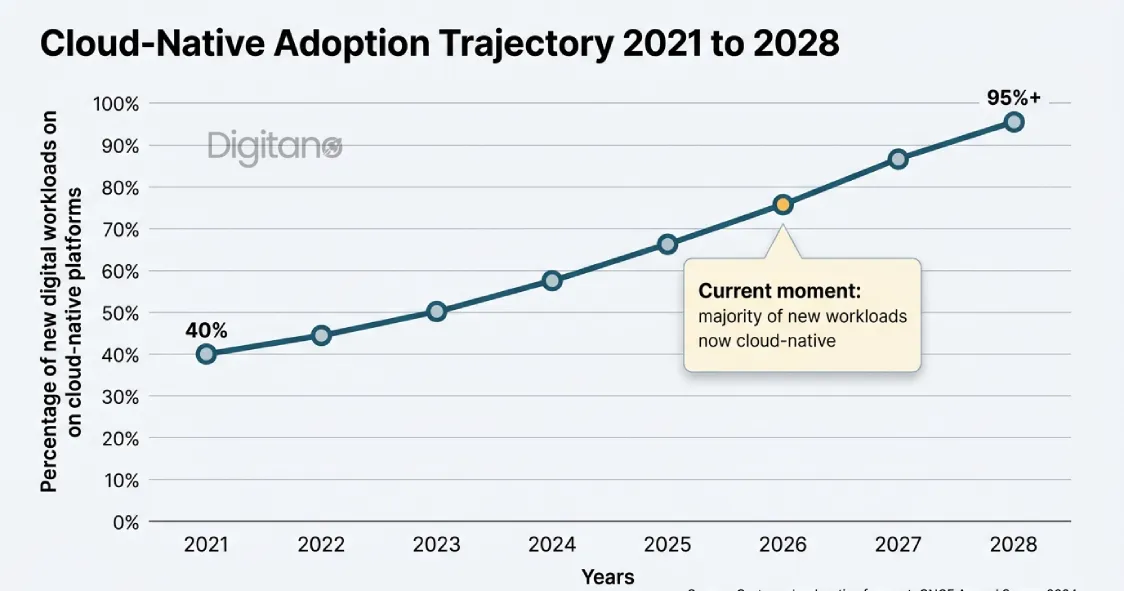
The picture is unambiguous: cloud-native isn't an emerging trend anymore. It's becoming the default for new application development, particularly in the US market where cloud adoption leads globally.
Faster Time to Market
The single most measurable benefit of cloud-native development is dramatically faster deployment velocity. Because applications are broken into small, independently deployable services, teams can ship features without coordinating a full application release.
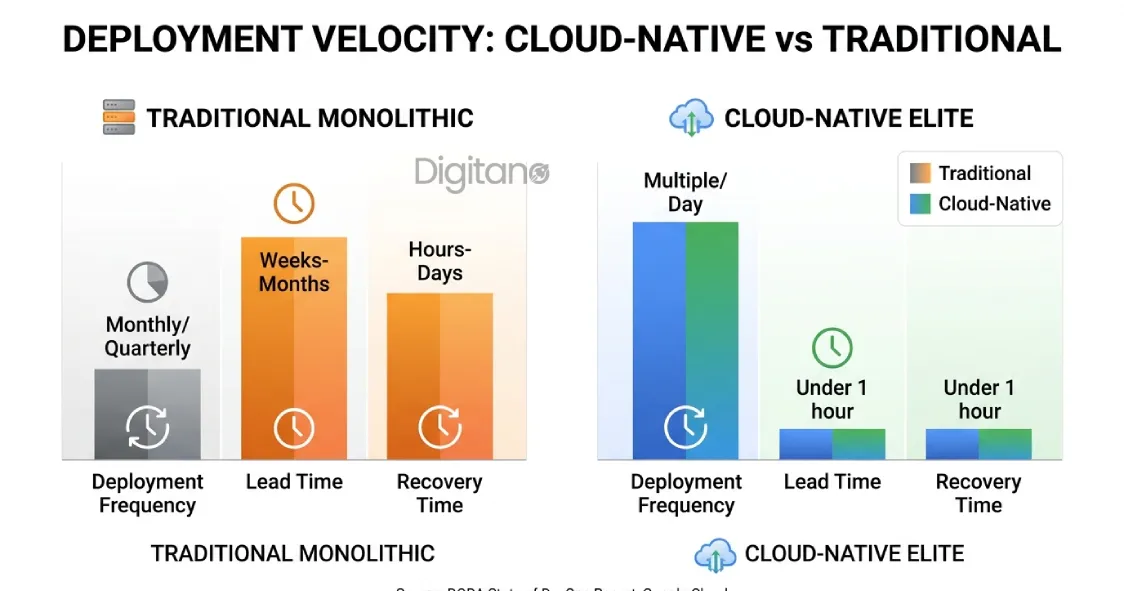
The DORA State of DevOps Report has consistently shown that elite performing teams deploy code multiple times per day, while low-performing teams deploy less than once every six months. That 100x+ deployment frequency gap correlates directly with cloud-native architectural patterns:
- Elite teams: Lead time from commit to production under one hour
- Elite teams: Change failure rate under 5%
- Elite teams: Mean time to recovery under one hour
Compare that to traditional monolithic applications where a single deployment might take weeks of coordination, testing, and downtime windows. The productivity difference isn't marginal. It's transformational.
Elastic Scalability
Traditional applications require capacity planning: you provision infrastructure for peak load and pay for it 24/7 even when demand drops. Cloud-native applications scale automatically based on actual demand, up during traffic spikes and down during quiet periods.
The practical impact for US businesses:
- E-commerce sites handle Black Friday traffic surges without pre-provisioning expensive infrastructure that sits idle 11 months per year
- SaaS platforms scale to accommodate new customer growth without infrastructure planning cycles
- Streaming services handle real-time event spikes (sports finals, product launches) without service degradation
- Startups can grow from 100 users to 10 million without rearchitecting
Cost analysis from Gitnux's 2026 cloud adoption research shows cost reductions ranging from 10% to 30% through governance-driven cloud management, and up to 20% to 40% from overall IT cost cuts when organizations properly implement cloud-native patterns.
Resilience and Fault Isolation
In a traditional monolithic application, a bug in one feature can bring down the entire system. In cloud-native microservices architecture, failures stay isolated within a single service. Your payment service might have an issue, but your product catalog and user authentication continue working.
Combined with container orchestration platforms like Kubernetes that automatically restart failed containers, cloud-native applications can achieve genuinely high availability. Major cloud providers offer service-level agreements at 99.9% or higher for properly architected cloud-native workloads.
Key resilience patterns cloud-native enables:
- Automatic health checks and restarts for failed services
- Load balancing that routes traffic away from unhealthy instances
- Multi-region deployment for disaster recovery
- Blue-green and canary deployments that let you roll back instantly if issues arise
- Circuit breakers that prevent cascading failures across services
Cost Optimization at Scale
The cloud-native cost story is nuanced. Cloud-native isn't automatically cheaper than traditional infrastructure. But when properly implemented, it delivers meaningful cost advantages that grow with scale.
Real 2026 cost optimization data from cloud native production usage:
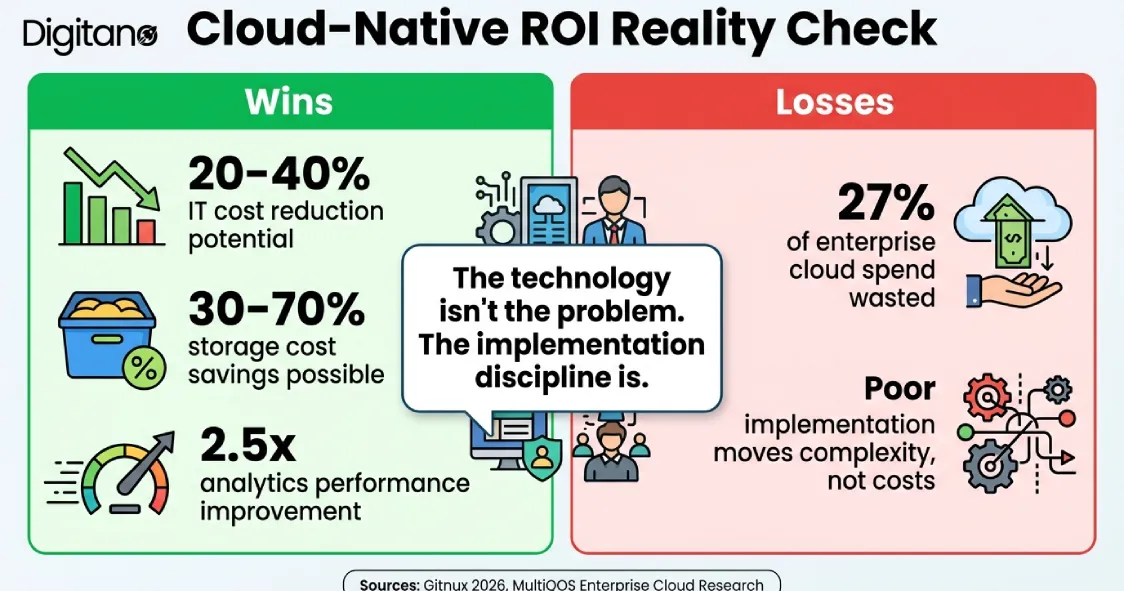
- AWS S3 storage optimization can cut storage costs 30% to 70% for organizations that properly implement lifecycle policies and storage class tiering (Gitnux 2026 cloud research)
- Cloud analytics performance gains improve efficiency by up to 2.5x through optimized architecture
- Overall IT cost reductions of 20% to 40% for organizations that fully adopt cloud-native patterns
However, enterprise cloud spend research shows that 27% of cloud investment is lost or wasted in 2026 due to poor implementation. The teams capturing real cost savings do so through:
- FinOps practices that tie cloud spending to business metrics
- Autoscaling policies that reduce over-provisioning
- Reserved instances and savings plans for predictable workloads
- Serverless functions for irregular workloads
- Multi-cloud strategies to avoid vendor lock-in and negotiate better pricing
Developer Productivity and Retention
This one gets overlooked but matters enormously for US businesses competing for engineering talent. Cloud-native tools and workflows are what modern developers expect to work with. Teams still building monolithic applications with manual deployment pipelines increasingly struggle to attract senior engineers.
The productivity dimensions:
- Faster feedback loops through CI/CD reduce time spent waiting for builds and deployments
- Better local development environments through containerization eliminate "works on my machine" issues
- Clearer service ownership through microservices architecture reduces cross-team coordination overhead
- Automated infrastructure removes toil work that senior engineers hate
The 2026 Cloud-Native Developer Survey from SD Times shows that developer satisfaction ratings are highest at organizations with mature platform engineering practices, with tools like Helm receiving 94% "adopt" ratings and GitHub Actions scoring 45% five-star ratings from familiar developers.
Innovation Speed
Cloud providers now offer hundreds of managed services (databases, machine learning, analytics, IoT platforms, streaming, event handling) that let teams add sophisticated capabilities without building from scratch. Cloud-native architecture makes it easy to integrate these services because everything communicates through standard APIs.
Real-world examples of innovation speed enabled by cloud-native:
- Adding AI/ML capabilities via managed services (AWS Bedrock, Azure OpenAI, Google Vertex AI) in days instead of months
- Integrating real-time analytics through managed streaming services
- Adding global content delivery through CDN services
- Implementing sophisticated authentication and authorization through identity platforms
For US businesses competing against digital-native competitors, this innovation speed matters. Legacy architecture makes every new feature harder to add. Cloud-native architecture makes every new capability easier.
Real Business Examples: Cloud-Native in Action
Abstract benefits only tell part of the story. Here's what cloud-native looks like at real US organizations:
Netflix: The Cloud-Native Pioneer
Netflix's engineering blog has documented their cloud-native journey extensively. They run thousands of microservices on AWS, deploy code thousands of times per day, and handle traffic spikes for hit show launches without infrastructure planning. Their architecture is genuinely considered a reference model for cloud-native at scale.
Capital One: Regulated Industry Cloud-Native
Capital One publicly documented their journey from traditional banking infrastructure to a cloud-native architecture on AWS. As one of the first major US banks to close its data centers entirely, they demonstrated that even highly regulated financial services can operate cloud-native successfully while meeting compliance requirements.
Airbnb: Marketplace at Global Scale
Airbnb's engineering team runs on a cloud-native architecture that handles massive traffic variations across global markets. Their engineering blog documents the architectural patterns that let them serve millions of hosts and guests reliably.
These aren't outlier cases. They're what becomes possible when organizations commit to cloud-native architecture as a foundational business decision, not a technology experiment.
The Uncomfortable Truth: Cloud-Native Isn't Automatic Success
Being honest here matters more than pushing an unqualified positive story. Cloud-native transformation projects fail regularly, and the failure modes are well-documented:
- 27% of enterprise cloud spending is wasted in 2026 due to poor implementation
- Complexity increases meaningfully compared to monolithic applications
- Skills gap challenges as containers, Kubernetes, and microservices require different expertise
- Legacy modernization difficulties where the effort to rearchitect exceeds the ROI
- Security surface area grows as distributed services introduce new attack vectors
The MultiQOS enterprise cloud research puts it directly: "If you do not realize the need to account for technical debt, then cloud adoption won't eradicate it. It just moves from on-prem servers to the cloud, where it exponentially grows."
The organizations capturing real ROI from cloud-native have three common traits: they treat modernization as a business strategy (not an IT project), they invest heavily in team upskilling, and they measure outcomes with rigor.
Practical Framework: How to Actually Adopt Cloud-Native
Based on patterns that work in 2026, here's a practical seven-step framework:
1. Portfolio assessment first, technology selection second. Map every application in your portfolio with a TCO calculation. Categorize into retire, replatform, refactor, or rebuild. Cloud-native investment goes to applications with business criticality and expected longevity.
2. Start with new applications, not legacy migrations. Building new applications cloud-native is meaningfully easier than rearchitecting legacy monoliths. Get organizational experience with cloud-native patterns on greenfield projects first.
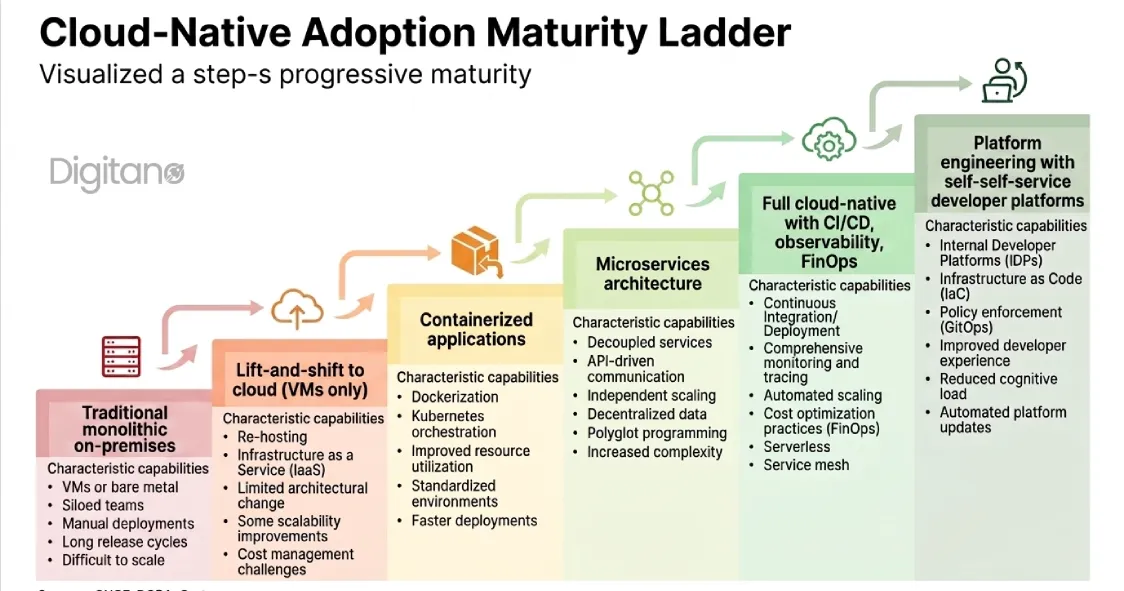
3. Invest heavily in platform engineering. Rather than every team building their own Kubernetes expertise, mature organizations build platform teams that provide internal developer platforms. This dramatically reduces the skills burden across product teams.
4. Adopt observability from day one. Distributed microservices are meaningfully harder to debug than monoliths. Comprehensive logging, metrics, and distributed tracing aren't optional. Tools like Prometheus, Grafana, and OpenTelemetry (from the CNCF landscape) are the current standards.
5. Build security into every layer. Cloud-native security isn't just perimeter security. It's identity-based, layered, and continuous. Concepts like zero-trust networking, service mesh (Istio, Linkerd), and shift-left security scanning matter here.
6. Measure DORA metrics from the start. Deployment frequency, lead time for changes, change failure rate, and mean time to recovery are the four metrics that separate high-performing teams from low-performing ones.
7. Plan for multi-cloud strategically. Gartner predicted 70% of enterprises would run on multiple clouds by 2025. Building portable cloud-native applications (containers work anywhere) provides negotiating leverage and reduces vendor lock-in.
Common Cloud-Native Mistakes
Based on patterns from 2026 industry analysis:
- Assuming lift-and-shift is cloud-native. Moving VMs to the cloud without architectural changes captures maybe 10% of possible benefits.
- Adopting Kubernetes without platform engineering. Kubernetes without a platform layer creates enormous operational burden for product teams.
- Fragmenting into too many microservices too fast. "Distributed monoliths" are worse than the monoliths they replace.
- Skipping observability investment. Distributed tracing, logging, and metrics aren't optional for cloud-native operations.
- Ignoring FinOps discipline. Cloud costs spiral without dedicated financial management for cloud spending.
- Treating security as a phase, not a discipline. Security scanning, secrets management, and identity management must be integrated throughout the pipeline.
- Underestimating training investment. The skills gap between traditional and cloud-native development is real. Budget for real training, not just tool licenses.
The Real ROI: What Cloud-Native Delivers
For a mid-sized US business with roughly $10 million in annual IT spend, mature cloud-native adoption typically delivers:
- 20-40% infrastructure cost reduction through elastic scaling and reserved capacity optimization
- 10-100x deployment frequency improvement enabling faster feature delivery
- 50-90% reduction in incident recovery time through automated healing and rollbacks
- Meaningful developer productivity gains typically 20-30% capacity freed for feature work vs. operational toil
- Improved developer retention in a competitive US engineering hiring market
Total measurable ROI can range from 2-5x within 24 months for well-executed cloud-native transformations. Poorly executed transformations, however, can produce negative ROI, which is exactly why the framework above matters.
Frequently Asked Questions
Q1: What is cloud-native application development?
Cloud-native application development means building applications specifically designed to run on cloud infrastructure using containers, microservices, container orchestration (typically Kubernetes), CI/CD pipelines, and infrastructure as code. It's different from simply hosting traditional applications on cloud infrastructure. The Cloud Native Computing Foundation provides the standard definition and reference technologies.
Q2: What are the main benefits of cloud-native for US businesses?
The primary benefits are faster time to market (elite teams deploy multiple times per day vs. monthly/quarterly for traditional), elastic scalability, fault isolation and resilience, cost optimization at scale (20-40% IT cost reduction for well-executed adoption), improved developer productivity, and faster innovation through managed cloud services. Real ROI typically ranges from 2-5x within 24 months for well-executed transformations.
Q3: How much does cloud-native application development cost?
Cost varies significantly based on scope, team size, and current infrastructure state. For SMBs, entry costs for adopting cloud-native patterns on new applications are typically minimal (mostly training and tool licensing). For enterprise legacy modernization, transformation programs can run into millions of dollars over multi-year timelines. The CNCF landscape includes many open-source options that reduce licensing costs significantly.
Q4: Is cloud-native better than traditional application development?
For new applications, generally yes, though the answer depends on specific requirements. Cloud-native delivers meaningfully better deployment velocity, scalability, and resilience for applications that will operate at any meaningful scale. However, cloud-native introduces complexity that may not be justified for very simple applications or specific use cases (like some embedded systems or applications with strict on-premises requirements).
Q5: What cloud provider is best for cloud-native development?
The three major hyperscalers (AWS, Azure, Google Cloud) all offer comprehensive cloud-native platforms. The choice typically depends on existing organizational relationships, specific service requirements, and cost negotiations. Many enterprises adopt multi-cloud strategies to reduce vendor lock-in. Gartner's Magic Quadrant for Cloud Infrastructure provides regularly updated vendor evaluations.
Q6: What's the biggest mistake companies make with cloud-native?
Adopting cloud-native technologies without changing organizational practices around them. Buying Kubernetes doesn't create cloud-native benefits. Adopting the practices (CI/CD, observability, DevOps, FinOps, platform engineering) around cloud-native technologies does. Companies that try to shortcut the cultural and process changes typically see negative ROI despite significant technology investment.
The Bottom Line
Cloud-native application development has moved from emerging technology to standard practice for new US business applications. The benefits are measurable and meaningful: faster time to market, elastic scalability, better resilience, cost optimization at scale, developer productivity gains, and innovation velocity that traditional architectures simply cannot match. Gartner's projection that 95%+ of new digital workloads will be cloud-native by 2028 reflects a real market shift, not vendor hype.
But cloud-native isn't automatic success. The 27% of enterprise cloud spending that's wasted in 2026, and the many failed transformation programs behind that number, are what happens when organizations adopt technology without changing practices. The businesses capturing real ROI treat cloud-native as a business strategy, invest heavily in team upskilling, measure outcomes rigorously, and follow proven implementation frameworks.
For organizations evaluating cloud-native transformation, choosing the right architecture, or building the DevOps and platform engineering practices that make cloud-native actually work, contact Digitano LLC. We help engineering and business teams turn cloud-native technology into disciplined, measurable business outcomes that ship better software and reduce operating costs at scale.