Here's a number that should reset your expectations before you build anything: only 0.05% of all startups ever receive venture capital funding. That's five in every ten thousand. And of the tiny slice that does get VC money, 75% never return capital to investors, according to Harvard Business School research analyzing 2,000 venture-backed companies. So when you're figuring out how to build an MVP that attracts investors, you're not competing against the average founder. You're competing against every other pitch that lands in a VC's inbox this week, and you're asking them to bet money on a category where the odds are already stacked against everyone.
The good news is that founders who understand what investors actually look for, versus what they think investors look for, build meaningfully better MVPs and raise capital at meaningfully higher rates. This guide walks through what an investor-ready MVP looks like in 2026, backed by real data from primary sources, along with a practical framework you can apply this quarter. If you'd rather have an experienced team help you build an investor-ready MVP for your startup, our digital marketing services at Digitano LLC include technical strategy for founders navigating pre-seed and seed-stage product development.
What Is an Investor-Ready MVP (And What It Isn't)
Let's start with a clear definition, because "MVP" is one of the most misused terms in startup vocabulary.
A Minimum Viable Product (MVP) is the smallest version of your product that lets you learn something meaningful from real users. Its purpose is validation, not launch. It's a learning tool, not a marketing tool.
But here's where founders get it wrong: an investor-ready MVP has to do double duty. It has to teach you whether the market wants what you're building, and it has to give investors something concrete to evaluate. Those two jobs sometimes pull in opposite directions, which is why so many first-time founders build MVPs that impress neither users nor VCs.
What an investor-ready MVP is:
- Functional enough to demonstrate the core value proposition
- Deployed with real users generating real usage data
- Built with a clear, testable hypothesis about product-market fit
- Accompanied by evidence of demand (waitlist, LOIs, pilot customers, early revenue)
- Technically credible enough that a VC's technical advisor can evaluate it
What an investor-ready MVP is NOT:
- A polished, feature-complete product ("we spent 18 months building this")
- A slide deck describing a product that doesn't exist
- A prototype without any real users
- A clone of a competitor with a minor tweak
- A weekend project
The 2026 Investor Landscape: What the Data Shows
Before jumping into the how-to, let's ground the conversation in what investors are actually funding right now. These 2026 numbers come from named sources you can verify yourself:
- $73.6 billion poured into GenAI application startups in the first three quarters of 2025 (DigitalSilk 2026 report)
- Only 0.05% of startups receive VC funding, per Harvard Business School research cited in WSJ
- Only 12% of venture-backed startups raise a Series A round (Zipdo 2026 data)
- $1.3M median seed round size for VC-backed startups in 2026 (Rudys.ai 2026 startup statistics)
- 74% of recorded startup shutdowns occurred at pre-seed or seed stage, per Carta 2024 shutdown data referenced in Preuve AI research
- 95% of generative AI pilot projects in enterprises fail to deliver measurable ROI, per MIT NANDA research cited by DigitalSilk
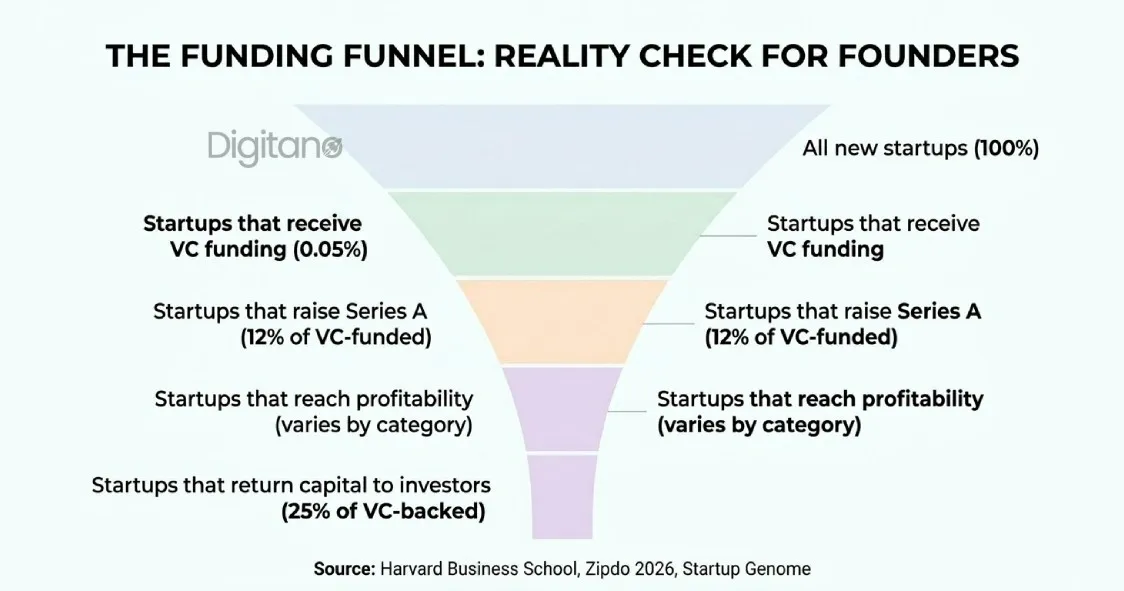
The picture is clear: raising investor capital is genuinely hard, and building an MVP that attracts investors requires you to think differently from founders who build for users alone.
Why Most MVPs Fail to Attract Investors
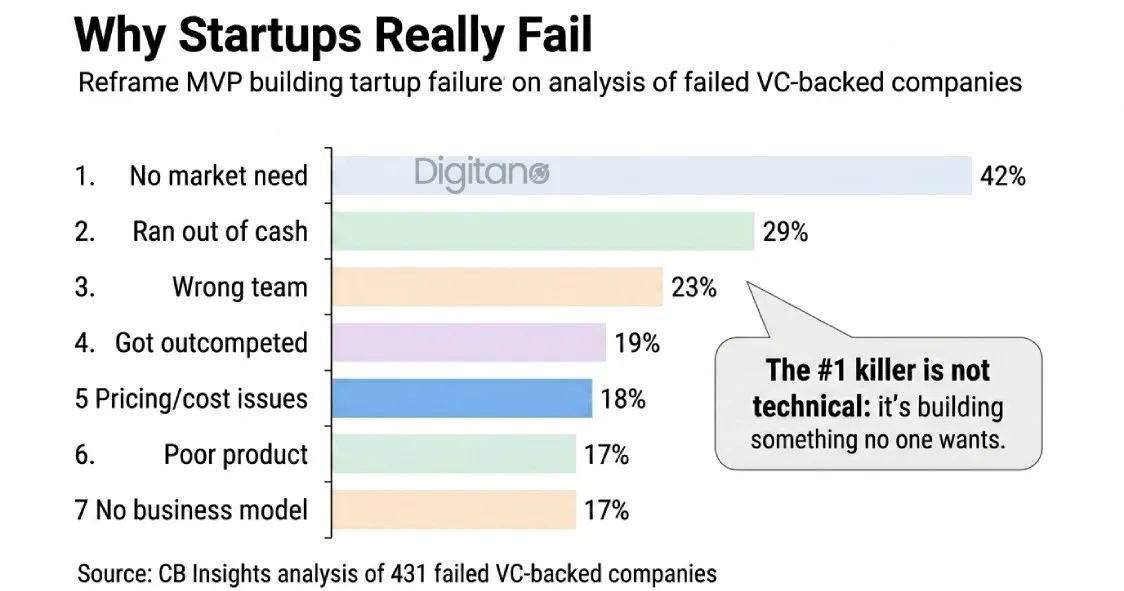
Understanding failure patterns helps you avoid them. Based on CB Insights research on 431 failed VC-backed companies, here are the top reasons startups fail, which map directly to MVP mistakes:
- 42% fail because there's no market need for the product (the number one killer)
- 29% run out of cash (usually the symptom of building the wrong thing for too long)
- 23% had the wrong team
- 19% got outcompeted
- 18% had pricing/cost issues
- 17% built a poor product
- 17% lacked a business model
The takeaway: the biggest MVP failure is technical excellence solving the wrong problem. Investors know this because they've watched it happen dozens of times, so they're specifically looking for evidence that you're solving a real problem for real customers who will pay.
What Investors Actually Look For in an MVP
This is the section where most content gets vague. Let me be specific about what actually convinces VCs in 2026.
1. Evidence of Real Demand (Not Just Interest)
Interest is worthless. Demand is money. Every credible early-stage investor draws this distinction sharply.
Signals of real demand investors will actually value:
- Paying customers, even at small scale ($100 in real revenue beats a 10,000-person waitlist)
- Letters of intent or signed pilot agreements from named enterprise customers
- Retention data showing users come back (weekly active user rate is the gold standard)
- Word-of-mouth referrals appearing organically without paid acquisition
- Willingness to pay demonstrated through pre-orders or paid pilots
Signals investors will discount heavily:
- Waitlist size without conversion evidence
- Total downloads or signups (vanity metrics)
- Social media followers or press mentions
- Free trial numbers without paid conversion rates
2. Clear Product-Market Fit Trajectory
Product-market fit (PMF) is what separates fundable startups from unfundable ones. According to Rudys.ai's 2026 startup research, startups that achieve product-market fit grow 5× faster than those still searching for their core value proposition.
Signals of emerging PMF that investors look for:
- Net Promoter Score (NPS) above 40 from active users
- Retention curves that flatten rather than continuously decline
- Customer conversations that shift from "explain what you do" to "when can I have more"
- User pull rather than push (users request features rather than churning)
3. Technical Credibility Without Over-Engineering
Investors want to see that you can build, but they don't want to see six months of engineering polish before you've validated the market. The sweet spot is a functional MVP that shows technical competence without demonstrating that you've been building the wrong thing longer than necessary.
The specific technical signals investors evaluate:
- Clean, maintainable code architecture (they'll have a technical advisor look)
- Modern, scalable stack choices that don't create expensive rewrites later
- Security fundamentals (particularly for consumer or enterprise data products)
- Basic observability and analytics so you can measure what's happening
- Deployment discipline (CI/CD, versioned code, real infrastructure)
Notice what's not on the list: perfect UI polish, comprehensive feature sets, or extensive documentation. Those come later.
4. Founder-Market Fit
Increasingly important in 2026: why you are the right person to solve this problem. Investors bet on founders as much as ideas. Signals of founder-market fit:
- Deep domain expertise or lived experience with the problem
- Existing network within the target market
- Prior startup experience (though not required)
- Technical skills that let you build without needing to hire immediately
5. Path to Meaningful Scale
Investors need to see that if the MVP works, you can build a $100M+ business. This is where market size, business model economics, and defensibility come in.
The specific things VCs evaluate:
- Total addressable market (TAM) with genuine bottom-up analysis
- Unit economics that improve at scale (CAC decreasing, LTV increasing)
- Defensibility (network effects, data advantages, switching costs)
- Scalable business model (SaaS, marketplace, or transaction economics that work)
The Framework: Building an MVP That Attracts Investors
Based on what works for founders who successfully raise seed capital, here's a practical framework you can follow.
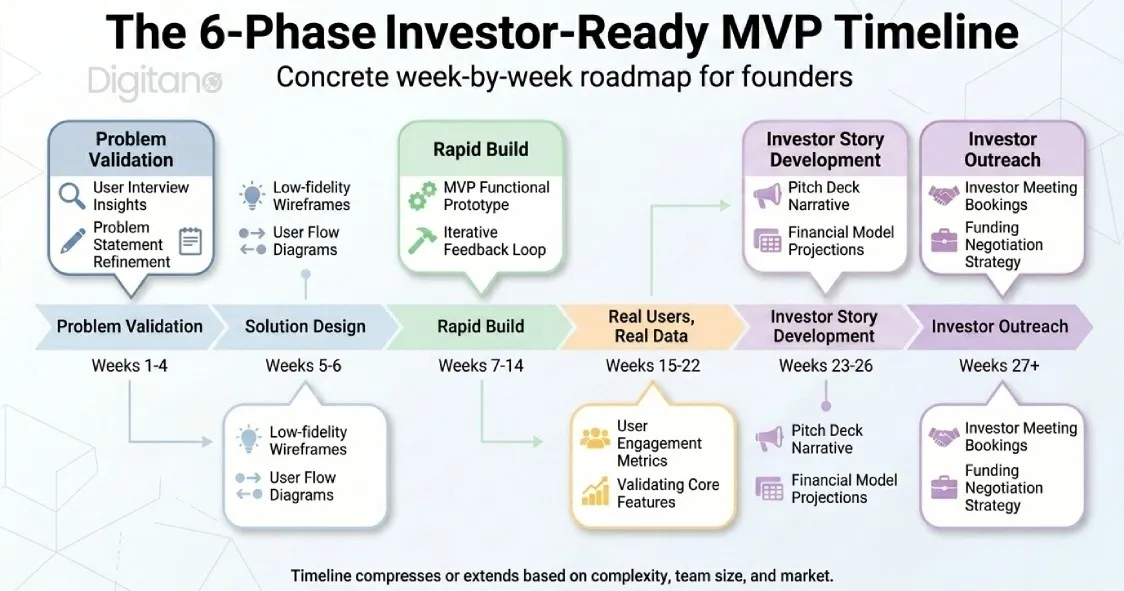
Phase 1: Problem Validation (Weeks 1 to 4)
Before writing a single line of code, prove the problem exists and is worth solving. This is where 85% of startups that launch an MVP first are more likely to achieve successful scaling, but only if the MVP addresses a validated problem.
Specific activities:
- Interview 30 to 50 target customers about their current workflow and pain points
- Analyze how they solve the problem today (spreadsheets, hacks, competing tools)
- Quantify the pain (time cost, dollar cost, frustration level)
- Identify the specific segment where the pain is most acute
Deliverable: A written problem statement that names the target customer, the specific pain, and the current alternatives. If you can't articulate this in two sentences, you're not ready to build.
Phase 2: Solution Design (Weeks 5 to 6)
Define what the MVP will and won't do, based on the validated problem.
Specific activities:
- Sketch the user journey from problem to solution
- Identify the one core feature that delivers the value
- Ruthlessly cut everything else from V1 (yes, everything)
- Define what "success" means in measurable terms
Deliverable: A one-page product spec with a single clear "core loop" and success metrics.
Phase 3: Rapid Build (Weeks 7 to 14)
Now build the actual MVP. According to Zipdo's 2026 startup research, startups that launch an MVP within 3 months of ideation have a 55% higher success rate than those that take longer.
Specific guidance for the build phase:
- Use modern frameworks (Next.js, Django, Rails) that let you ship fast
- Use managed services (Supabase, Firebase, Stripe, Twilio) instead of building infrastructure
- Deploy on cloud platforms (Vercel, AWS, GCP) with automated CI/CD from day one
- Instrument analytics from the first user (PostHog, Mixpanel, Amplitude)
- Keep the feature set brutally minimal
Watch out for the biggest trap here: 81% of startups that delay their launch due to "perfectionism" fail within 2 years. If you're polishing, you're procrastinating on the actual test.
Phase 4: Real Users, Real Data (Weeks 15 to 22)
Get real users into the product, gather data, and iterate weekly.
Specific activities:
- Launch to a small target segment (100 to 500 initial users)
- Run weekly user interviews to understand what's working and what isn't
- Track the core metrics: retention, activation, engagement, revenue if applicable
- Iterate the product weekly based on what you learn
- Startups that use customer feedback to iterate within 4 weeks have a 47% lower failure rate
Deliverable: Weekly product data showing retention, engagement, and conversion trends.
Phase 5: Investor Story Development (Weeks 23 to 26)
Once you have real usage data, build the story investors will want to hear.
Specific components:
- A pitch deck with your traction as the centerpiece (not the vision as the centerpiece)
- A demo that shows the working product with real user data
- A financial model that projects unit economics and path to Series A
- A capital plan showing exactly how you'll spend the raise
Phase 6: Investor Outreach (Weeks 27+)
With a validated MVP, real users, and a clear story, you're ready to raise.
Practical tips:
- Warm intros beat cold outreach 10 to 1 (per multiple 2026 fundraising reports)
- Target 30 to 50 investors matched to your stage and sector
- Expect 5 to 10 first meetings, 2 to 4 partner meetings, 1 term sheet
- Plan for a 3 to 6 month fundraising cycle
Real 2026 Startup Examples: MVPs That Attracted Investors
Abstract frameworks only tell part of the story. Here are examples of successful MVPs and what they teach us:
Airbnb: The Ugliest MVP That Worked
In 2007, Brian Chesky and Joe Gebbia rented out air mattresses in their San Francisco apartment to make rent. Their "MVP" was literally three air mattresses and a website called AirBed & Breakfast. What made it fundable wasn't polish. It was real transactions from real customers proving people would pay strangers for accommodation. Their early journey is documented on the Airbnb tech blog.
Dropbox: The Explainer Video MVP
Before writing production code, Drew Houston released a three-minute demo video showing what Dropbox would do. The video drove 75,000 people to sign up for the beta list overnight, proving demand before he'd built the product. That waitlist was the evidence he brought to investors.
Zapier: The Manual MVP
Wade Foster, Bryan Helmig, and Mike Knoop built Zapier's first "automations" manually behind a fake automation interface. Users thought they were getting automated workflows. In reality, the founders were manually triggering integrations. This let them validate that people would pay for the service before building the actual automation engine. Their Y Combinator application journey demonstrated the demand.
The through-line: successful MVPs prove someone wants the thing before optimizing the thing.
Common Mistakes Founders Make With Investor-Ready MVPs
Based on patterns from 2026 startup analysis:
- Building for 6 to 12 months before launching. 92% of startups overestimate the number of users they'll acquire in the first 6 months. Launch early, learn fast.
- Confusing interest with demand. A waitlist proves interest. Paying customers prove demand.
- Pitching before you have traction. Investor conversations without usage data waste both parties' time.
- Optimizing UI polish over core value. VCs know good design can come later. They want to see the core value first.
- Building features to impress investors instead of serving users. The user always wins; investor-only features add complexity without market value.
- Ignoring unit economics. Growth without unit economics is a treadmill. VCs in 2026 specifically look for capital-efficient paths.
- Overspending on team before validating. 61% of startups fail because they ran out of funds, often because they hired before validating.
- Not tracking the right metrics. Vanity metrics (downloads, signups, social followers) don't move investors. Cohort retention, revenue growth, and unit economics do.
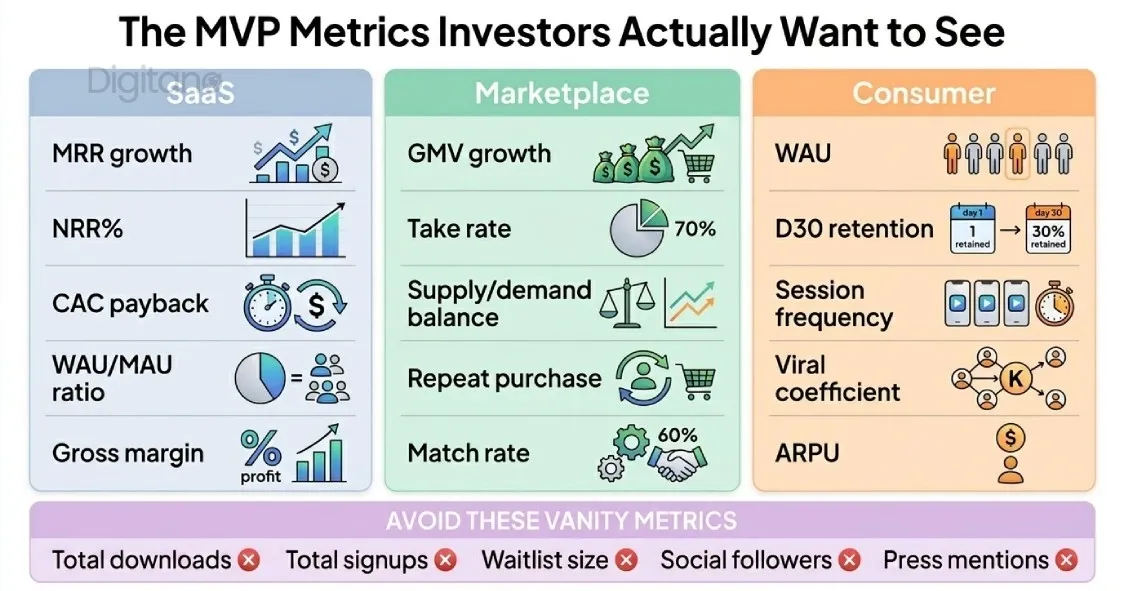
The Metrics Investors Actually Care About
Here's the specific list of what shows up on a 2026 seed-stage pitch deck for a successful fundraise:
For SaaS:
- Monthly Recurring Revenue (MRR) with growth trend
- Net Revenue Retention (NRR) percentage
- Customer Acquisition Cost (CAC) with payback period
- Weekly Active Users / Monthly Active Users ratio
- Gross margin
For marketplaces:
- Gross Merchandise Value (GMV) with growth trend
- Take rate percentage
- Supply/demand balance
- Repeat purchase rate
- Match rate (successful transactions vs. searches)
For consumer apps:
- Weekly Active Users (WAU)
- Day-30 retention rate (elite is 30%+ for consumer apps)
- Session length and frequency
- Viral coefficient (K-factor)
- Revenue per user (ARPU) if monetized
Investors will discount vanity metrics like total downloads or total signups. They want engagement, retention, and revenue.
Frequently Asked Questions
Q1: How long should MVP development take to attract investors?
Ideally 3 to 6 months from ideation to launched MVP with real users. Startups that launch an MVP within 3 months have a 55% higher success rate than those that take longer. Anything over 12 months signals to investors that you're building without validating.
Q2: How much traction do I need to raise seed funding?
For 2026 seed rounds, most investors want to see meaningful usage data. This typically means 100+ engaged users showing retention, or $10K to $50K in monthly recurring revenue, or letters of intent from named enterprise customers. The exact bar varies by category, but "we have an idea and a prototype" almost never raises seed capital anymore.
Q3: What do VCs look for in an MVP presentation?
Real usage data (not projections), evidence of product-market fit (retention curves that flatten, NPS above 40, organic word-of-mouth), a clear customer profile, unit economics that work, and a founder story that explains why you're the right person to build this. The demo comes second to the data.
Q4: Can I raise investor funding without a technical co-founder?
Yes, but it's harder in 2026. If your MVP is software (which most fundable startups are), investors want confidence you can execute. Options include: hiring a strong technical lead before pitching, using no-code/low-code tools to demonstrate you can ship, or having advisors with technical credibility. Solo non-technical founders raise at meaningfully lower rates.
Q5: How do I know if my MVP is investor-ready?
The clearest test: can you show real users doing real things repeatedly? If yes, you're ready to pitch. If you're still explaining your product to potential users, iterating on core features, or lacking retention data, you're not investor-ready yet. Founders who pitch too early waste their investor relationships.
Q6: What's the biggest mistake founders make when pitching their MVP?
Leading with the vision instead of the traction. Investors have heard the vision before. What they haven't seen is your specific traction. Lead with what real users are doing, then explain how that scales into the vision. Founders who reverse this order rarely get to the second meeting.
The Bottom Line
Building an MVP that attracts investors in 2026 isn't about technical brilliance or design polish. It's about proving, with real data from real users, that you've found something people want and will pay for. The founders who successfully raise capital treat their MVP as a validation tool first and a marketing asset second, iterate weekly based on actual user behavior, and lead with traction rather than vision when they pitch.
The 2026 investor landscape is meaningfully more disciplined than the 2021 peak. Investors expect capital-efficient paths to profitability, real evidence of product-market fit, and founders who understand their business economics. The bar is higher, but the framework for clearing it is well-documented. The founders who follow it dramatically improve their odds in a category where most attempts still fail.
For startup founders who need help building an investor-ready MVP, choosing the right technical stack, or developing the metrics story that convinces VCs, contact Digitano LLC. We help founders move beyond ideas into disciplined, measurable product development that captures investor attention and produces real business outcomes.