A practical, honest guide for healthcare providers, clinic managers, and decision-makers who are tired of software that almost works
Here's a scenario that plays out in clinics every single day.
A doctor finishes a patient consultation and turns to her computer to update the records. The off-the-shelf EHR system doesn't match how her orthopedic clinic actually documents cases. So she builds a workaround copy-pasting from one field to another, saving notes in a separate spreadsheet, manually emailing labs to request integrations the system doesn't support. She spends two hours every evening catching up on documentation.
Meanwhile, her front desk team manages appointment scheduling in a different system. The billing happens in a third. None of them talk to each other. Staff spend a significant portion of their day bridging gaps that software was supposed to eliminate.
This is not an unusual story. It is the daily reality for thousands of clinics worldwide and it's the exact problem that custom healthcare software is built to solve.
In 2026, the conversation around healthcare software has fundamentally shifted. It's no longer about whether to go digital. It's about building the right digital infrastructure for how your clinic actually operates.
The Market Is Telling You Something Important
Let's start with the numbers, because they reveal the scale of what's happening.
The global healthcare software market was valued at $42.54 billion in 2026 and is projected to reach $102.98 billion by 2035, growing at a CAGR of 10.34%. Zoom out further and the broader healthcare IT market which includes everything from software to cloud infrastructure was estimated at $390.97 billion in 2025 and is expected to reach $1.69 trillion by 2035 at a 15.76% annual growth rate.
These numbers don't just represent market opportunity. They represent a fundamental truth: healthcare providers globally have recognized that outdated systems are costing them patients, revenue, and staff wellbeing and they're investing heavily to fix it.
What's driving the urgency? Three things.
First, regulatory pressure. Standards like HIPAA in the United States, GDPR in Europe, and HITECH are becoming stricter, not looser. The U.S. 21st Century Cures Act now mandates open API access and data interoperability, forcing health systems to modernize whether they're ready or not. In 2025, 725 data breaches were reported to the Office for Civil Rights, exposing over 133 million patient records. The cost of a single healthcare breach averages $4.4 million, the highest of any industry.
Second, the post-pandemic shift. COVID-19 permanently changed patient expectations. Nearly 96% of U.S. hospitals now enable telehealth services, and 71% of organizations already offering telehealth plan to expand it. Patients who experienced virtual care are not going back to a system that requires them to drive 45 minutes for a 10-minute consultation.
Third, the workforce crisis. The World Health Organization reported a global shortage of 5.3 million healthcare workers as of 2024. Every hour a clinician spends navigating clunky software is an hour not spent on patient care. One study found that doctors spend 34% of their time on administrative tasks and healthcare apps with smart scheduling and digital prescriptions can drastically cut that down.
Generic software cannot fix these problems. It was never designed to.
What Custom Healthcare Software Actually Is
Before going further, let's be clear about what custom healthcare software means because it's often misunderstood.
Custom software doesn't mean building everything from scratch or spending years in development. It means creating a system that is designed around how your clinic actually works, rather than forcing your clinic to adapt to how a software company decided healthcare should work.
A rural family medicine practice has completely different needs than a pediatric surgical center in an urban hospital. A mental health clinic operates differently from an orthopedic rehabilitation unit. Off-the-shelf solutions might handle the basics for either, but they consistently fail at the edges which, in healthcare, is exactly where the most important work happens.
By 2026, a truly custom healthcare solution isn't about minor field customization. It's about purpose-built architecture: clinical workflows designed intentionally, data flows that match real processes, integrations with the systems your team already uses, and security that reflects your actual operational risks, not a generic checklist.
The Types of Custom Solutions Worth Building
Depending on where your clinic's pain points are, custom development can take several forms. Here's an honest look at what each one involves and the real-world impact it delivers.
Electronic Health Records (EHR): The Foundation
EHR systems are the backbone of clinical operations. 96% of U.S. hospitals have now adopted certified EHRs but adoption doesn't mean satisfaction. The complaint heard most often from clinicians is that their EHR was built for billing, not for care.
Custom EHR development builds the system around clinical workflows instead. Specialty-specific templates. Automated documentation that pulls from prior records. Integration with imaging, labs, and prescribing. And increasingly ambient AI that transcribes doctor-patient conversations and drafts clinical notes automatically.
Real-world impact: Ambient AI documentation tools, now being piloted in 2025 and 2026, have been shown to cut documentation time from 2 hours to just 15 minutes in some outpatient clinic settings. That's not a marginal improvement that's a doctor getting back a meaningful portion of their working day to spend with patients instead of paperwork.
The global EHR market is expected to reach $43.36 billion by 2030, and the fastest growth is in purpose-built systems tailored to specific clinical specialties, not one-size-fits-all platforms.
Telemedicine Platforms: Virtual Care That Actually Works
Telemedicine has gone from crisis response to core infrastructure. The global telemedicine market is projected to reach $380.33 billion by 2030 at a CAGR of 17.55%.
But most off-the-shelf telehealth tools hit a ceiling fast. You start with basic video consultations. Then you want to add an AI intake bot. Then connect your EHR. Then pull data from wearables. And the platform either can't do it, or does it badly, or hits you with upgrade fees and months of delays.
Custom telemedicine software is built to grow. You define what it integrates with, how patients authenticate, how clinical notes flow back into the EHR, and how billing connects to the visit from day one.
Real-world example: UCHealth in Colorado launched its Virtual Health Center with a handful of hospitals in 2016. By 2023, using a scalable, custom-built virtual care system, it had expanded across all 12 hospitals in its network handling over 70,000 virtual visits per month, compared to fewer than 20 video consultations when it launched. The scalability came from building the infrastructure correctly at the start, not bolting on features after the fact.
Language access is another area where custom development makes a decisive difference. A study in California found that patients with limited English proficiency used telehealth at just 4.8% versus 12.3% for fluent English speakers. The barrier wasn't medical, it was the software. Custom platforms can be built with multi-language support, simplified interfaces for different literacy levels, and accessibility features for older patients from the ground up.
AI and Diagnostic Software: The New Clinical Partner
AI in healthcare has moved from research labs to clinical workflows. Custom AI diagnostic software uses machine learning to analyze imaging data, patient history, and clinical signals to assist clinicians in diagnosis and treatment recommendations.
Healthcare providers using custom AI solutions built for their specific specialty not general-purpose tools are seeing meaningfully better results. AI diagnostic tools built on specialty-specific training data outperform general models, and they generate fewer false positives that waste clinician time and cause patient anxiety.
Beyond diagnostics, AI is transforming the operational side of healthcare. The global AI in patient scheduling software market grew from $80.55 million in 2025 to $102.82 million in 2026 and is projected to reach $925 million by 2035. Hospitals using AI scheduling tools have achieved up to 50% reductions in patient wait times and 50.7% reductions in missed appointments through predictive no-show modeling that reaches 86% accuracy.
Patient Portals and Engagement Platforms
Patient portals are no longer optional features; they're what patients expect. They want 24/7 access to test results, the ability to message their care team, prescription refill requests, and appointment management without calling a front desk.
Custom patient portals are built to match your specific patient population and clinical workflows. A fertility clinic's portal looks and functions very differently from a pediatric portal and it should. The design, the communication flows, the health tracking features all need to reflect the actual patient journey in your setting.
Practice Management and Billing Software
Administrative inefficiency is quietly one of the most expensive problems in healthcare. U.S. hospitals spend approximately $10 billion annually storing and managing 500 million paper patient records and even with EHR adoption, manual billing, prior authorization delays, and claim errors continue to cost enormous amounts.
Custom practice management software automates billing, insurance claim submissions, patient registration, and financial reporting integrated directly with clinical records so the administrative layer reflects what actually happened clinically. The result is faster reimbursement cycles, fewer rejected claims, and dramatically reduced administrative burden on staff.
The global AI in medical scheduling software market is growing at a 28.14% CAGR through 2035, and practices that implement intelligent scheduling and billing automation are reporting meaningful improvements in both staff satisfaction and revenue capture.
Wearable and Remote Patient Monitoring Integration
The wearable healthcare technology market is one of the fastest-growing segments in healthcare IT. Smartwatches, cardiac monitors, continuous glucose monitors, smart inhalers these devices are generating real-time patient data that clinicians have never had access to before.
The value is only realized when that data flows directly into your clinical system and triggers meaningful actions. A custom integration connects wearable data to patient records, sets automated alert thresholds, and notifies care teams when something requires attention without requiring a patient to come in for a visit they might not need.
Remote patient monitoring has been shown to reduce 30-day hospital readmission rates by up to 20% a number that matters enormously both clinically and financially, particularly under value-based care models where readmissions directly affect revenue.
What You Need to Get Right Before Development Starts
This is where many healthcare software projects go wrong. Not in the development itself, but in the decisions made or not made before a single line of code is written.
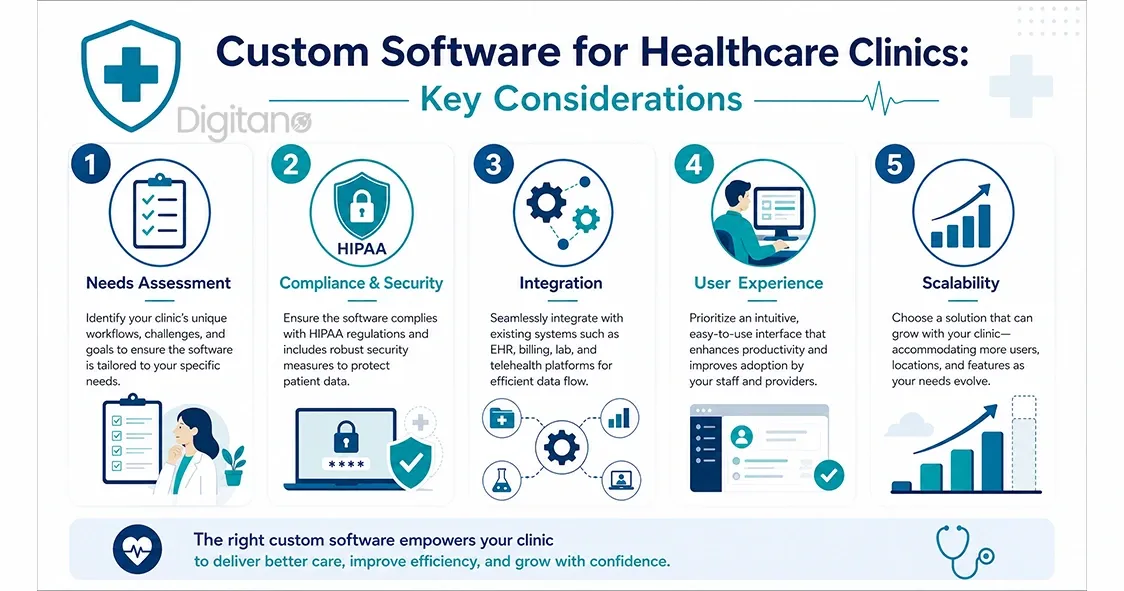
1. Define Your Objective With Painful Clarity
"We need better software" is not a project brief. Before development begins, you need to be specific: which clinical workflows are broken, which administrative bottlenecks are costing money, what patient experience problems are you solving, and how will you measure success.
Every ambiguous requirement becomes a scope change during development which means cost overruns and timeline delays. The clearer your objectives from day one, the more smoothly development proceeds and the better the final product serves your team.
2. Understand Compliance From the Start, Not the End
Regulatory compliance in healthcare is not something you add at the end of development. It has to be baked into the architecture from the beginning.
In the United States, HIPAA governs the protection of patient health information and requires secure storage, transmission, and access control. HITECH strengthens those requirements for electronic records. GDPR applies to any system handling data of EU residents, giving patients full control over how their health information is used. If your software functions as a medical device or supports clinical decision-making, FDA regulations may also apply.
The development partner you choose must have proven experience building HIPAA-compliant systems not just familiarity with the regulations, but a track record of delivering software that has passed compliance audits and withstood real-world security testing. In 2026, good data security is no longer just a regulatory requirement, it's the basis of patient trust, and losing it can end a healthcare organization.
3. Choose Your Development Partner Like You're Hiring a Clinical Partner
This decision often determines whether the project succeeds or fails. The healthcare software market is full of development companies, and not all of them understand what makes healthcare different.
Look for partners with a proven portfolio specifically in healthcare not general enterprise software with one or two healthcare clients. Review their case studies carefully, not just for what they built but for the clinical and operational outcomes their software delivered. Check platforms like Clutch and GoodFirms for independent client reviews. If possible, speak directly with the development company's previous healthcare clients about how the team handled compliance challenges, integration complexity, and post-launch support.
Experience matters because healthcare software has failure modes that general enterprise software doesn't. A billing integration error in an e-commerce app is annoying. The same error in a clinical system can affect patient care, trigger a compliance investigation, or create billing fraud exposure.
4. Plan the Tech Stack for Your Clinical Environment
The right technology choices depend on what you're building, for whom, and where.
For mobile apps, Kotlin and Java are standard for Android, while Swift handles iOS natively. For cross-platform development where both are needed, frameworks like Flutter offer efficiency without sacrificing performance. Backend systems typically run on Node.js, .NET, or Python, with AWS or Azure providing the cloud infrastructure and security controls required for healthcare data.
For data interoperability connecting your custom software to existing EHRs, lab systems, and other clinical platforms HL7 FHIR is the standard that most major systems now support. As of 2026, 67% of hospitals have integrated FHIR-compliant data exchange platforms, and building new software that doesn't speak FHIR is building a dead end.
5. Design for the People Who Will Actually Use It
Healthcare software gets abandoned when clinicians and patients find it more frustrating to use than the process it replaced. User experience isn't a design luxury, it's a clinical safety issue.
Clinicians already face significant burnout. Market data shows that clinicians will bypass any system requiring more than 60 seconds for a standard task. That's not impatience, that's what happens when people have 30 patients to see and software that works against them.
The prototyping phase should always involve actual clinicians: doctors, nurses, medical assistants, and front desk staff who will use the system daily. Their workflow knowledge and pain points are the design brief. The developer's job is to build a system that makes their work faster and less error-prone, not to impose a technical architecture on a clinical environment.
For patient-facing systems, accessibility matters enormously. Different language support, simpler navigation for older patients, and clean interfaces that reduce steps are not nice-to-have features; they directly affect whether patients actually use the system and whether it improves health outcomes.

6. Plan for Integration, Not Replacement
Most healthcare organizations have significant existing technology investments EHR systems, lab systems, medical devices, billing platforms. Custom software should integrate with these systems, not force a rip-and-replace decision that creates massive disruption and risk.
Integration is technically complex. FHIR APIs make it more manageable, but legacy systems often require custom middleware, careful data mapping, and extensive testing to ensure records remain accurate during and after integration. This is not work to underestimate in your planning or budget.
7. Security Cannot Be an Afterthought
Healthcare data is the most valuable target for cyberattackers more valuable on black markets than financial data, because it cannot be changed. The healthcare cybersecurity market is projected to reach $34 billion by 2026, driven by the increasing frequency and severity of attacks on clinical systems.
Minimum requirements for any custom healthcare system include end-to-end encryption for data in transit and at rest, two-factor authentication, role-based access control that limits data access based on clinical role, comprehensive audit logging, and regular penetration testing. These are not optional extras; they are the baseline for operating legally and responsibly in healthcare.
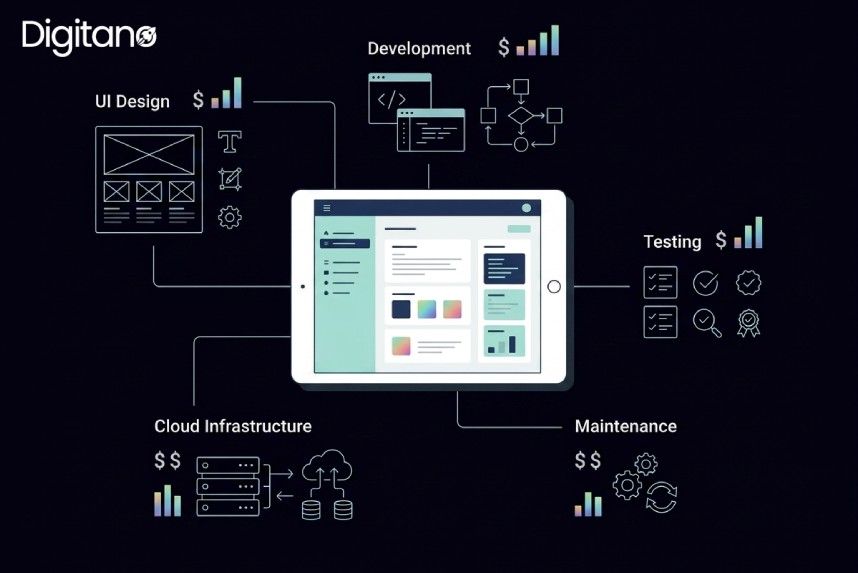
8. Budget for the Full Lifecycle, Not Just Development
Development costs for custom healthcare software range from approximately $30,000 for simpler applications to $500,000 or more for enterprise-grade systems with complex integrations, AI capabilities, and multi-platform support. Those numbers reflect reality, not padding.
But the development cost is only part of the picture. Testing, compliance auditing, staff training, post-launch support, security updates, feature expansions, and scaling infrastructure all carry ongoing costs that are frequently underestimated. Healthcare software is not a one-time purchase, it's an ongoing operational investment. Build that into your financial planning from the beginning.
The Honest Truth About Off-the-Shelf vs. Custom
Off-the-shelf healthcare software has a role. For very small practices with standard workflows and limited budgets, generic solutions can work well enough. They're faster to deploy and have lower upfront costs.
But for any healthcare organization with complexity specialty care, multi-location operations, unique clinical workflows, significant patient volumes, or ambitions for growth, off-the-shelf solutions consistently reveal their limits. The workarounds accumulate. The integrations remain broken. The staff frustration builds. And the cost of those inefficiencies, measured in staff time, billing errors, and patient experience failures, often exceeds what custom development would have cost.
The healthcare providers winning in 2026 are those who invested in building the right infrastructure, not the cheapest one.
Frequently Asked Questions (FAQs)
Q1: What is custom healthcare software and how is it different from off-the-shelf solutions?
A: Custom healthcare software is built specifically for a healthcare organization's unique workflows, clinical requirements, and operational needs. Off-the-shelf software is pre-built for a broad market and designed to work "well enough" for most use cases. The key difference is fit: custom software adapts to how your clinic works, while off-the-shelf software requires your clinic to adapt to how the software was designed. For clinics with specialty care, complex integrations, or specific compliance requirements, that distinction has a direct impact on clinical efficiency, staff satisfaction, and patient outcomes.
Q2: How much does it cost to build custom healthcare software in 2026?
A: Costs vary significantly depending on complexity. Simple custom applications a basic patient portal or appointment scheduling system typically start around $30,000. Mid-complexity systems with EHR integration, telemedicine features, or mobile applications range from $100,000 to $250,000. Enterprise-grade platforms with AI capabilities, multi-system integration, and multi-platform support can reach $500,000 or more. Beyond development, plan for ongoing costs including maintenance, security updates, compliance auditing, and feature expansions. Getting a detailed scope from multiple development partners before committing to a budget is strongly recommended.
Q3: What regulations must custom healthcare software comply with?
A: The key regulations depend on your region and the nature of your software. In the United States: HIPAA protects patient health information and governs storage, transmission, and access. HITECH strengthens HIPAA enforcement and promotes secure EHR adoption. If your software functions as a medical device or supports clinical decision-making, FDA regulations also apply. In the European Union: GDPR governs how patient and personal data is collected, stored, processed, and shared. Healthcare data is also subject to the European Health Data Space directives. For any system handling patient data internationally, understanding which regulations apply from the earliest planning stages and choosing a development partner with proven compliance expertise is essential.
Q4: How long does it take to build custom healthcare software?
A: Timelines vary by project scope. A simple custom application can be developed in 3–6 months. A full EHR system, telemedicine platform, or hospital management system typically takes 9–18 months from requirements definition through testing and launch. Projects with complex integrations to existing systems, AI capabilities, or regulatory approval requirements take longer. Rushing development in healthcare software is a false economy, inadequate testing leads to clinical errors, security vulnerabilities, and compliance failures that cost far more to fix post-launch than they would have cost to prevent.
Q5: What is FHIR and why does it matter for healthcare software integration?
A: FHIR (Fast Healthcare Interoperability Resources) is the international standard for exchanging healthcare information electronically. It defines a common language that different healthcare systems use to share patient data so a custom application can connect to an existing EHR, lab system, or pharmacy platform without needing bespoke integration work for every connection. As of 2026, 67% of hospitals have integrated FHIR-compliant data exchange platforms, and major EHR vendors including Epic, Oracle Health, and Cerner all expose FHIR-based APIs. Building new healthcare software without FHIR support creates a system that can't communicate with the broader healthcare ecosystem, a significant technical and operational liability.
Q6: How do I choose the right software development partner for a healthcare project?
A: Look for four things: healthcare-specific experience (not just general enterprise software), a portfolio of completed projects with real clinical and operational outcomes, independent client reviews on platforms like Clutch and GoodFirms, and demonstrated expertise in HIPAA compliance and healthcare data security. Before signing a contract, request references from previous healthcare clients and speak to them directly about the development process, how the team handled compliance challenges, and the quality of post-launch support. The cheapest development partner is rarely the best choice in healthcare, where the cost of errors is measured in patient safety and regulatory liability, not just project budgets.
Q7: Can custom healthcare software integrate with our existing EHR system?
A: Yes, in most cases though the complexity and cost of integration depend on which EHR system you use and how it exposes data. Systems that support FHIR APIs (most major modern EHR platforms do) are significantly easier to integrate with than legacy systems that require custom middleware or data translation layers. A good development partner will assess your existing systems during the requirements phase and provide a clear technical plan for integration, including data mapping, testing protocols, and validation to ensure patient records remain accurate throughout. Never assume integration will be straightforward, always validate it with a technical assessment first.
Q8: What should I prioritize when building custom software for a small clinic vs. a large hospital?
A: Small clinics should prioritize simplicity, usability, and a tight scope. The most impactful investments are usually a well-integrated EHR, streamlined appointment scheduling, and automated patient communication. Adding complexity before the fundamentals work well is the most common mistake small practices make. Large hospitals or multi-location networks need to prioritize interoperability, scalability, and governance ensuring that data flows correctly across systems, that access controls are appropriate for different roles, and that the architecture can grow without requiring a complete rebuild in 3–5 years. Both should prioritize security and compliance from day one, regardless of size.
Q9: How do I ensure our custom software is actually adopted by clinical staff?
A: The most common reason healthcare software fails is not technical, it's adoption. Clinicians and administrative staff who weren't involved in designing the system often resist using it, especially if it adds friction to their existing workflows. Involve end users from the start: observe how they actually work, include them in prototyping sessions, test with real users before launch, and address the specific pain points they identify. Post-launch, provide proper training and dedicated support during the transition period. And measure adoption, track which features are being used and which aren't, and iterate accordingly. Software that staff don't use delivers no value, no matter how technically excellent it is.
Q10: Is AI worth building into custom healthcare software right now?
A: For the right use cases, yes and 2026 is a genuinely good time to build AI into healthcare systems because the technology has matured significantly. The highest-ROI AI applications in clinical settings right now are ambient documentation (AI that transcribes and summarizes clinical encounters, reducing documentation time from hours to minutes), predictive scheduling and no-show reduction (AI that improves appointment fill rates and reduces waste), and clinical decision support (AI that flags potential drug interactions, abnormal results, or high-risk patients based on their records). For diagnostic imaging and complex clinical decision-making, AI is powerful but requires careful validation, specialty-specific training data, and human oversight protocols. Don't add AI because it sounds impressive, add it because it solves a specific, measurable problem in your clinical workflow.
Final Thought
Custom healthcare software isn't just a technology decision. It's a clinical decision, an operational decision, and a patient care decision wrapped into one.
Done well, it gives clinicians more time with patients. It gives administrators cleaner data and faster processes. It gives patients a healthcare experience that feels designed for them. And it gives your organization the ability to grow and adapt without being held back by systems that were never built for your reality.
Done badly without clear objectives, proper compliance planning, the right development partner, or realistic budgets it creates exactly the kind of mess you were trying to escape.
The difference between those outcomes is mostly what happens before the first line of code is written. Get that right, and the rest follows.