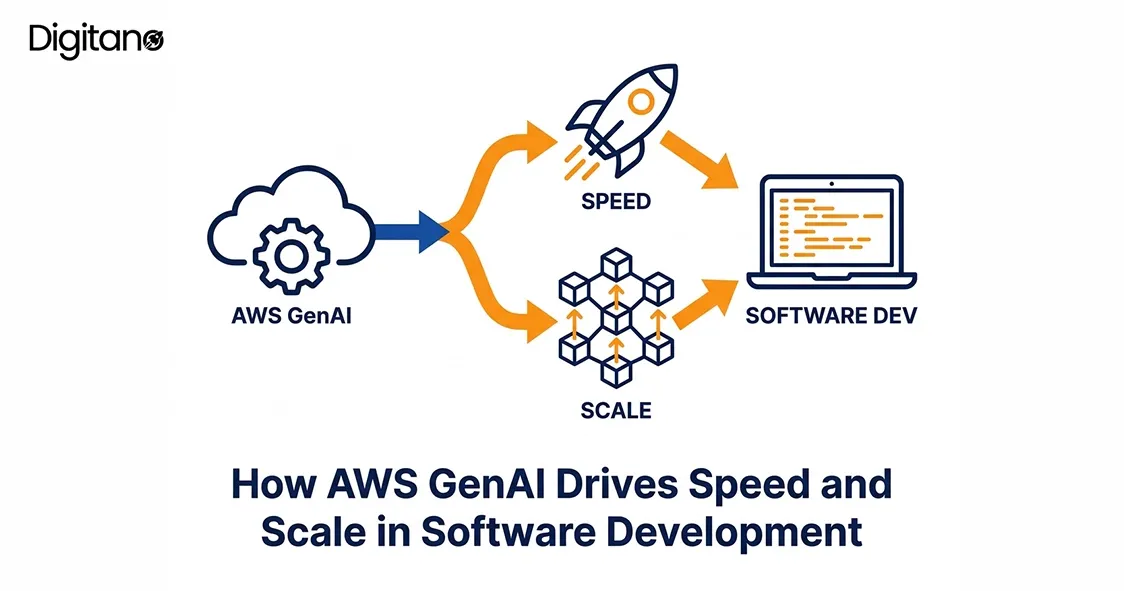
A no-jargon, real-world look at what Amazon's AI tools are actually doing for development teams in 2026 and the numbers that prove it
Let's start with a real story.
A company called Novacomp builds cloud solutions for enterprise clients. Before AWS GenAI tools, their developers spent hours writing boilerplate code, digging through AWS documentation, and manually debugging errors. After adopting Amazon Q Developer, their CTO Gerardo Arroyo said something that stuck: "Using Amazon Q Developer, we can write a lot of applications in hours, with good precision and quality. In the end, that saves money for ourselves and for our clients."
That's not a marketing slide. That's a technology leader describing what changed in their day-to-day work.
Stories like Novacomp's are playing out across thousands of software teams right now. AWS has quietly built one of the most comprehensive AI ecosystems for developers on the planet and in 2026, it's delivering results that were hard to imagine just three years ago.
This blog breaks it all down. What AWS GenAI actually is, how it works in practice, what the real numbers look like, and what it means if you're building software today.
First, the Numbers Because They Tell the Story
Before diving into tools and use cases, let's set the stage with some facts.
The global AI coding assistant market reached $6.8 billion in 2025 and is estimated to hit $8.5 billion by 2026, growing toward $47.3 billion by 2034 at a 24% annual growth rate. Departmental AI spending on coding alone hit $4 billion in 2025 up 4x year over year.
On the developer side: 82% of developers now use AI tools weekly, and 78% say those tools have improved their productivity. Developers save an average of 3.6 hours per week using AI coding assistants. Enterprises that adopted AI code assistants reported 45% higher developer productivity and a 35% reduction in critical bugs.
And here's the AWS-specific headline: organizations implementing generative AI on AWS with partner support achieved an average 240% ROI and $16.5 million in benefits over three years, according to a 2025 Forrester Total Economic Impact study.
Those are the broad strokes. Now let's look at how AWS actually delivers this.
The AWS GenAI Stack What It Is and How It Fits Together
AWS doesn't have one AI product for developers. It has an entire ecosystem. Understanding how the pieces fit together helps you see why companies choose AWS over building on a single tool.
At the top sits Amazon Q Developer, the AI assistant that sits inside your IDE, your terminal, your AWS Console, and even your Slack and Teams channels. Think of it as the developer-facing layer: the thing you talk to when you want code suggestions, explanations, bug fixes, test generation, or help migrating a Java application from an older version.
Below that sits Amazon Bedrock, the platform that powers intelligence. Bedrock gives developers and organizations access to nearly 100 foundation models from providers including Anthropic (Claude), Meta (Llama), Mistral, Amazon's own Nova models, and even OpenAI (via a 2026 integration called Project Mantle). You don't train these models. You use them, customize them with your own data, and build applications on top of them.
Then there's Amazon SageMaker, the deeper layer for teams that need to build, train, and fine-tune their own custom AI models. Where Bedrock is "use existing AI fast," SageMaker is "build your own AI from the ground up."
And finally, the newest addition: the AWS DevOps Agent, announced at re:Invent 2025 an autonomous AI agent that monitors production systems, resolves incidents, and proactively prevents outages. This is AI that doesn't wait to be asked. It acts.
Together, these tools cover the entire software development lifecycle, from the first line of code to production monitoring and incident response.
Amazon Q Developer The AI Pair Programmer That Knows AWS Cold
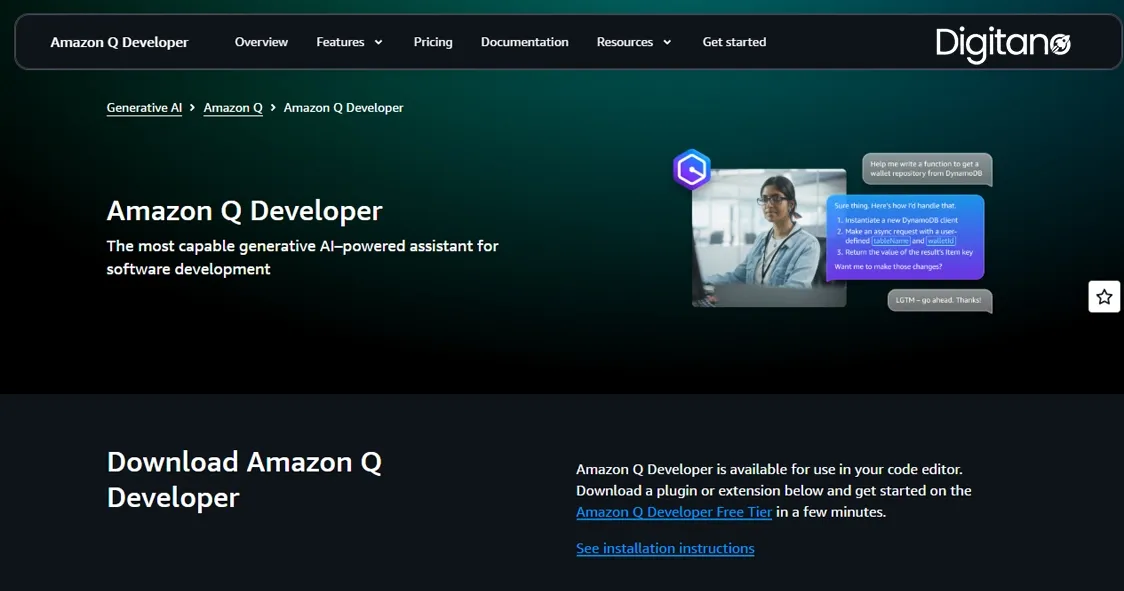
If you've heard of GitHub Copilot, Amazon Q Developer is the AWS equivalent but with a key difference. While Copilot is a general-purpose coding assistant, Q Developer is purpose-built for the AWS ecosystem. It knows AWS services, APIs, best practices, and security requirements at a level no other tool can match.
Here's what that looks like in practice. A developer writing a Lambda function can type a comment in plain English something like "create an S3 bucket with encryption and versioning enabled" and Q Developer generates the correct, secure, production-ready code. No Stack Overflow. No documentation tab. No copy-paste accidents.
The productivity data is compelling. Developers using Q Developer report 20–35% speedups on repetitive and AWS-specific work. In a controlled productivity challenge, users generated code 27% faster with a 57% higher success rate on coding tasks. It also includes a built-in security scanner that catches issues like hardcoded secrets, SQL injection risks, and weak authentication patterns as you type before anything ships.
But the most impressive example of what Q Developer can do isn't from a customer. It's from Amazon itself.
Amazon deployed Q Developer internally to automate the upgrade of tens of thousands of its own production applications migrating Java versions and porting .NET applications from Windows to Linux at a scale that would have taken years of manual engineering effort. The entire operation was completed in a fraction of that time, with substantial performance improvements and cost savings across the company. When a company uses its own tool at that scale and talks about it publicly, that's a meaningful signal.
For pricing context: Q Developer has a free individual tier, and the Pro tier costs $19 per user per month covering advanced agents, enterprise security controls, and higher usage limits.
Amazon Bedrock Where Enterprise GenAI Gets Built
Amazon Bedrock is where the real scale happens. This is what development teams use when they're not just using AI to write code they're building AI-powered products and internal tools.
As of April 2026, Bedrock powers generative AI for more than 100,000 organizations worldwide, from startups to Fortune 500 companies. It provides access to nearly 100 foundation models through a single API, with enterprise-grade security, compliance coverage including HIPAA and FedRAMP High, and a critical promise: Bedrock never stores or uses your data to train its models.
That last point matters enormously for regulated industries like healthcare and finance. It's the reason many enterprises chose Bedrock over alternatives.
One standout capability is Bedrock Guardrails, which can block up to 88% of harmful content and identify correct model responses with up to 99% accuracy to minimize hallucinations. For teams building customer-facing AI features, this kind of reliability isn't optional, it's a prerequisite for shipping.
Real-world example: Rexera, a real estate tech company, uses Bedrock to process 5 million pages of documents every month. The result? They reduced manual document-processing workloads for customers by 99%, saved customers an average of 4 hours per transaction, and lowered operational costs by 25%. After a 2-week proof of concept and 2-week migration, they were fully in production. That's the kind of speed that changes business timelines.
Another example: Multitudes, a New Zealand startup focused on engineering team performance, used Bedrock to build a code review quality feature. After evaluating nearly 1,000 code reviews and using Bedrock to power the analysis, they reduced their misclassification rate from 20% down to less than 1% and increased monthly active users by 44%.
And Availity, a healthcare technology company, built a suite of AI bots using Bedrock and Amazon Q including a Production Readiness Bot that monitors development progress and guides teams through deployment, a Risk Assessment Bot that analyzes releases for security issues, and a Security Bot that scans code automatically. The result: Amazon Q Developer now generates 33% of all code written by their engineering teams, with a 31% code acceptance rate and 19,500 lines of AI-generated code already in production.
The DevOps Agent AI: That Fixes Production Problems While You Sleep
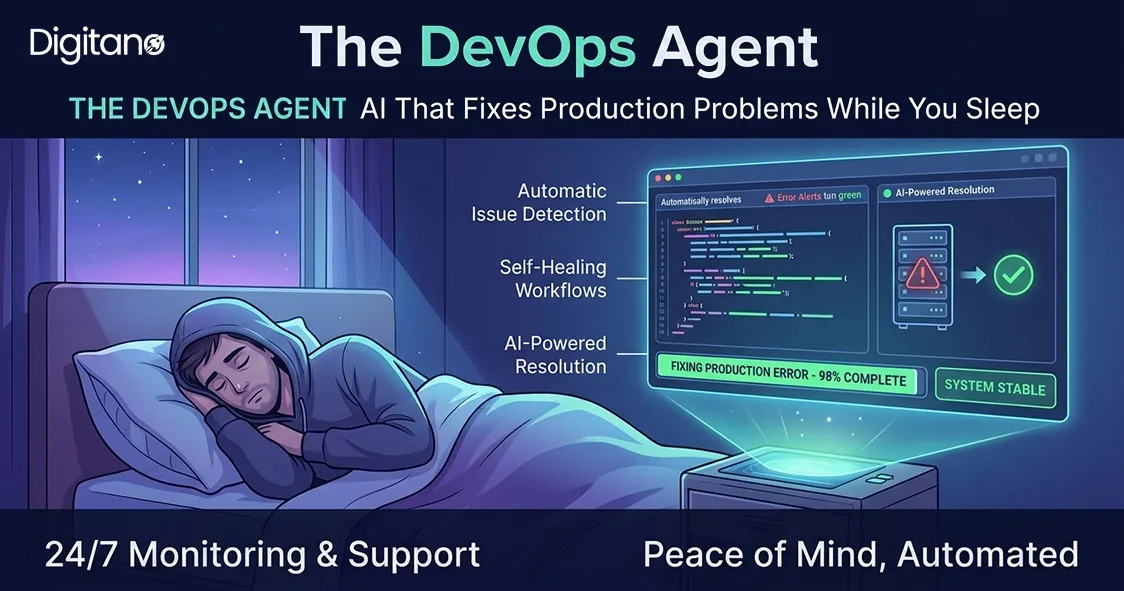
At AWS re:Invent 2025, Amazon announced something that felt genuinely different: the AWS DevOps Agent.
This isn't a coding assistant. It's an autonomous agent that monitors production environments in real time, detects incidents, investigates root causes, and resolves issues proactively. It doesn't wait for a PagerDuty alert to wake up a developer at 2am. It identifies the problem, reasons through the cause, and takes action.
For teams running at scale hundreds of microservices, complex distributed systems, high traffic this is a meaningful capability. The cognitive load of incident response is one of the most expensive and burnout-inducing parts of modern software development. An agent that handles the first layer of that, autonomously and accurately, is real relief.
This sits within AWS's broader concept of GenAIOps essentially, applying DevOps principles to generative AI workloads. Just as traditional DevOps introduced continuous integration and continuous deployment, GenAIOps introduces continuous evaluation, monitoring, and improvement loops for AI systems running in production. It's the discipline that makes GenAI sustainable at scale, not just impressive in demos.
JetBrains: A Case Study in What AWS GenAI Makes Possible
If you want to understand what the AWS GenAI stack looks like from the inside, look at JetBrains, the company behind IntelliJ, PyCharm, and some of the world's most-used developer tools.
JetBrains has been on AWS since 2013. When they wanted to integrate the latest large language models into their AI assistant plugins, they turned to Amazon Bedrock. The advantage? They could evaluate and adapt new LLMs in as little as one day, rather than weeks of infrastructure setup. Bedrock also helped them maintain compliance across different geographic regions, which is critical for a company selling globally.
They trained their Mellum model with over 4 billion parameters using NVIDIA GPUs on AWS, including the cutting-edge NVIDIA B200 and H200 chips. JetBrains was even the first AWS customer to use Amazon EC2 P6 instances featuring the new NVIDIA Blackwell GPUs. They then published their Mellum model on the Amazon Bedrock Marketplace, making it available to developers worldwide.
Their CTO described it simply: "AWS is providing top-notch infrastructure, but it can also adapt to our business model. That's a really great thing."
The Real Challenges What AWS GenAI Doesn't Solve Automatically
It would be dishonest to write about AWS GenAI without acknowledging the real challenges teams face.
Trust in AI-generated code is still a work in progress. Only 33% of developers say they fully trust AI outputs, and studies show AI-generated code has roughly 1.7 times as many defects as human-written code on average, with up to 2.7 times as many security vulnerabilities in some contexts. This doesn't mean AI coding assistants aren't valuable, it means they require skilled human review. Teams that treat AI suggestions as drafts rather than finished work get much better results.
Debugging AI-generated code takes time. Around 45% of developers report that debugging AI-generated code sometimes takes longer than writing it manually. The productivity gains are real, but they're not uniformly distributed across all tasks.
Data governance needs deliberate attention. Bedrock's security guarantees are strong, but teams still need clear policies about what data goes into AI systems, what models are used for what purposes, and who has visibility into outputs. Governance doesn't happen automatically, it has to be designed.
GenAIOps is a new discipline with a learning curve. Treating AI applications like traditional software doesn't work. Probabilistic outputs require evaluation pipelines, monitoring, and feedback loops that most teams haven't built yet. The organizations getting the most from AWS GenAI are the ones that have invested in this infrastructure.
Frequently Asked Questions (FAQs)
Q1: What is the difference between Amazon Q Developer and Amazon Bedrock?
A: Amazon Q Developer is the AI assistant that developers interact with directly; it lives in your IDE, your terminal, and your AWS Console. It helps you write code, fix bugs, generate tests, and navigate AWS services. Amazon Bedrock is the underlying platform that development teams use to build AI-powered applications and products. It gives you access to nearly 100 foundation models through a single API, with enterprise security and compliance built in. Q Developer is what you use as a developer. Bedrock is what you build on as a builder.
Q2: Is Amazon Q Developer only useful if I'm building on AWS?
A: Q Developer works best for teams building on AWS. It has deep knowledge of AWS services, APIs, and best practices that no general-purpose tool can match. However, it supports general-purpose coding in languages like Python, JavaScript, TypeScript, Java, PHP, Go, Rust, and more. If you're working in a hybrid environment or migrating to AWS, Q Developer's value compounds the more AWS is involved in your stack.
Q3: How does Amazon Bedrock handle data privacy and security?
A: Bedrock never stores or uses your data to train its models. All data in transit and at rest is encrypted. It supports IAM-based access policies, VPC integration, and comprehensive audit logging. It's in scope for major compliance standards including HIPAA, FedRAMP High, GDPR, SOC, and ISO certifications. For regulated industries like healthcare and financial services, this makes Bedrock the go-to choice compared to alternatives that offer weaker data guarantees.
Q4: What is the AWS DevOps Agent and how is it different from other AI tools?
A: The AWS DevOps Agent, announced at re:Invent 2025, is an autonomous AI agent that monitors production environments, detects incidents, investigates root causes, and resolves issues proactively and without waiting to be asked. Other AI coding tools assist developers with tasks they initiate. The DevOps Agent acts independently in production, reducing the incident response burden on engineering teams. It represents the shift from AI as assistant to AI as autonomous operator within defined guardrails set by your team.
Q5: How accurate is AI-generated code from tools like Amazon Q Developer?
A: AI coding assistants genuinely improve developer speed and output quality, but they require human review. Studies show that AI-generated code can have more defects and security vulnerabilities than carefully written human code, which is why Q Developer includes a built-in security scanner that flags issues as you type. Think of AI-generated code as a strong first draft that needs expert review, not a finished product. Teams that combine AI generation with strong code review practices get the best of both worlds.
Q6: What does Amazon Bedrock cost to use?
A: Bedrock pricing is consumption-based; you pay per token (roughly per word) processed by the model. Costs vary significantly depending on which model you choose and how much you use it. Lightweight models like Amazon Nova Micro are very affordable for high-volume routine tasks. Frontier models like Claude for complex reasoning cost more. The key is matching the right model to the right task, not using the most powerful model for everything. Many organizations find Bedrock more cost-effective than building custom infrastructure or using per-seat pricing from other providers.
Q7: Can small teams or startups benefit from AWS GenAI, or is it just for large enterprises?
A: AWS GenAI tools are genuinely accessible to small teams. Q Developer has a free individual tier. Bedrock's pay-per-use pricing means you only pay for what you actually use, no large upfront commitment. AWS even runs a Generative AI Accelerator program that selects promising startups for $1 million in AWS credits. Many of the most interesting Bedrock use cases come from startups (like Multitudes and Rexera) rather than large enterprises. The tools scale up as you do, which means small teams can start lean and grow without migrating platforms.
Q8: What is GenAIOps and why does it matter?
A: GenAIOps is the application of DevOps principles to generative AI workloads continuous evaluation, monitoring, and improvement of AI systems in production. Traditional DevOps handles deterministic software that produces predictable outputs. GenAI systems are probabilistic; the same input can produce different outputs, and model performance can drift over time. GenAIOps adds the infrastructure to manage this: evaluation pipelines that test model outputs against quality thresholds, monitoring that tracks accuracy and latency in production, and feedback loops that catch regressions before they affect users. Teams that skip GenAIOps discover its importance the hard way.
Q9: How does Amazon Bedrock compare to building directly on OpenAI's API?
A: Bedrock gives you access to multiple model providers including Claude, Llama, Mistral, and now OpenAI models via Project Mantle through a single API with consistent security and compliance. Building directly on OpenAI means your data goes to OpenAI's servers, which creates compliance complexity for regulated industries. Bedrock keeps everything in your AWS environment, which simplifies data governance significantly. It also gives you flexibility to switch models without rewriting your application. If a better or cheaper model becomes available, you can swap it in without changing your codebase.
Q10: What should a team do first when starting with AWS GenAI?
A: Start with one specific problem, not a broad transformation. Pick a repetitive, low-stakes part of your development workflow writing unit tests, generating documentation, summarizing pull requests, or drafting boilerplate code for AWS integrations. Try Q Developer there for two to four weeks and measure the time savings honestly. If it works, expand to the next pain point. If you're building an AI-powered product feature, start with a Bedrock proof of concept using a mid-tier model, evaluate the output quality against your use case requirements, then decide whether to scale it. The teams that get stuck are those that try to transform everything at once. The teams that win are those that find one clear win, prove it, and build from there.
What This Means If You're Building Today
Here's the practical takeaway for development teams.
If you're on AWS already and you're not using Q Developer, you're leaving productivity on the table. The free tier is genuinely useful, and the Pro tier at $19/month is competitive with any alternative. Start with your most repetitive tasks: boilerplate generation, unit test writing, documentation and measure the time savings. Then expand.
If you're building an AI-powered feature or product, Bedrock removes the hardest infrastructure problems from your plate. You get access to best-in-class models, enterprise security, compliance coverage, and a single API that works across providers. The 2-week migration timeline that Rexera achieved is not unusual; it's what Bedrock is designed to make possible.
And if you're thinking at the organizational level running multiple teams, shipping complex systems, managing risk GenAIOps is the framework worth investing in. The teams winning with AWS GenAI aren't just using better tools. They're running better processes around those tools.
The numbers are clear. The case studies are real. The tools exist today, not in a roadmap.
The question is simply: what are you waiting for?