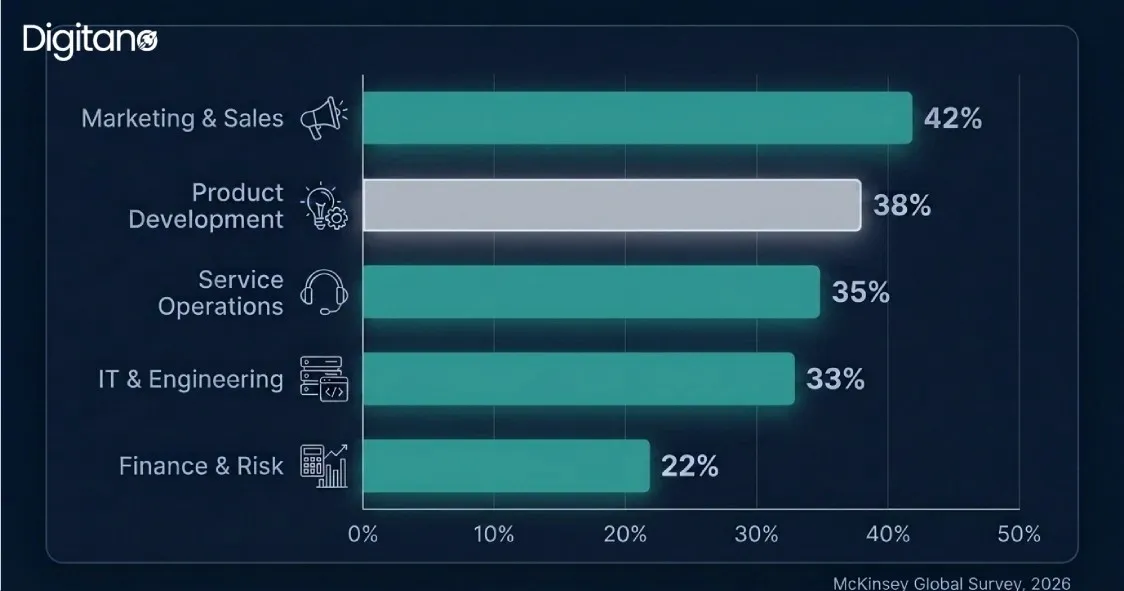
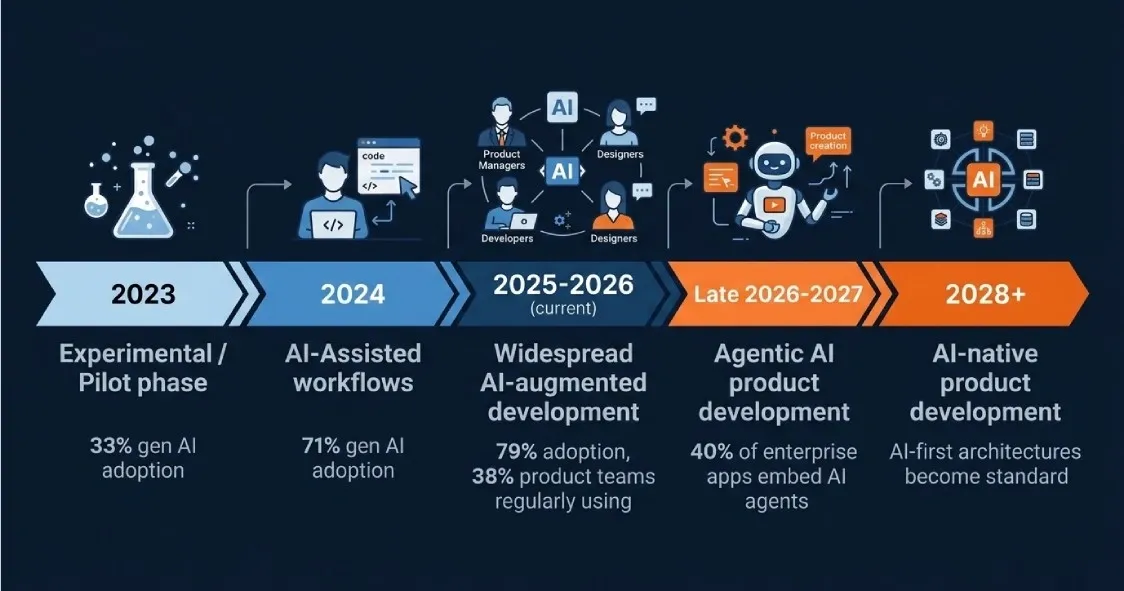
Two years ago, most product teams treated generative AI as an experiment. A cool demo. Something the R&D team was playing with on the side. In 2026, that framing is genuinely gone. Gartner now expects generative AI to support around 80% of the product development lifecycle, and McKinsey's 2026 organizational survey found that 38% of product teams use generative AI regularly, making it the second-most-adopted business function behind marketing. If your competitors are shipping features faster, validating ideas earlier, and understanding customers deeper than you are, it's genuinely likely they've quietly built generative AI into their product process while you were still evaluating.
This guide walks through exactly how generative AI in product development is reshaping every stage of building software, backed by real 2026 statistics and practical examples. If you'd rather have an experienced team help you integrate generative AI into your own product process, our digital marketing services and consulting work at Digitano LLC include this kind of technical strategy for organizations serious about capturing real productivity gains.
The State of Generative AI in Product Development (2026 Snapshot)
Before jumping into specific use cases, let's set the baseline with real, sourced numbers. These aren't projections. They're where the industry actually is right now:
- 88% of organizations use AI in at least one business function (McKinsey, 2026)
- 79% of organizations use generative AI specifically (McKinsey, 2026)
- 38% of product development teams use generative AI regularly (McKinsey, 2026)
- 82% of software developers report using generative AI tools at work, the highest of any professional role
- 3.7x average ROI per dollar invested in generative AI (IDC and Microsoft, 2026)
- $67 billion projected 2026 market size for generative AI, expected to reach $1.3 trillion by 2032 (Bloomberg Intelligence)
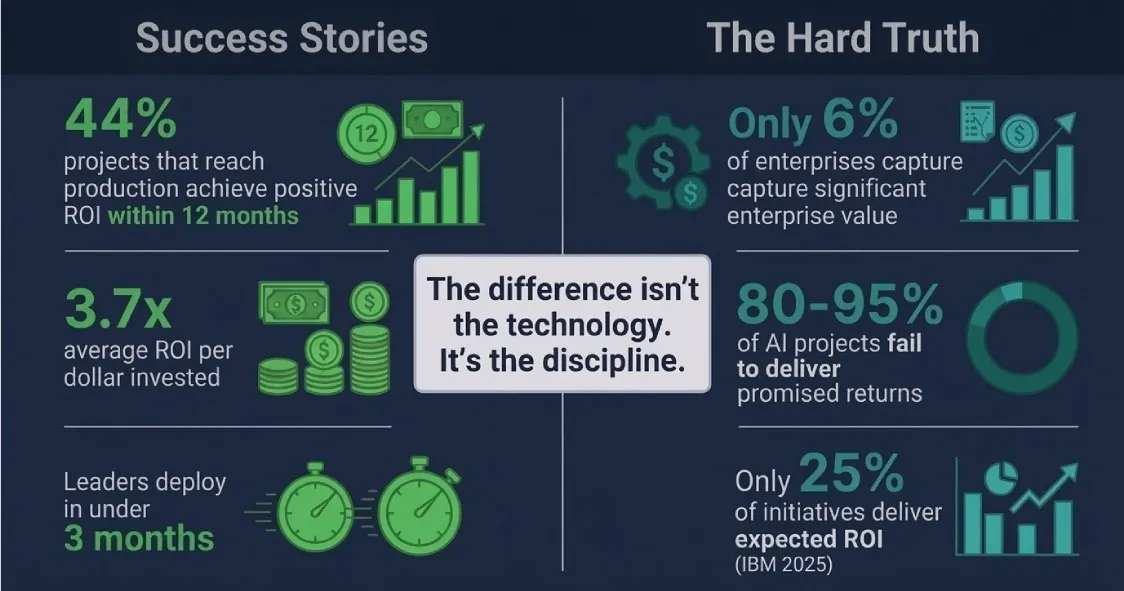
- 44% of AI projects that reach production achieve positive ROI within 12 months (Forrester, 2026)
The gap between AI leaders and laggards is widening fast, with leaders deploying generative AI in under three months while laggards are still stuck moving from pilot to production. In 2026, this isn't a wait-and-see technology anymore.
The Product Development Lifecycle: Where Generative AI Actually Shows Up
To make this concrete, let's walk through the actual stages of building a software product and where generative AI is meaningfully changing the work.
Stage 1: Discovery and Ideation
The old process: weeks of stakeholder interviews, competitor research, market analysis, and internal debate before you even settle on what to build.
The new process: generative AI compresses that timeline dramatically. Teams now use AI for competitive intelligence synthesis, customer interview transcription and analysis, market trend identification, and even hypothesis generation. Research synthesis is the #4 most-adopted generative AI use case in 2026 at 42% enterprise adoption, and product teams are among the heaviest users.
Real example: A product manager investigating whether to add a new feature can now upload 20 customer interview transcripts, three competitor product docs, and their own backlog notes to Claude or ChatGPT, and get a synthesized analysis with themed customer pain points and prioritization recommendations in under an hour. That same analysis used to take a UX researcher two to three days.
Stage 2: Requirements and Specification
Writing product requirements documents (PRDs), user stories, acceptance criteria, and technical specifications used to be one of the most tedious parts of product management. Generative AI now handles the first draft.
Product managers describe a feature at a high level, and the AI generates structured user stories with acceptance criteria formatted for their team's ticketing system. Engineers get better-scoped work. Stakeholders see the intent captured clearly. And PMs spend their time editing and validating instead of typing from scratch.
Stage 3: Design and Prototyping
This is where the impact has been most visible. Tools like Figma AI, Uizard, and generative UI copilots let designers describe a screen and get a working mockup in seconds. What used to take a designer half a day to sketch now takes ten minutes.
For product teams, this means:
- More design variations get tested (three or four alternatives instead of one)
- Junior designers can produce senior-quality first drafts and iterate
- Non-designer PMs and engineers can produce meaningful wireframes to communicate ideas
The bottleneck moves from "producing options" to "evaluating options," which is a genuinely better problem to have.
Stage 4: Code Generation and Software Engineering
This is where the ROI story is most measurable. Code generation is the second-largest segment of the entire generative AI market at $43.7 billion in 2026, and it's the highest-productivity use case of any AI application.
The specific data:
- 82% of software developers actively use AI code assistants at work (2026)
- 58% enterprise adoption rate for code generation tools like GitHub Copilot, Claude Code, and Cursor
- 55% faster task completion with AI-assisted coding versus manual (N-iX and controlled studies)
- 53% higher first-attempt unit test pass rate for AI-authored code (N-iX)
- 126% increase in developer output in Nielsen Norman Group controlled productivity studies
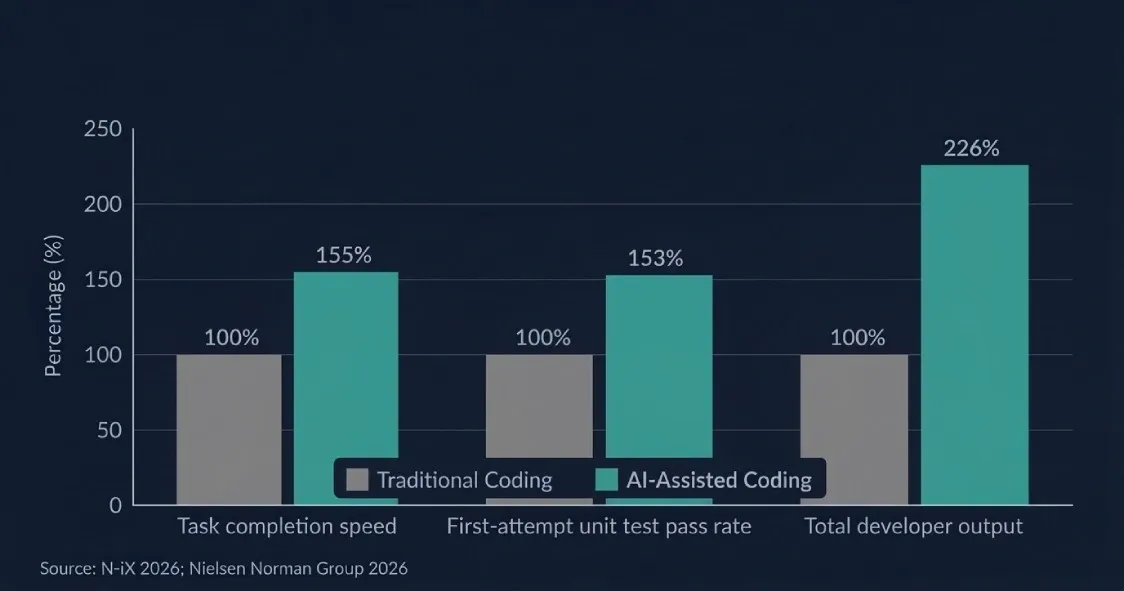
The important nuance most breathless AI coverage misses: these numbers require disciplined human review. AI-generated code without human oversight introduces its own risks, security vulnerabilities, technical debt, and hallucinated dependencies that don't exist. Teams capturing real ROI are the ones treating AI as an amplifier of developer expertise, not a replacement for it.
Stage 5: Testing and Quality Assurance
AI-powered testing has become one of the fastest-adopting product development categories, with 67% of QA teams now using at least one AI-powered testing tool, up from just 21% in 2024. The measurable gains:
- 60-80% reduction in test maintenance time through self-healing automation
- 30-50% more bugs caught compared to manual testing alone
- 40-60% reduction in overall QA costs
For product teams, this means faster release cycles, higher release confidence, and fewer post-release production incidents.
Stage 6: Customer Engagement and Personalization
Once a product ships, generative AI reshapes how you engage users. AI personalization now touches onboarding flows, feature announcements, in-app prompts, and customer support conversations. McKinsey's CPG research showed generative AI increased conversion rates by up to 40% through improved campaign targeting, and similar gains apply to product feature adoption when AI helps deliver the right message at the right moment.
Real example: A SaaS product notices a user hasn't tried its analytics module. Instead of sending a generic "have you tried analytics?" email, the AI generates a personalized message referencing the specific workflow the user is currently using and how analytics would specifically help that workflow. Open rates and click-through rates typically improve dramatically on personalized versus generic messaging.
Stage 7: Analytics and Product Intelligence
Product analytics used to require a dedicated analyst asking specific questions. Generative AI now lets PMs and even non-technical team members ask questions in plain language and get answers backed by real data.
"How did feature adoption change after our last release?" used to be a 20-minute analyst query. Now it's a natural-language question in a product analytics tool with an AI layer, answered in seconds.
Where Product Teams Are Getting the Highest ROI in 2026
Not all generative AI use cases are created equal. Real data from 2026 shows a clear hierarchy of where product teams capture the most measurable value:
| Use Case | Adoption Rate | Productivity Impact |
|---|---|---|
| Content creation (marketing, docs) | 71% | 62% faster production, 3.8x higher output |
| Code generation | 58% | 55% faster tasks, 126% higher developer output |
| Customer interaction | 54% | 40-60% automation of structured workflows |
| Research synthesis | 42% | Days-to-hours compression of research tasks |
| Data analysis | 38% | Real-time analytics for non-technical users |
| Design and creative | 33% | 3-4x more design variations tested |
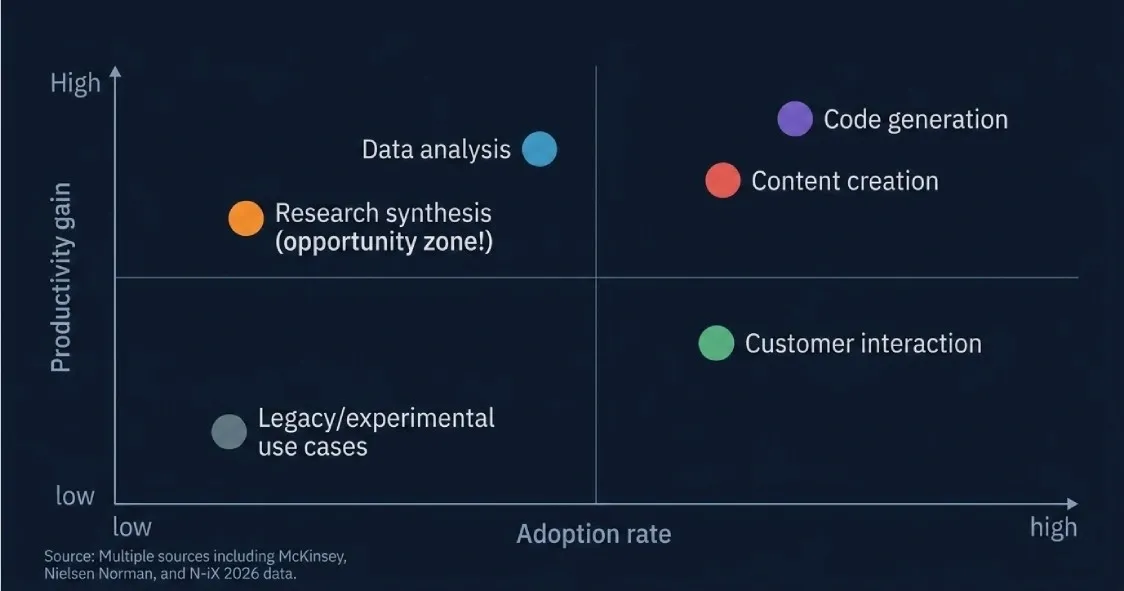
The pattern: the highest-ROI use cases (code generation, content creation) already have widespread adoption. The next competitive wave will come from teams that unlock the high-value, still-underused areas like automated research synthesis and AI-driven product analytics.
Real 2026 Company Examples
Abstract statistics only tell part of the story. Here's what generative AI in product development actually looks like at real companies in 2026:
Fintech: Personalized Financial Advice at Scale
Fintech companies are using generative AI to produce personalized financial advice, automate market analysis report writing, and create synthetic data for testing fraud detection algorithms. This lets small fintech product teams deliver enterprise-quality customer experiences without hiring analyst teams for every user segment.
Healthtech: Accelerated Drug Discovery Documentation
Healthtech product teams use generative AI to draft clinical trial documentation, generate patient-friendly summaries of complex medical information, and even accelerate drug discovery by generating novel molecular structures. Products that used to require dedicated medical writers now ship with AI-augmented documentation pipelines that clinicians validate rather than author from scratch.
E-commerce: SEO-Optimized Product Descriptions and Virtual Try-Ons
E-commerce product teams use generative AI to automatically write SEO-optimized product descriptions at catalog scale (impossible manually for stores with thousands of SKUs), power virtual try-on experiences, and generate unique lifestyle imagery for ad campaigns. Retailers using AI-driven personalization have reduced customer acquisition costs by up to 50% while boosting revenue 5-15% (McKinsey).
SaaS: AI-Native Product Features
Modern SaaS products are being built AI-native from day one. Instead of asking "how do we bolt AI on later," teams design core workflows around AI assistance. The result: product experiences that feel meaningfully more capable than pre-AI competitors, even for the same underlying business use case.
The Uncomfortable Truth: Most AI Product Initiatives Still Fail
Here's the honest reality most vendor content skips: adoption is high, but only about 6% of enterprises capture significant value from AI, and an estimated 80-95% of AI projects fail to deliver their promised return (Stanford AI Index, 2026). IBM's 2025 CEO study found only 25% of AI initiatives delivered expected ROI.
Why the gap? A few recurring patterns:
- Adopting AI tools without redesigning workflows around them. Bolting AI onto existing processes captures maybe 20% of the possible productivity gain.
- Skipping change management and training. Employees who don't know how to use the tools effectively don't get the benefits from having access to them.
- Ignoring the human review requirement. Teams that treat AI output as final product without review accumulate quality debt that shows up as production incidents six months later.
- Choosing wrong use cases. Teams often start with flashy demos instead of high-frequency, measurable workflows where ROI compounds quickly.
- Underestimating data quality requirements. AI can't produce good output from bad or fragmented input data.
The teams capturing real ROI in 2026 aren't the ones with the fanciest AI models. They're the ones with disciplined workflows, real training investment, and clear measurement of what's actually working.
Practical Framework: How to Actually Integrate Generative AI Into Your Product Process
Based on what's genuinely working for teams in 2026, here's a practical seven-step framework:
1. Audit your current product workflow. Map every stage (discovery, requirements, design, coding, testing, analytics, engagement) and identify the highest-friction, most-repetitive activities. These are your priority AI targets.
2. Start with one high-volume, measurable use case. Code generation and content creation typically win here because they're frequent, measurable, and the outputs are easy to review.
3. Invest in team training, not just tools. Employees who understand prompt engineering, AI limitations, and effective review workflows capture 3-4x more value than those given the same tools without training.
4. Set clear measurement criteria upfront. What does success look like? Faster cycle time? Lower defect rates? Higher developer satisfaction? Pick specific metrics and track them.
5. Build human review into every workflow. AI-generated content, code, and analysis all need human validation before entering production. This isn't optional; it's the primary quality safeguard.
6. Plan for the "second wave" use cases early. Once you've captured value from code generation and content, move quickly to research synthesis, data analysis, and personalization. These are where competitive advantage builds.
7. Establish AI governance. Document how AI is used, what data it touches, and how outputs are reviewed. Regulatory expectations (like the EU AI Act) are tightening, and governance now saves compliance headaches later.
What's Coming Next: The Agentic Product Development Wave
The 2026-to-2027 transition is going to look different from what happened in 2024-2025. The shift is from "AI-assisted product development" to "agentic product development," where AI agents don't just suggest, they autonomously handle multi-step tasks.
Gartner forecasts that 40% of enterprise applications will embed task-specific AI agents by end of 2026, up from under 5% in 2025. For product teams, this means:
- AI agents that autonomously handle repetitive backlog grooming, ticket triage, and testing
- AI agents that monitor product analytics and proactively surface anomalies
- AI agents that execute A/B test analysis, personalization tuning, and feature performance monitoring without human queries
- AI agents embedded directly in product experiences to handle customer workflows autonomously
The teams preparing for this now (building the data infrastructure, governance frameworks, and human-oversight workflows agentic AI requires) will move much faster than teams still trying to master AI-assisted workflows.
Frequently Asked Questions
Q1: How does generative AI improve product development speed?
Generative AI compresses time across multiple stages: research synthesis moves from days to hours, code generation is 55% faster, testing maintenance drops 60-80%, and design iterations happen 3-4x faster. Combined, teams report cycle time reductions of 30-50% across the full product lifecycle when AI is properly integrated.
Q2: What percentage of product teams use generative AI in 2026?
According to McKinsey's 2026 survey, 38% of product development teams use generative AI regularly, making it the second-most-adopted business function after marketing. Software developers specifically show the highest usage rate at 82%, meaning the engineering side of product teams is even further along.
Q3: Which product development stage sees the biggest generative AI impact?
Code generation delivers the highest measurable ROI, with 55% faster task completion and 126% increase in developer output. However, content creation (71% adoption) and research synthesis (42% adoption) also produce substantial time and cost savings. Design and prototyping is seeing rapid growth as generative UI tools mature.
Q4: What's the average ROI of generative AI in product development?
IDC and Microsoft measure a 3.7x average return per $1 invested in generative AI, though results vary widely. Forrester found 44% of AI projects that reach production achieve positive ROI within 12 months. However, 80-95% of AI projects fail to deliver expected returns, so results depend heavily on execution discipline, not just tool adoption.
Q5: Will generative AI replace product managers or engineers?
Based on current evidence, no. Generative AI amplifies human expertise rather than replacing it. The IMF estimates only 3% of jobs are at immediate risk of full automation, while 14% are significantly augmented. Workers with AI skills command a $48,000 average salary premium, suggesting the roles are evolving into higher-value work rather than disappearing.
Q6: What are the biggest mistakes product teams make with generative AI?
The most common mistakes: adopting AI tools without redesigning workflows around them, skipping team training, treating AI output as final without review, choosing flashy use cases instead of high-frequency ones, and underestimating data quality requirements. These are why 80-95% of AI projects fail to deliver promised ROI.
The Bottom Line
Generative AI has moved from experimental technology to standard practice in product development. In 2026, the question isn't whether to integrate it, but how quickly and effectively you can. Teams that treat AI as an amplifier of human expertise, invest in training and governance, choose high-frequency measurable use cases, and prepare for the coming agentic wave will build meaningful competitive advantages over teams still trying to figure out where to start.
The good news: the fundamentals of building a strong product still matter. Deep customer understanding, disciplined engineering, thoughtful design, and honest measurement don't go away because AI is in the toolkit. If anything, they matter more, because AI makes speed accessible to everyone, and the differentiator becomes what you choose to build and how well you build it.
For organizations that need help integrating generative AI into their product development process, choosing the right tools, or building the workflows and governance that turn AI adoption into real ROI, contact Digitano LLC. We help engineering and product teams move beyond experimentation into disciplined, measurable AI-augmented product development that actually ships better products.