A Plain-English Guide for Founders, Entrepreneurs & Product Managers
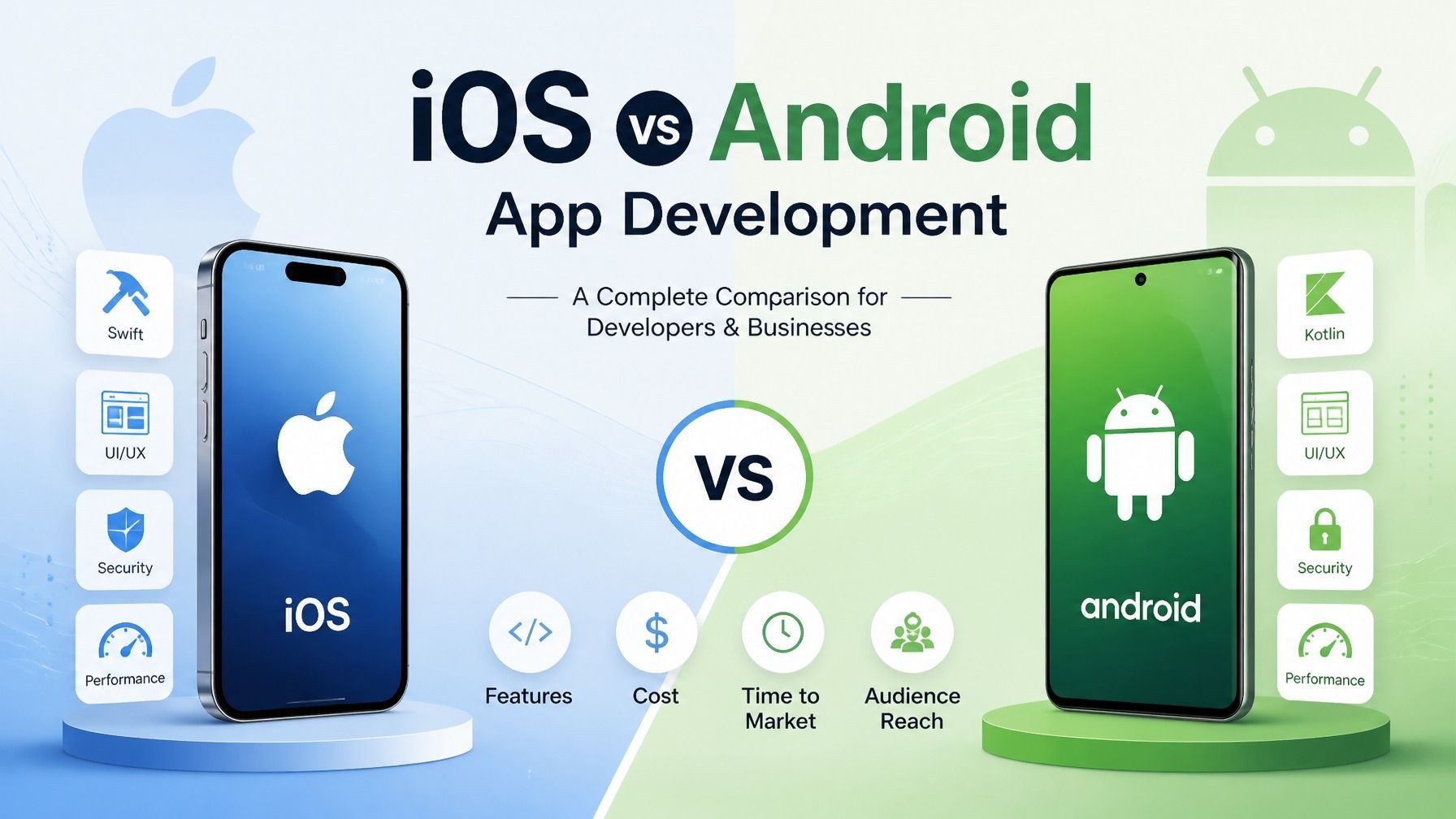
It is one of the first questions almost every app founder faces: should I build for iOS first, or Android?
It sounds like a simple question. But the answer has real consequences for your budget, your launch timeline, your target audience, and your long-term revenue. Make the wrong call and you could spend months building for users who are not your customers yet.
Here is the scale of what we are talking about. As of early 2026, the Apple App Store hosts approximately 2.02 million apps, while Google Play offers around 3.95 million apps (Business of Apps & TekRevol, 2026). Together, mobile apps generated over $1.3 trillion in developer billings and sales in 2024, a number that continues to climb every year.
Both platforms are massive. Both are profitable. But they attract different users, in different countries, with different spending habits and different expectations. Knowing those differences is how you make the right call for your specific business.
This guide walks you through everything you need to know: market share, revenue, development cost, user behavior, and which platform is right for your specific situation. No jargon, no fluff. Just the real facts and a clear answer at the end.
The Global Picture: Android Dominates, But iOS Earns More
Let us start with the numbers, because they tell a fascinating story.
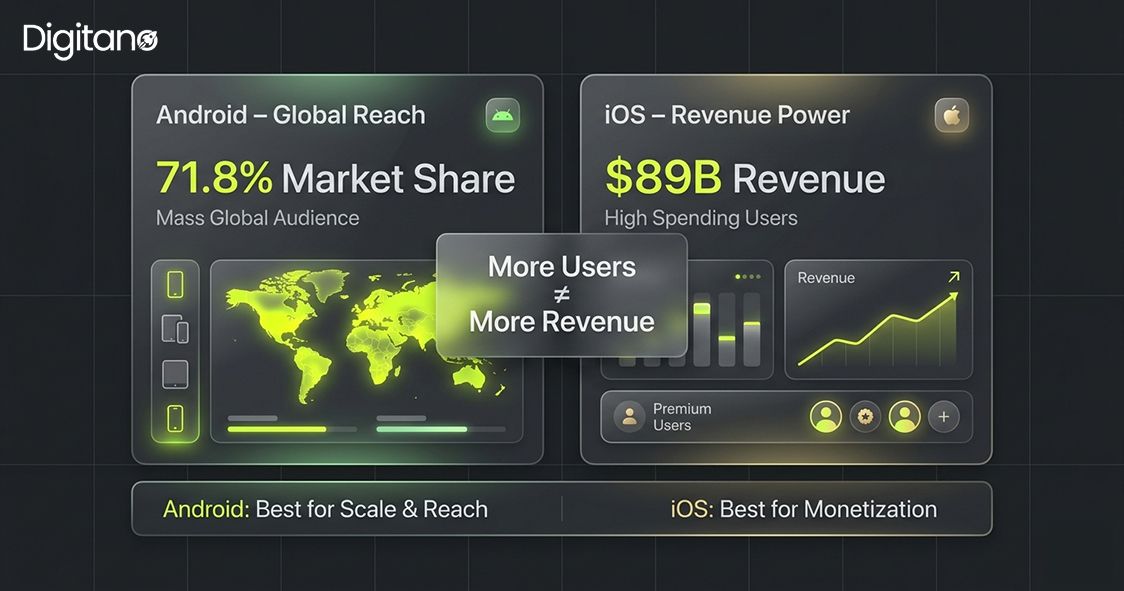
As of 2025–2026, Android holds approximately 71–72% of the global smartphone market share, while iOS holds around 27–29% (StatCounter, 2025). On raw user numbers alone, Android wins by a landslide, there are roughly 3.9 billion Android users versus 1.56 billion iPhone users worldwide.
But here is the twist that surprises most people: iOS users spend dramatically more money on apps.
According to Business of Apps (2025), the Apple App Store generated approximately $85 billion in revenue in 2025, while Google Play generated around $49 billion, a 13% increase for Google Play year-over-year, yet still less than half of Apple's total. iOS generated nearly double the revenue of Android despite having a fraction of the users. In fact, iOS users account for 68.6% of all consumer spending on mobile apps globally, while Android holds just 31.4%.
What does that mean for you as a builder? If your business model relies on users paying for your app, subscribing, or making in-app purchases, iOS users are statistically far more likely to open their wallets. If your goal is to reach and scale across as many users as possible especially in developing markets, Android is your platform.
Neither answer is wrong. They just serve different goals.
Geography Matters: Where Are Your Users?
Platform preference is not the same everywhere in the world. Your target geography should heavily influence your platform choice.
iOS-Dominant Markets
- United States: iOS holds approximately 58–60% market share as of 2025 (StatCounter).
- United Kingdom: iOS holds around 52% market share.
- Australia, Canada, Japan: All iOS-majority markets. Japan is particularly strong at over 68% iOS.
- Scandinavia and Western Europe: Strong iOS adoption among premium segments.
Android-Dominant Markets
- India: Android holds over 95% market share and is one of the strongest Android bastions globally.
- Indonesia, Bangladesh, Pakistan, Nigeria: 90%+ Android dominance.
- Brazil, Mexico, most of Latin America: Android leads by a wide margin.
- Eastern Europe and Southeast Asia: Heavily Android.
The lesson here is simple: if you are building for users in the US, UK, or Australia, iOS should be your priority. If you are building for Southeast Asia, South Asia, Africa, or Latin America, Android is where your audience lives.
Development Cost: What Does Each Platform Actually Cost?
Cost is usually the most pressing question for early-stage startups. Let us be direct about it.
Building a native iOS app and a native Android app as two separate projects can cost anywhere from $50,000 to $300,000+ each, depending on complexity. That means building for both simultaneously can cost a small startup half a million dollars before they have a single paying user.
This is why most startups do not build for both platforms at launch. They pick one, validate their idea, and add the second platform once they have revenue and product-market fit.
Key Cost Factors to Consider
- iOS uses Swift. Android uses Kotlin. These are different programming languages, requiring different developers.
- iOS testing is simpler because Apple only makes a limited number of devices. Android runs on over 24,000 distinct device models, though Google is pushing harder for standardization in 2026.
- Apple charges $99/year for an Apple Developer account. Google charges a one-time $25 fee. Note also: iOS development typically requires a Mac ($1,000+), while Android can be developed on any platform.
- App Store review on iOS typically takes 24–72 hours. Google Play can approve apps in hours. Both have been more consistent in 2025–2026 than in previous years.
- Ongoing maintenance costs are generally higher for Android due to device fragmentation, though Google's stricter quality standards from 2025 onward have started to narrow the gap.
The bottom line on cost: if you are budget-constrained, building for one platform first is smarter than stretching thin to cover both. Use cross-platform tools like Flutter or React Native if you truly need both from day one.
User Demographics: Who Uses iOS vs Android?
Understanding your user is the most important thing in product development. Platform demographics tell you a lot.
iOS Users Tend To
- Have higher average household incomes. In the US, iPhone users are 48% more likely to earn over $125,000 per year than Android users (DemandSage, 2026).
- Spend significantly more on technology iPhone users spend an average of $101/month on tech, compared to $50 for Android users.
- Skew younger in Western markets 68% of 18–29 year-olds in the US use iPhones, making iOS the dominant OS among Gen Z.
- iPhone users are 55% more likely to hold a four-year degree, and 27% more likely to hold a graduate or PhD-level qualification.
- Be more loyal over 90% of iPhone users remain loyal to Apple.
Android Users Tend To
- Be a much larger and more diverse group globally approximately 3.9 billion active Android users worldwide.
- Represent a wider income range, from budget phone users to Samsung flagship owners.
- Dominate in emerging markets where mobile-first internet access is the norm.
- Be more price-sensitive in many regions, though premium Android users (Samsung Galaxy S-series, Google Pixel) rival iPhone users in spending power.
- Show loyalty rates of 70–80% depending on the brand, lower than iOS but still strong.
This matters enormously for your monetization strategy. If you are building a premium subscription product or a luxury e-commerce app, iOS users in developed markets are your ideal audience. If you are building a free app with ad revenue, a social network, or a utility targeting mass adoption, Android's sheer scale is your friend.
App Store vs Google Play: The Publishing Experience
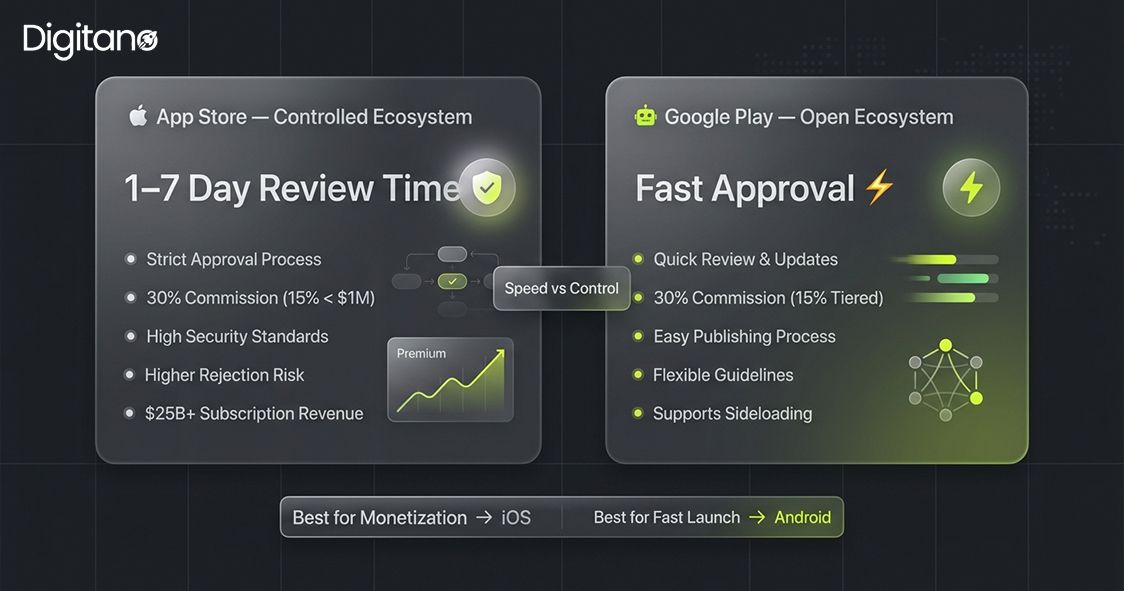
Once you build your app, you need to publish it. The experience on each platform is quite different.
Apple App Store (2025–2026)
- Strict review process that typically takes 24–72 hours, occasionally up to a week for complex apps.
- Apple takes a 30% commission on in-app purchases and subscriptions, reduced to 15% for developers earning under $1M per year, and 15% after the first year of a subscription.
- Tighter design and security guidelines mean fewer malicious apps but also more rejection risk.
- Subscription revenue is enormous: the global app subscription economy hit $79.5 billion in 2025, with iOS driving nearly three-quarters of that total.
- The App Store now hosts approximately 2.02 million apps as of 2026.
Google Play Store (2025–2026)
- Faster and a more flexible review process with many apps approved within hours.
- Google also takes 30% commission, reduced to 15% for the first $1M in annual revenue.
- In 2026, Android now requires all apps on certified devices to come from verified developers, a significant shift toward quality control.
- Google Play generated $49.2 billion in revenue in 2025, a 13% increase year-over-year.
- The store hosts approximately 3.95 million apps, though active/quality apps are far fewer after ongoing clean-ups.
- 97% of apps on Google Play are free; revenue is driven almost entirely by in-app purchases, subscriptions, and advertising.
One practical note: if speed matters for your launch, Android is easier to publish on quickly. If your business model is subscriptions and premium purchases, the iOS App Store is where the bulk of that revenue is earned.
Performance, Security & Device Fragmentation
This section has real business impact. Understanding it will help you plan your development and testing budget.
iOS has a significant advantage when it comes to device fragmentation. Apple controls both the hardware and the software, so there are a limited number of iPhone models and iOS versions in active use at any time. This makes testing and quality assurance much simpler and cheaper.
Android, on the other hand, runs on over 24,000 distinct device models from hundreds of manufacturers including Samsung, Xiaomi, OnePlus, Oppo, Google, and many more. Android OS versions also vary widely. This fragmentation means significantly more testing effort to ensure your app works well across all devices though Google's stricter developer policies introduced in 2025 are beginning to address this.
On security, iOS has a long-standing reputation as the more secure platform. Apple's walled garden approach where apps can only be installed from the App Store and must pass strict review significantly reduces the risk of malware. Android has made meaningful progress here: Google's Privacy Sandbox and enhanced encryption frameworks have improved Android's security posture considerably by 2025–2026, though iOS still leads in this area.
For startups building in fintech, healthcare, or any industry where security and trust are paramount, iOS gives you a built-in credibility advantage. For startups targeting mass consumer markets in diverse geographies, the fragmentation challenge of Android is a cost of doing business worth accepting.
What's New in 2026: AI, Foldables & Privacy
The platform landscape in 2026 looks meaningfully different from just two years ago. Here are the key new factors founders need to consider:
AI Integration
Both platforms now compete aggressively on AI features. Apple Intelligence Apple's on-device AI suite debuted with iOS 18 and has been a significant driver of iPhone upgrades in 2025–2026. Google's Gemini AI is deeply integrated into Android, powering smart replies, photo editing, and real-time translation. For developers, both platforms now offer robust AI APIs, making it easier to build AI-powered features without building models from scratch.
Foldable Devices
Foldables now represent approximately 5% of global smartphone sales in 2025, led by Samsung, Oppo, and Honor. This is exclusively an Android category for now. Apple is expected to enter the foldable market by 2026–2027. If your app has strong content or productivity use cases, foldable-optimization is worth considering for Android.
Privacy & Data Regulations
iOS continues to lead on privacy with App Tracking Transparency, on-device processing, and end-to-end encryption. Android has significantly improved with Google's Privacy Sandbox framework. Both platforms now require clearer data disclosure from developers. For apps in regulated industries (fintech, health, legal), both platforms are increasingly demanding compliance with GDPR, CCPA, and regional equivalents.
5G Adoption
5G now accounts for approximately 77% of global smartphone shipments. Android leads deployment in Asia; iOS drives adoption in the US and Japan. If your app relies on high-bandwidth or low-latency features, both platforms now support 5G robustly, but Android reaches more 5G users globally due to its larger install base.
So Which One Should YOU Choose? A Decision Framework
Let us put it all together. Here is a simple decision framework based on the most common startup scenarios:
Choose iOS First If...
- Your target market is the US, UK, Canada, Australia, or Japan.
- Your business model depends on paid downloads, subscriptions, or in-app purchases.
- You are building for higher-income demographics or Gen Z in Western markets.
- Your product requires strong security and trust (fintech, healthtech, legal tech).
- You want a cleaner testing environment and faster, more predictable iteration.
Choose Android First If...
- Your target market includes India, Southeast Asia, Africa, or Latin America.
- You want maximum reach and the largest possible user base (3.9 billion+ users).
- Your app is free with ad-based or freemium monetization.
- You want a faster and more flexible app publishing process.
- You are building utilities, social apps, or productivity tools for mass adoption.
Build for Both Simultaneously If...
- You have the budget (over $100,000 for development) and a capable technical team.
- You use a cross-platform framework like Flutter or React Native to share the codebase.
- Your product genuinely serves users equally across both platforms from day one.
- You have investors or partners who require dual-platform coverage.
iOS vs Android: Side-by-Side Comparison (2026)
A quick reference to help you compare both platforms at a glance:
Frequently Asked Questions (FAQs)
Q1: Which platform should a first-time startup founder choose?
A: For most first-time founders in Western markets, iOS is the recommended starting point. The users tend to spend more (iOS drives 68.6% of global app consumer spending despite having fewer users), the testing environment is simpler, and the quality bar of the App Store pushes you to build a better product from day one. However, if your product is designed for emerging markets in Asia, Africa, or Latin America, start with Android that is where your actual users live.
Q2: Is it more expensive to develop for iOS or Android?
A: iOS development is generally slightly cheaper overall for two main reasons. First, Apple controls its own hardware ecosystem, so there are far fewer devices to test on. Second, the App Store's design standards are well-documented. Android development, while often cheaper per developer hour, can cost more overall due to the enormous number of device types and OS versions that must be tested and supported. Note also that iOS development requires a Mac computer, adding to upfront hardware costs.
Q3: Can I build one app that works on both iOS and Android?
A: Yes, absolutely. Cross-platform frameworks like Flutter (by Google) and React Native (by Meta) allow you to write a single codebase that runs on both iOS and Android. These tools have matured significantly and are now widely considered best practice for most consumer app projects in 2026, used by major companies including BMW, Alibaba, Shopify, and many others. The trade-off is that some very complex or platform-specific features may require additional native code.
Q4: Which platform makes more money for app developers?
A: iOS consistently generates more revenue per user. The Apple App Store produced approximately $85 billion in revenue in 2025, compared to $49.2 billion on Google Play. iOS users spend an average of $1.08 per user versus $0.43 per Android user a 2.5x difference. Subscription revenue on iOS is particularly strong: iOS drives roughly three-quarters of the global $79.5 billion app subscription economy. If your business model is paid or subscription-based, iOS is the higher-earning platform. If your model is ad-supported or freemium with a very large user base, Android's 3.9 billion+ users can make up the difference at scale.
Q5: How long does it take to get an app approved on each platform?
A: The Apple App Store review process typically takes 24 to 72 hours for a standard review, though it can occasionally take up to a week for more complex apps or during high-volume periods. Critical bug fixes can often be expedited. Google Play tends to be faster, with many apps approved within a few hours, though first-time submissions or certain app categories may take 3 to 7 days. In 2026, Android now requires stricter verification of developers, which has modestly extended first-time submission timelines.
Q6: Is Android more popular than iOS worldwide?
A: Yes, by a significant margin when measured by total users. Android holds roughly 71–72% of the global smartphone market share compared to iOS at 27–29% (StatCounter, 2025). However, popularity in terms of user numbers does not equal profitability. iOS leads in revenue, engagement, and average revenue per user in most developed markets. In the US specifically, iOS has been the majority platform since 2022, now holding approximately 58–60% of the US smartphone market.
Q7: What if my target audience uses both iOS and Android equally?
A: If your audience is genuinely platform-agnostic, the most efficient path is to use a cross-platform framework like Flutter or React Native. This lets you build once and release on both platforms without maintaining two entirely separate codebases. It is the approach taken by thousands of well-funded startups in 2026 and is now widely considered best practice for most consumer app projects where budgets allow.
Q8: Should I build a mobile app or a mobile website first?
A: A mobile-responsive website or Progressive Web App (PWA) can often validate your idea faster and cheaper than building a native app. Many successful products ran as mobile websites before becoming full native apps. If you are trying to validate a business idea on the tightest possible budget, a well-designed mobile website built with tools like Webflow or Next.js is often the smartest first step. Build the native app once you have proof that people want what you are offering.
Q9: How has the iOS vs Android landscape changed in 2025–2026?
A: Several meaningful shifts have occurred. First, iOS has overtaken Android in the US (now ~58–60% vs ~40%), a reversal from just a few years ago. Second, AI features Apple Intelligence on iOS and Gemini on Android are now major purchase drivers, with both platforms competing aggressively on AI capabilities. Third, non-gaming apps surpassed gaming apps in revenue for the first time in 2025 ($82.6 billion vs $72.2 billion), reflecting the explosion of subscription-based productivity and streaming services. Finally, Android's stricter 2025–2026 developer policies are reducing junk apps and raising the quality bar across the entire ecosystem.
Final Thoughts
Here is the honest truth: the iOS vs Android debate does not have a single right answer. It has a right answer for your business, your users, and your goals. That is what this guide has been trying to help you find.
If you are in an early-stage startup with limited funding, stop trying to do everything at once. Pick one platform. Build something real. Get it in front of users. Learn fast. The second platform will come when you have the revenue and the team to support it.
The most important thing is not which platform you choose. It is that you build something people actually want to use. A brilliant app on one platform will always beat a mediocre app on both.
Think about your target user. Where do they live? What phone do they carry? Are they likely to pay for your app or will you earn through advertising? Those three questions will give you your answer faster than any comparison article ever could.
The global app economy generated over $1.3 trillion in developer billings and sales in 2024, with global app revenue projected to hit $270 billion by 2025–2026 (Statista). There is room for your idea on both platforms. But today, your only job is to build the best version of it. Start there.