A clear, jargon-free breakdown of both sides of SEO — with real data and practical advice you can act on today.
If you've spent any time reading about SEO, you've probably come across the terms on-page and off-page thrown around a lot often without much explanation of what they actually mean in practice. And when people do explain them, it usually sounds more complicated than it needs to be.
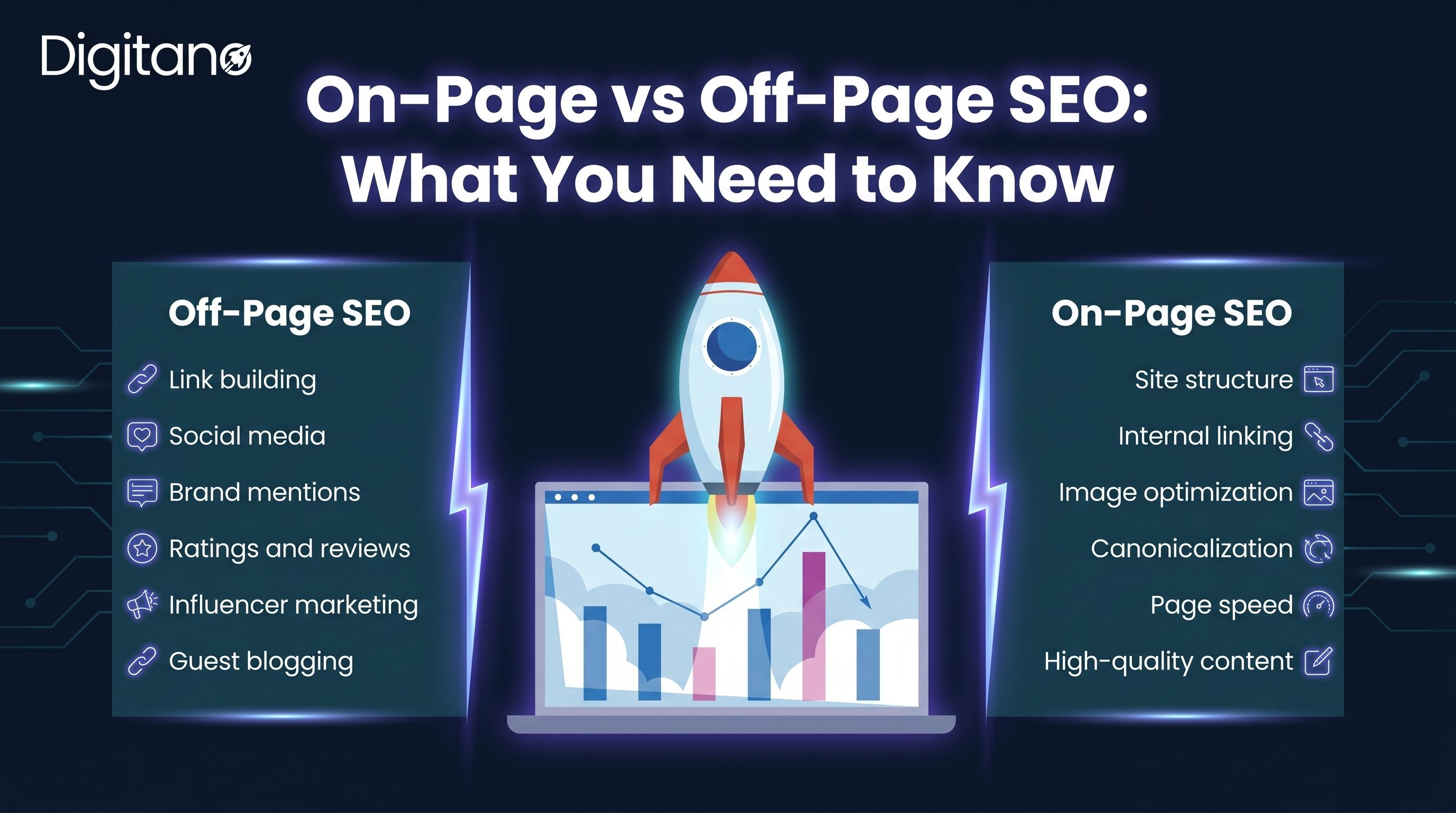
Here's the simple version: on-page SEO is everything you do on your own website. Off-page SEO is everything that happens outside your website. Both matter. They work together. And understanding the difference between them is the first step to building an SEO strategy that actually gets results.
This article breaks down both clearly, with real facts and figures so you can make decisions based on data rather than guesswork.
What Is On-Page SEO?
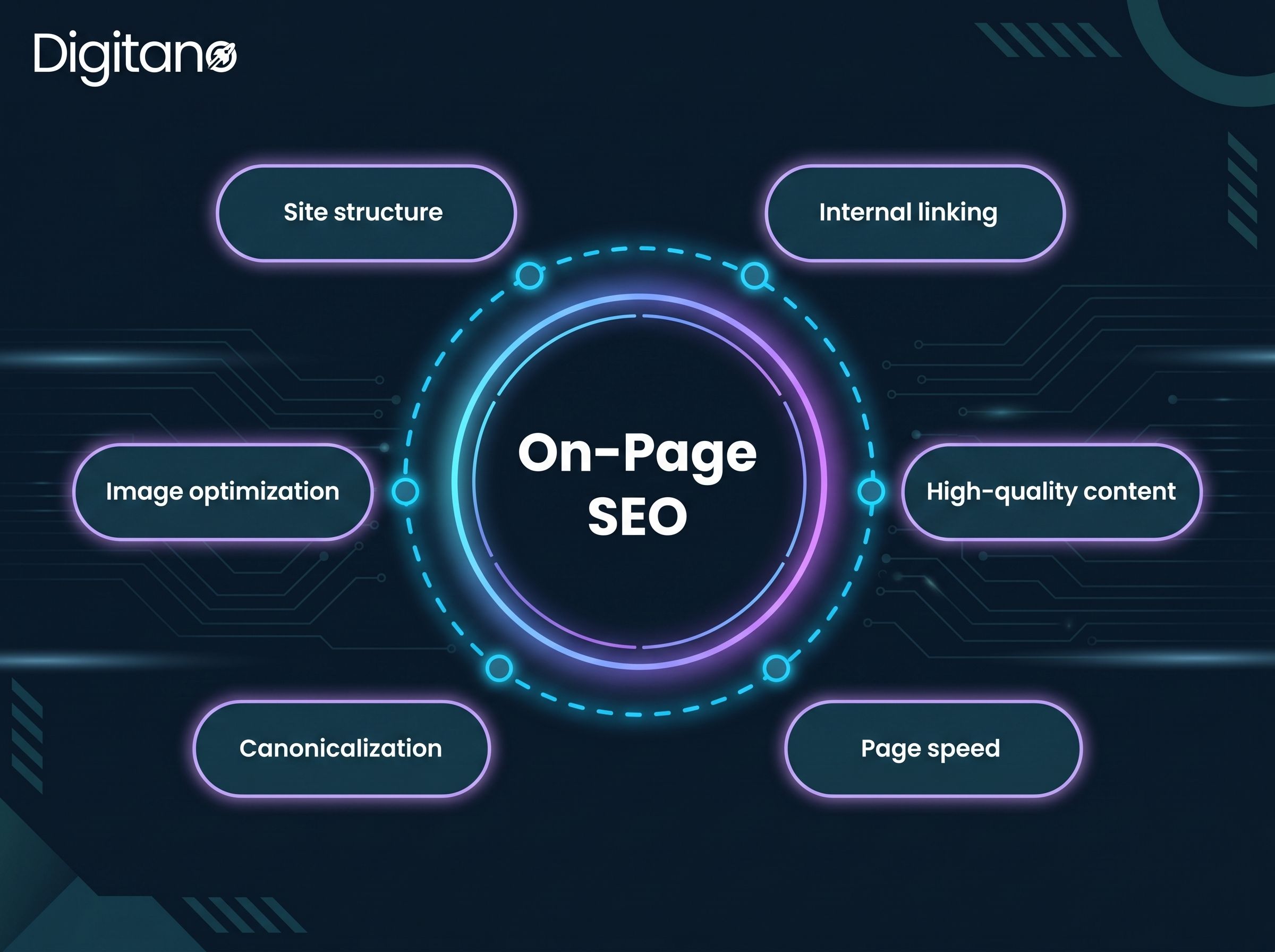
On-page SEO refers to everything you can directly control and optimize on your website. This includes your content, how that content is structured, the technical signals you give search engines through your HTML, and how fast and user-friendly your pages are.
Think of it as your own house. You can paint the walls, rearrange the furniture, fix the plumbing, and make it as welcoming as possible. On-page SEO is you making your house the best it can be so that when Google comes knocking to evaluate it, it likes what it sees.
The main on-page SEO elements include:
- Content quality and relevance Is your content genuinely useful? Does it answer the question the user typed?
- Title tags The clickable blue headline in search results. This is one of the most important on-page signals
- Meta descriptions The summary text under your title in search results. Not a direct ranking factor, but critical for click-through rate
- Headings (H1, H2, H3) How your content is structured and organized
- URL structure Clean, keyword-relevant URLs perform better than long, cryptic ones
- Internal linking How your pages connect to each other, helping users and Google navigate your site
- Image alt text Descriptions for images that help search engines understand visual content
- Schema markup Structured data that helps Google display rich results like star ratings or FAQs
- Page speed and Core Web Vitals How fast and stable your page loads, especially on mobile
Why On-Page SEO Is Your Starting Point
On-page SEO is non-negotiable; it has to come first. No amount of backlinks will rescue a page that Google can't understand, that loads painfully slowly, or that doesn't genuinely answer what someone was searching for.
Google's algorithm has grown dramatically more sophisticated at evaluating content quality. The E-E-A-T framework which stands for Experience, Expertise, Authoritativeness, and Trustworthiness guides how Google assesses whether your content deserves to rank. A page with weak, thin content won't benefit much from off-page signals. Garbage in, garbage out.
Some specific on-page facts worth knowing:
- Google is 57% more likely to rewrite title tags that exceed the recommended character limit so sloppy titles actually get overwritten (Ahrefs)
- Almost 41% of top-ten pages have meta descriptions that are too long and get truncated in search results (Ahrefs)
- Approximately 7.4% of high-ranking pages have no title tag at all and around 25% lack a proper meta description (SEO Sherpa, 2025)
- URLs that include target keywords earn a 45% higher click-through rate than those without keywords (Backlinko, 2025)
The takeaway is simple: even the basics are done poorly by many websites, which means getting the fundamentals right gives you a real competitive edge.
Content: The Core of On-Page SEO
If you could only focus on one on-page element, it would be your content. Google's entire purpose is to match people with the best possible answer to their search. If your content is that answer, everything else gets easier.
What does 'good content' actually look like in 2026?
- It directly addresses search intent what the user actually wants to know, not just what the keyword says
- It covers the topic thoroughly long-form content attracts 77% more backlinks than short posts (Young Urban Project, 2026)
- It's written by someone with genuine knowledge, not padded out with filler
- It's kept up to date approximately 60% of pages ranking on Google's first page are three or more years old, but they're actively maintained (DemandSage, 2026)
- It uses clear structure headings, short paragraphs, and bullet points where appropriate
One thing worth flagging in 2026 specifically: with AI-generated content flooding the internet, Google has become more aggressive at rewarding content with real first-hand experience and punishing thin, formulaic writing. The bar for quality has gone up not down.
What Is Off-Page SEO?
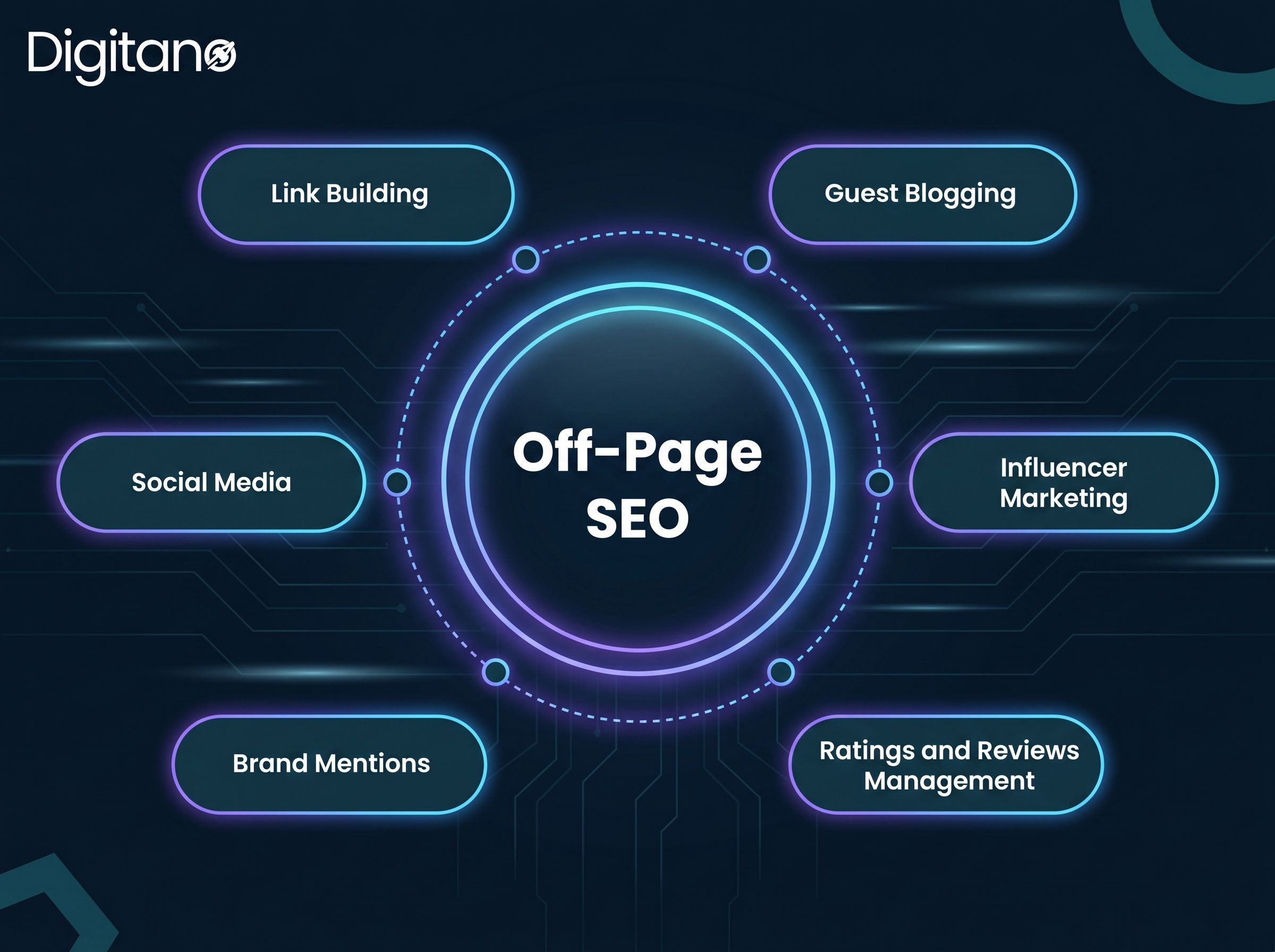
Off-page SEO is everything that happens away from your own website that influences how search engines perceive your authority and trustworthiness. The most important off-page signal by far is backlinks links from other websites pointing to yours. But it also includes brand mentions, social signals, reviews, and your broader digital reputation.
The logic behind off-page SEO is actually quite intuitive. If a lot of respected, relevant websites link to your page, it signals to Google that other people find your content worth referencing. It's essentially a vote of confidence from the rest of the internet.
The main off-page SEO elements include:
- Backlinks Links from external websites pointing to your content (the most important off-page factor)
- Domain authority: The overall strength of your site's backlink profile, built over time
- Brand mentions: References to your brand name online, even without a direct link
- Guest posting: Publishing content on other relevant sites with a link back to yours
- Digital PR: Getting your content, data, or opinion pieces covered by media outlets
- Social signals: Shares and engagement on social platforms (indirect influence on visibility)
- Local citations: Listings in directories like Google Business Profile, Yelp, and industry directories
- Reviews: Customer reviews on Google and other platforms, especially important for local SEO
Why Backlinks Still Matter in 2026
There's been a lot of debate in the SEO industry about whether backlinks are losing their importance, especially with Google's AI developments. The honest answer is: they're still critically important, but quality has become far more important than quantity.
A study of 11.8 million Google search results found that a site's overall link authority strongly correlates with higher rankings (Backlinko). That correlation hasn't gone away.
Here's what the data shows:
- 95% of all web pages on the internet have zero backlinks — zero. This means even a modest backlink profile puts you ahead of most of the competition (SEOmator, 2025)
- 92% of websites in the top 10 Google results have a Domain Authority of 35 or higher (SEMrush, via SEO Sandwitch)
- 91% of websites ranking in Google's top 3 have a Domain Authority score above 40 (Ahrefs)
- Websites with a DA above 80 receive over 500% more organic traffic than those with a DA of 30 (Ahrefs)
- On average, link building takes about 3.1 months to show noticeable results it's a slow burn, but a powerful one (SEOmator, 2025)
The key shift in 2026 is that one high-quality backlink from a respected, relevant publication is worth vastly more than dozens of low-quality links. Quality over quantity isn't just advice it's the algorithm.
Sources: SEOmator, 2025 / SEO Sandwitch / Ahrefs
How to Build Quality Backlinks
This is the part that intimidates most people, because unlike on-page SEO, you can't just log in and fix it yourself. Building backlinks requires other people to choose to link to you. But there are strategies that genuinely work:
- Create linkable assets Original research, data studies, free tools, and comprehensive guides that people naturally want to reference
- Guest posting Write for respected publications in your industry. Digital PR has become the #1 tactic, used by 67.3% of marketers (SEOmator, 2025)
- Broken link building Find broken links on relevant websites and suggest your content as a replacement
- Digital PR Pitch your data or expert opinion to journalists. Being mentioned in news articles generates high-authority links naturally
- Earn brand mentions The more your brand is discussed online, even without links, the more Google recognises your authority
One thing to be cautious about: buying cheap backlinks. Expect to pay upwards of $300 per worthwhile backlink on an authoritative site. Links that seem very inexpensive are often spammy and can actually trigger penalties.
Source: Adam Connell / adamconnell.me, 2026
On-Page vs Off-Page: Side-by-Side
Which One Is More Important?
This is probably the most common question people ask when they first learn about the on-page/off-page distinction. The answer, honestly, is that it's the wrong question.
They're not competing with each other, they're complementary. On-page SEO is the foundation. Off-page SEO is the amplifier. Without a solid on-page foundation, backlinks have limited impact. And without off-page authority, even perfect on-page optimization will struggle to rank in competitive spaces.
Think of it this way: on-page SEO makes your site worth visiting and worth ranking. Off-page SEO convinces Google that other people think so too. You need both.
That said, there's a practical order of operations:
- Start with on-page Get your content right, fix your technical issues, optimize your titles and URLs. This is entirely in your control and costs only time
- Then invest in off-page Once your foundation is solid, start building links and your broader online presence
- Keep doing both SEO is not a one-time project. Rankings shift, competitors build links, content needs updating. It's an ongoing process
A Quick Note on Technical SEO
You'll sometimes see technical SEO mentioned as a third category alongside on-page and off-page. Technically (no pun intended), it's a subset of on-page SEO but it deserves a mention because it's often overlooked.
Technical SEO covers the infrastructure of your site: how quickly it loads, whether it's mobile-friendly, how well search engines can crawl and index it, and whether there are any structural issues like broken links, duplicate content, or redirect errors.
A few technical benchmarks worth knowing:
- Over 62% of global web traffic now comes from mobile devices if your site isn't mobile-optimized, you're failing the majority of visitors
- 53% of mobile users abandon a site that takes longer than 3 seconds to load
- Google processes around 8.5 billion searches per day a technically broken site simply won't get its fair share of that traffic
Tools like Google Search Console and Google PageSpeed Insights are free and will show you exactly what needs fixing. There's really no excuse for leaving obvious technical issues unaddressed.
Source: Statista / SE Ranking, 2025
Frequently Asked Questions
Q1: Should I focus on on-page or off-page SEO first?
A. Always start with on-page SEO. There's no point driving traffic or building backlinks to a page that's slow, poorly structured, or doesn't properly address what users are searching for. Fix your content, titles, URLs, and technical foundation first. Once that's solid, start working on off-page authority. Trying to do both simultaneously before your on-page foundation is ready is just spreading thin effort across too many things.
Q2: How many backlinks do I need to rank on page one?
A. There's no magic number; it depends entirely on your industry, the competitiveness of the keyword, and the quality of the links. What the data shows is that 95% of web pages have zero backlinks, which means even a handful of quality links from relevant, respected sites can make a meaningful difference. Focus on quality over quantity. One link from a respected industry publication is worth far more than fifty links from low-quality directories.
Q3: Do social media links count as off-page SEO?
A. Social media links are technically 'nofollow,' which means they don't pass direct link authority to your site the way editorial backlinks do. However, social signals aren't completely irrelevant either. High social engagement increases your content's visibility, which can lead to more people naturally linking to it. Think of social media as an amplifier for your content; it helps your work get seen by the people who might link to it, rather than being a direct ranking signal itself.
Q4: How long does off-page SEO take to work?
A. Link building typically takes around 3 months before you see noticeable movement in rankings. Building meaningful domain authority takes 6–12 months of consistent effort. This is why off-page SEO is often described as a long-term investment. Don't judge it by month-one results. The businesses that win at SEO are the ones that commit to it consistently over time, not the ones looking for a quick boost.
Source: SEOmator, 2025
Q5: Can I rank without backlinks?
A. Yes, in certain cases particularly for low-competition, niche, or long-tail keywords where there's not much content to compete with. If you're targeting highly competitive keywords in a crowded industry, you'll almost certainly need backlinks to rank alongside established sites. For smaller businesses in local markets or specialized niches, solid on-page SEO combined with a strong Google Business Profile can often rank well without a significant backlink campaign.
Q6: What is a good Domain Authority score?
A. Domain Authority (DA) is a score developed by Moz ranging from 1 to 100. It's not a Google metric Google has its own internal authority calculations but it's a useful proxy for benchmarking. Position #1 results average a DA of 71, while position #10 averages DA 49. The key is not to chase a specific number in isolation, but to compare your DA against the specific competitors you're trying to outrank. A DA of 30 might be plenty in a low-competition niche, while you'd need 60+ in a competitive national market.
Source: Ranktracker / Moz data, 2025
Q7: Does on-page SEO include technical SEO?
A. Yes. Technical SEO page speed, mobile-friendliness, crawlability, site structure is a subset of on-page SEO because it all happens on your own website. The reason it's sometimes discussed separately is because it requires a more technical skill set than content and titles. For most small businesses, the practical approach is to handle technical SEO first (fix the obvious issues), then focus on content and keyword optimization, and then invest in off-page link building.
Final Thoughts
On-page and off-page SEO are not rivals; they're the two halves of one strategy. Trying to rank with only one of them is like trying to drive with one hand tied behind your back. It's not impossible, but you're making things harder than they need to be.
The businesses that rank consistently well in 2026 are doing the boring, foundational work properly: clean site structure, well-written content that actually answers questions, fast page loads on mobile, and a steady effort to build genuine relationships and earn real backlinks. No tricks. No shortcuts. Just doing the basics better than the competition.
If you're new to SEO and not sure where to start, here's the shortest version of a plan that works:
- Step 1: Audit your on-page basics Use Google Search Console to spot technical issues, and check your title tags, meta descriptions, and content quality on your most important pages
- Step 2: Fix what's broken Slow pages, missing titles, thin content, broken links. These are easy wins that compound over time
- Step 3: Create content worth linking to Answer real questions, publish original insights, and build resources your audience will find genuinely useful
- Step 4: Start building relationships Guest posts, digital PR, industry partnerships. Earn links the right way, and they'll serve you for years
- Step 5: Measure and adjust Track your rankings, traffic, and CTR in Search Console every week. Double down on what's working, cut what isn't
SEO isn't complicated. It's just consistent. The businesses that treat it as a long-term investment rather than a one-time project are the ones that win.