AI-assisted coding tools have moved from novelty to necessity for most software teams in under two years. GitHub Copilot, Claude Code, ChatGPT, and Cursor now write meaningful portions of the code shipped by teams across the US, and productivity gains are legitimately real. But underneath the marketing and speed metrics, the honest picture of AI-assisted software development risks is genuinely concerning. Recent 2026 security research from Veracode found that 45 percent of AI-generated code contains security vulnerabilities, with some studies pushing that number as high as 62 percent for design or security flaws. That's not a minor issue you can patch around; it's a systemic pattern that requires a fundamental rethink of how development teams operate.
This guide walks through the specific hidden risks of AI-assisted development in 2026, backed by real security research from named authorities, along with practical mitigation strategies that don't require abandoning AI tools entirely. If you'd rather have an experienced team help you build safer AI-augmented development workflows for your business, our digital marketing services and consulting work at Digitano LLC include this kind of technical strategy for organizations navigating the new AI landscape.
Why This Matters More in 2026 Than It Did Last Year
The AI coding landscape has shifted meaningfully in the past 18 months. AI tools now generate 30 to 40 percent of enterprise code according to 2026 industry data, and 86 percent of organizations use third-party packages with critical vulnerabilities in AI-driven environments. Meanwhile, the EU Cyber Resilience Act (which entered force in December 2024) begins imposing product vulnerability reporting requirements starting September 11, 2026, with main obligations applying from December 11, 2027. The regulation applies to manufacturers, importers, and distributors of products with digital elements sold or made available in the EU market, and it prescribes that products must arrive on the market free from known exploitable vulnerabilities.
For US teams selling into or operating in the EU, this shifts AI-generated code from a productivity question to a regulatory compliance one. The days of treating "the AI wrote it" as a defense are effectively over.
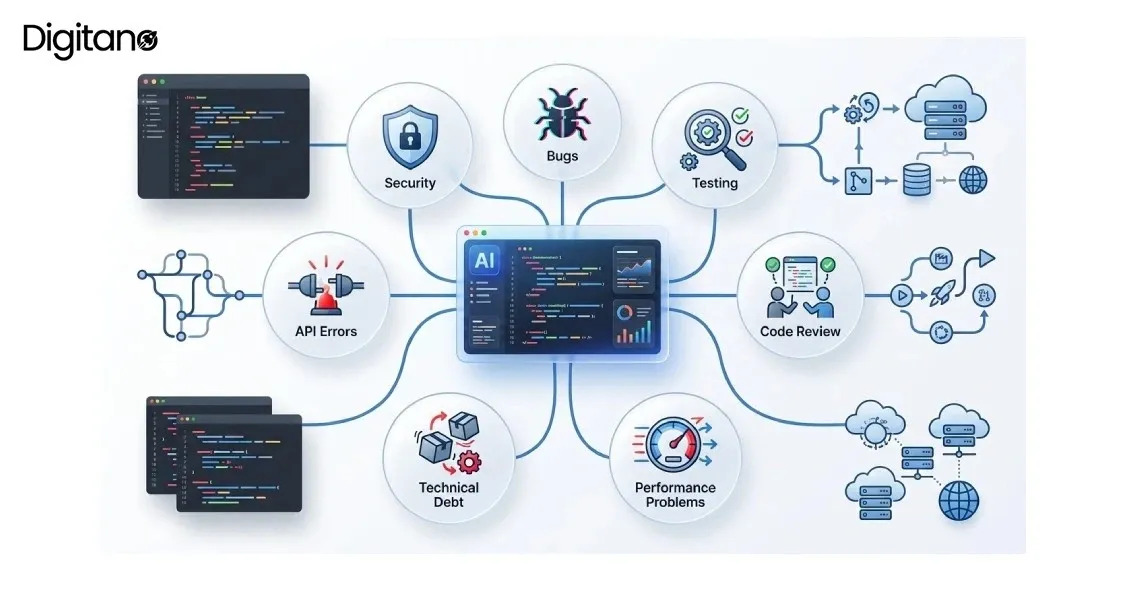
Risk #1: Security Vulnerabilities at Scale
This is the biggest, most-documented risk category, and the numbers are genuinely alarming. Veracode's 2025 GenAI Code Security Report found that 45 percent of AI-generated code contains security vulnerabilities. Independent research has pushed that number as high as 62 percent for design or security flaws depending on the specific study.
The most common vulnerability categories AI tools introduce include:
- SQL injection paths where AI-generated database queries don't parameterize inputs properly
- Cross-site scripting (XSS) vulnerabilities in front-end code that doesn't properly sanitize user input
- Insecure deserialization in AI-generated data handling logic
- Missing authentication and authorization checks in AI-generated API endpoints
- Overly permissive CORS configurations in generated backend services
The pattern behind these vulnerabilities is worth understanding: AI models learn from training data that includes both secure and insecure code, and they can systematically reproduce coding anti-patterns from that training data. This means the vulnerabilities aren't random; they're patterns the AI has "learned" and will reproduce until the underlying training or prompting is adjusted.
Risk #2: Prompt Injection and Supply Chain Attacks
Prompt injection has become the defining new attack surface of the AI era, and the 2026 data shows how serious it's become. CrowdStrike's 2026 threat reporting documented prompt injection attacks against more than 90 organizations. Security assessments found that 73 percent of AI systems evaluated in 2026 showed exposure to prompt injection vulnerabilities, with attack success rates ranging from 50 to 84 percent depending on configuration.
What makes prompt injection particularly dangerous in an AI-assisted development context:
- Malicious content embedded in third-party libraries, documentation, or dependency descriptions can influence AI coding assistants during development
- AI-generated code that calls external APIs is vulnerable to prompt injection through returned data
- Development tools that use AI to analyze pull requests can be tricked into approving malicious changes through cleverly crafted commit messages or code comments
Traditional input validation doesn't defend against prompt injection because the "input" is often the natural language documentation or comments developers rely on daily. This is a fundamentally new class of vulnerability that requires new defenses.
Risk #3: Overly Broad Permissions in Generated Code
One of the most underreported risks in AI-assisted development is the tendency to generate code with permissive default settings. 2026 industry data shows that 41 percent of AI-generated backend code includes overly broad permission settings, and 33 percent of cloud-based AI-generated scripts expose privilege escalation pathways. Misconfigured IAM roles appear in nearly 50 percent of AI-assisted cloud deployments.
The core issue: AI coding tools tend to default to admin-level access controls without role restriction because that produces working code faster. Sixty percent of developers reportedly fail to adjust permission scopes in AI-generated code before deployment, meaning these overly broad permissions propagate directly to production.
This is exactly the kind of issue that violates the principle of least privilege, which is foundational to secure application design. When it becomes the default across dozens or hundreds of AI-generated code sections, the aggregate risk to your infrastructure grows significantly.
Risk #4: Hallucinated Dependencies (Package Confusion Attacks)
AI coding tools sometimes reference package names, functions, or APIs that don't actually exist. This "hallucination" problem has enabled a new attack pattern called dependency confusion or slopsquatting: attackers register malicious packages with names that AI tools commonly hallucinate, waiting for developers to blindly install them.
The mechanism is straightforward and dangerous:
- An AI coding assistant suggests importing a package that doesn't exist
- The developer, trusting the AI suggestion, runs the install command
- If an attacker has registered a malicious package with that hallucinated name, the malicious package installs instead
- The malicious code has now entered the developer's project, and potentially the production environment
This is a genuinely novel attack surface enabled specifically by AI coding tools, and defending against it requires reviewing every dependency an AI tool suggests before installing.
Risk #5: Data Leakage Through AI Tools
AI coding tools that transmit code to external services create meaningful data leakage risks. IBM's 2026 X-Force Threat Intelligence Index found that over 300,000 ChatGPT credentials were discovered in infostealer malware in 2025. When those credentials get stolen, attackers gain access to entire conversation histories, which often contain sensitive business information: proprietary business logic, API keys, database schemas, and internal architectural decisions.
For teams using AI coding tools, this creates concrete data leakage vectors:
- Proprietary source code sent to AI tools becomes part of the tool's data flow
- Sensitive business logic embedded in code becomes exposed to potential AI-service breaches
- Environmental variables, secrets, or credentials accidentally included in AI queries can leak
- Company-specific architectural patterns become visible to any AI service processing your code
The mitigation is meaningful: enterprise-grade AI tools with data-handling agreements (like private-hosted Claude, self-hosted alternatives, or vendor solutions with explicit data-processing commitments) meaningfully reduce this risk compared to consumer chat interfaces.
Risk #6: Technical Debt That Compounds Silently
Beyond security, AI-assisted development creates a distinct form of technical debt that's genuinely dangerous because it's invisible. When AI generates code that "works" without being reviewed for maintainability, testability, or alignment with existing architectural patterns, the codebase quietly accumulates:
- Duplicate logic where AI generates similar functionality multiple times rather than reusing existing utilities
- Inconsistent patterns where AI-generated code follows different conventions than the surrounding human-written code
- Untested paths where AI-generated code doesn't include appropriate test coverage
- Poor documentation where AI-generated code doesn't clearly explain intent or design decisions
- Overly complex solutions where AI generates working code that's harder to maintain than a simpler alternative
The compounding problem: AI tools trained on codebases full of AI-generated code will produce more AI-generated code with the same patterns. Teams that don't actively enforce code quality standards on AI output are quietly building codebases that become progressively harder to maintain, evolve, and secure.
Risk #7: Loss of Deep Understanding Across Development Teams
This is a more subtle but genuinely important risk. When developers rely on AI to generate significant portions of code, they can lose the deep understanding of how that code actually works. When something breaks in production, that lack of understanding becomes a crisis. When a security vulnerability needs patching, that lack of understanding delays the fix. When a junior developer needs to learn how the system works, there's no experienced developer who genuinely understands the AI-generated portions.
This isn't a hypothetical: it shows up concretely in production incidents where teams struggle to debug AI-generated code they don't fully understand. The pattern is worth watching for on any team that uses AI extensively for code generation.
Risk #8: Over-Reliance on Hallucinated Vulnerability Findings
Interestingly, AI tools used for security analysis introduce their own hidden risks. Research across 245 active security researchers in 2026 found that 50 percent cited false positives as their top concern with AI-assisted security tools, and 48 percent were concerned about hallucinated vulnerability findings.
This means the AI tools intended to help catch AI-generated vulnerabilities may themselves be misleading. Development teams that trust AI security scanning without human review may miss real vulnerabilities while chasing false positives.
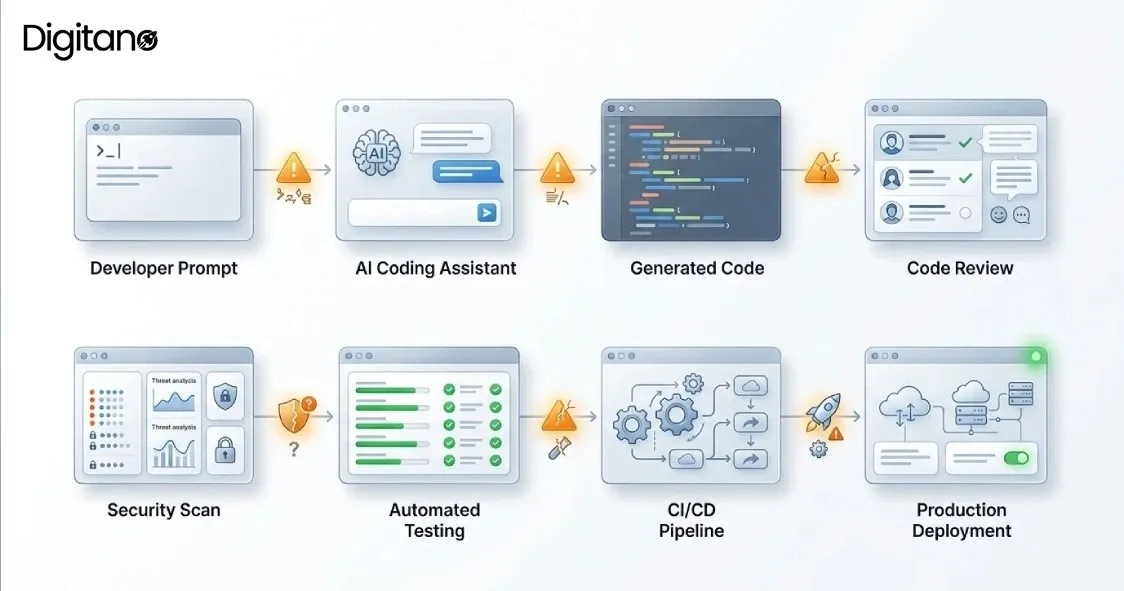
Practical Mitigation Strategies
The good news: none of these risks require abandoning AI tools entirely. They do require intentional, disciplined engineering practices layered on top of AI-augmented workflows.
1. Every Line of AI-Generated Code Gets Human Review
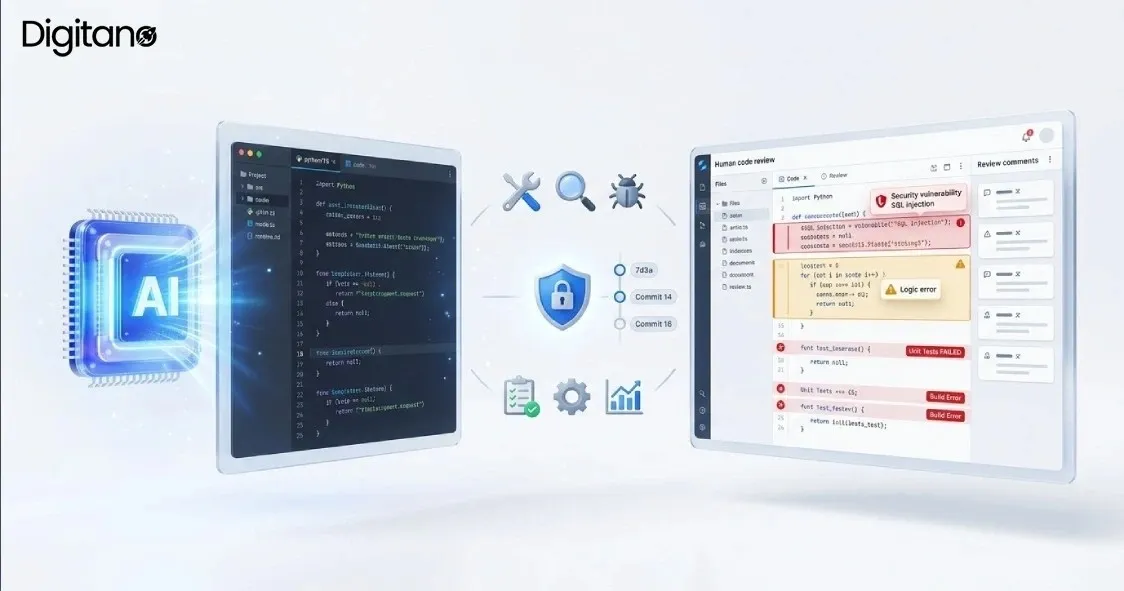
This is the non-negotiable foundational practice. AI-generated code should never be committed to a production codebase without meaningful human review, particularly for security-sensitive areas like authentication, authorization, data handling, and external API integration.
2. Automated Security Scanning on All AI-Generated Code
Configure your CI/CD pipeline to run automated security scanning tools (SAST, DAST, dependency scanning) on every commit. Don't rely solely on AI to check other AI's work. Use dedicated security tools like Veracode, Snyk, Checkmarx, or open-source alternatives like Semgrep and Bandit.
3. Verify Every Dependency Before Installing
Before installing any package an AI tool suggests, verify:
- The package actually exists on the official registry (npm, PyPI, Maven Central, RubyGems)
- The package has meaningful download history and community adoption
- The package's most recent release wasn't uploaded within the last 24 hours by an unknown author
- The package matches the exact name and version the AI suggested (case-sensitive)
4. Enforce Principle of Least Privilege
Explicitly review permission scopes on any AI-generated code that touches authentication, authorization, cloud IAM, or API access. Never accept "admin" default permissions when a more restricted role would work. Configure your linting and code review tools to flag overly permissive patterns.
5. Isolate Sensitive Code From AI Tools
For code that handles secrets, credentials, or particularly sensitive business logic, avoid using AI tools that transmit code externally. Use IDE-based AI tools with proper data handling agreements, or handwrite these portions.
6. Establish Coding Standards That Apply Equally to AI Output
The same standards you apply to human-written code (consistent patterns, appropriate test coverage, clear documentation, proper error handling) should apply to AI-generated code without exception. This is often the difference between AI as productivity tool and AI as invisible technical debt generator.
7. Prompt Injection Defense in Application Code
For applications that use AI tools at runtime (agents, LLM-powered features), implement:
- Explicit separation between user-provided input and system prompts
- Validation of AI responses before they trigger consequential actions
- Rate limiting and anomaly detection on AI-invoked API calls
- Detailed logging of AI decision paths for incident investigation
8. Ongoing Training and Awareness
Development teams need ongoing awareness of AI-specific security patterns. This isn't a one-time training event; it's an ongoing conversation as attack patterns evolve. Consider regular internal security reviews focused specifically on AI-generated code and workflows.
Common Mistakes Teams Make With AI-Assisted Development
Based on repeated patterns from 2026 security research and industry reports:
- Assuming AI code is production-ready. Speed is genuinely faster, but production readiness requires human review, testing, and security validation.
- Skipping test coverage on AI-generated code. AI-generated code deserves the same test rigor as human-written code, and arguably more.
- Trusting AI-suggested dependencies without verification. Package confusion attacks are a real and growing threat.
- Using consumer AI tools for proprietary business code. Data handling matters; enterprise tools with proper agreements exist for good reasons.
- Treating AI as a replacement for security review rather than a supplement. AI security tools have real value but genuine limitations, including false positives and hallucinated findings.
- Failing to update team practices as AI tools evolve. The AI landscape shifts rapidly, and last quarter's best practices may not be sufficient for this quarter's tools.
- Ignoring the regulatory dimension. The EU Cyber Resilience Act and similar regulations create real compliance obligations that ignoring AI-generated vulnerabilities won't satisfy.
Frequently Asked Questions
Q1: How safe is AI-generated code in 2026?
The honest answer is: less safe than most developers assume. Independent security research consistently finds that 45 to 62 percent of AI-generated code contains vulnerabilities of some kind, and many of these are exploitable. AI-generated code requires the same or greater security scrutiny than human-written code before deployment.
Q2: Should we stop using AI coding tools because of these risks?
Not necessarily. AI coding tools genuinely improve productivity when used with appropriate discipline. The right approach is layered defense: use AI for productivity gains, apply rigorous human review, run automated security scanning, verify all dependencies, and treat AI output as a starting point rather than a final product.
Q3: What's the single biggest hidden risk?
For most teams in 2026, it's likely the combination of overly broad permissions in AI-generated code and the failure of most developers to adjust those permissions before deployment. This creates systemic security debt that compounds silently across a codebase.
Q4: How do we protect against prompt injection attacks?
Traditional input validation doesn't defend against prompt injection because the attack surface is the natural language processing itself. Effective defenses include: explicit separation of user input from system prompts, validation of AI responses before consequential actions, rate limiting on AI-invoked API calls, and detailed logging of AI decision paths. New tools specifically designed for LLM security are emerging.
Q5: Does the EU Cyber Resilience Act affect US developers?
Yes, if your products or services are sold or made available in the EU market. The regulation applies to manufacturers, importers, and distributors of products with digital elements, and it requires products to arrive on the market free from known exploitable vulnerabilities. Product vulnerability reporting requirements begin September 11, 2026, with main obligations from December 11, 2027.
Q6: Are premium enterprise AI tools genuinely safer than consumer tools?
For data handling specifically, generally yes. Enterprise tools typically include explicit data processing agreements, isolation from other customers' data, and options for private-hosted deployment. This meaningfully reduces the data leakage risk that comes with consumer chat interfaces. Whether the underlying code generation is meaningfully safer depends on the specific tool.
The Bottom Line
AI-assisted software development is genuinely transformative for productivity, and it's also introducing hidden risks that require serious engineering discipline to manage. The data from 2026 security research is clear: 45 to 62 percent of AI-generated code contains security vulnerabilities, 73 percent of AI systems are exposed to prompt injection, and 41 percent of AI-generated backend code has overly broad permissions. These aren't marginal issues; they're systemic patterns that require intentional mitigation.
The good news: AI tools remain valuable when combined with human review, automated security scanning, dependency verification, least-privilege enforcement, and ongoing team awareness. The teams navigating this well aren't the ones avoiding AI. They're the ones using it thoughtfully within disciplined engineering practices.
For organizations that need help building safer AI-augmented development workflows or navigating the evolving regulatory landscape, Contact Digitano LLC. We help teams turn the productivity gains of AI into sustainable engineering practices that manage risk while capturing real value.