A Complete Guide to Building Your App Without Wasting Time or Money
You have a great idea for an app. You know it can solve a real problem. But then the big question hits you: where do you even begin to build it?
For startups, choosing the right app development platform is one of the most important early decisions you will make. Get it wrong, and you could burn through your budget, waste months of development time, or end up with an app that cannot scale.
Startups that launch the right app at the right time have a genuine shot at capturing a piece of that growth. But here is the challenge: there are dozens of platforms out there, each promising to be the best. Some are built for speed. Some are built for scale. Some cost almost nothing. Some will drain your seed funding before you even launch.
This guide cuts through the noise. We have broken down the best app development platforms for startups in 2026, explaining what each one is good for, who it is best suited to, and what you need to watch out for. By the end, you will know exactly where to start.
Why Your Choice of Platform Matters More Than Ever in 2026
A few years ago, most startups faced a simple choice: build a native iOS app, a native Android app, or a mobile website. Today, the options have exploded. You can build with no-code tools, low-code platforms, cross-platform frameworks, or full custom development.
According to Gartner, 70% of new applications built by enterprises in 2026 use low-code or no-code technologies, up from less than 25% in 2020. And by 2026, 80% of low-code users will come from outside formal IT departments. Among startups, this shift is even more pronounced. Why? Because speed to market is everything.
A CB Insights study found that 42% of startups fail because there is no market need for their product. The faster you can build, test, and validate your idea with real users, the faster you learn whether you have a winning product. The right platform gives you that speed.
Cost also matters enormously. Based on industry data from over 5,000 app development projects, the average cost of custom mobile app development in 2025-2026 is approximately $171,450, with most small to mid-business applications falling between $50,000 and $150,000 depending on complexity (Cynoteck / Netguru, 2025-2026). However, cross-platform frameworks reduce costs by 30-50% compared to separate native builds, and no-code tools can bring an MVP down to a few thousand dollars.
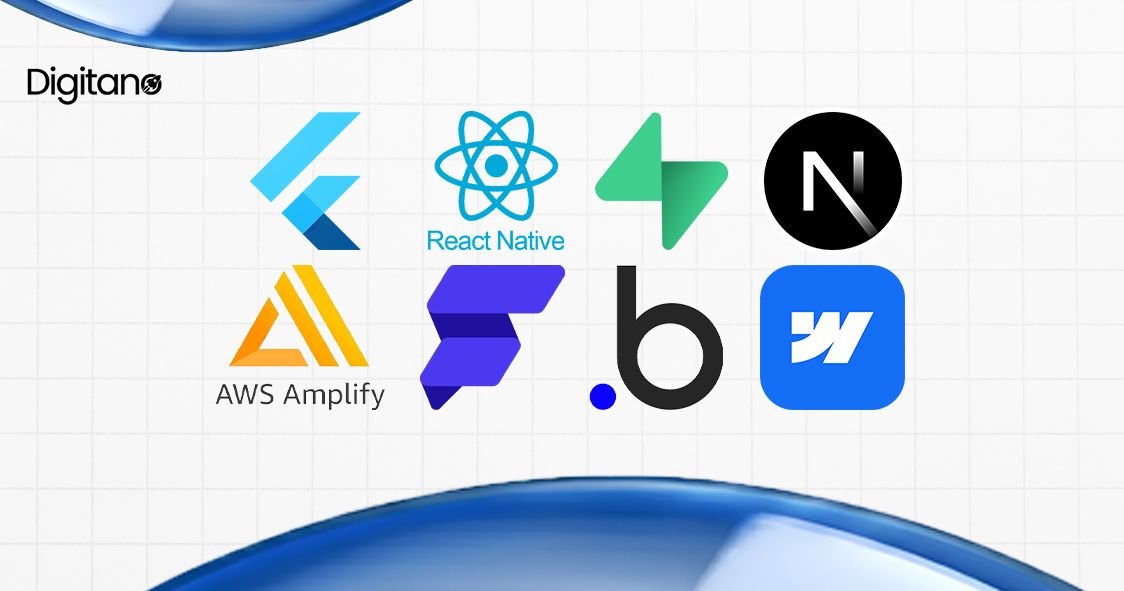
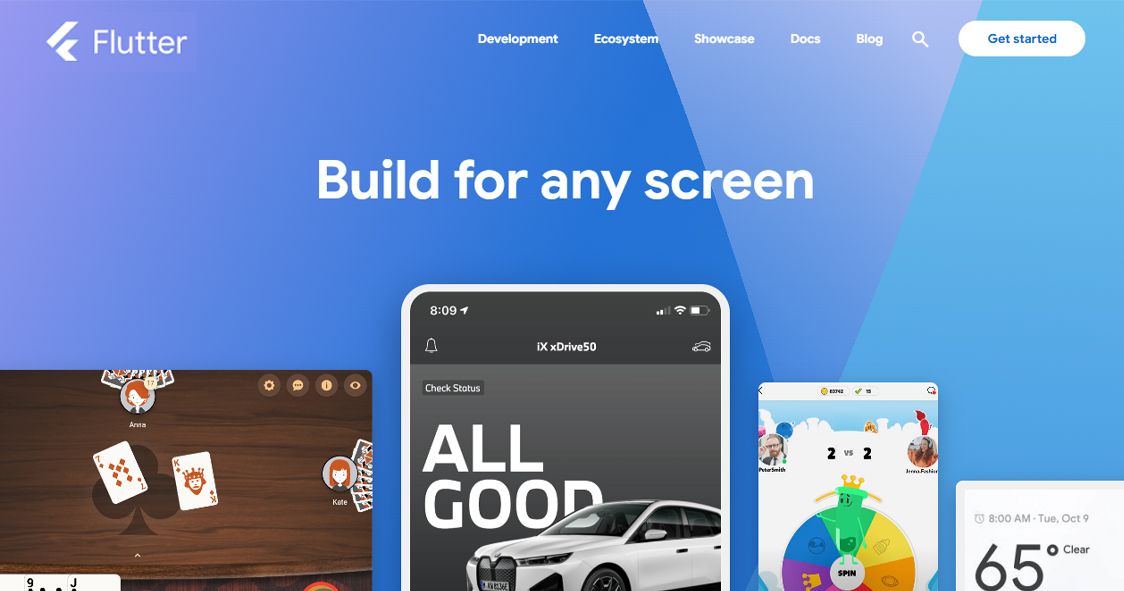
1. Flutter: Best for Cross-Platform Mobile Apps
Key 2026 Stats:
- ~175,000 GitHub stars as of early 2026 more than any other mobile framework (DevNewsletter, 2026)
- Holds approximately 46% of the cross-platform mobile market share in 2026 (Statista / TechAhead, 2026)
- Flutter's Impeller rendering engine (which replaced Skia on iOS) now delivers consistent 120fps performance
- Saves 30-50% of development cost compared to building separate iOS and Android native apps (Cynoteck, 2025-2026)
- Used by brands including BMW, eBay Motors, Google Pay, and Hamilton the Musical
- In 2026, Flutter is estimated to power roughly 1 in 4 new mobile apps across iOS and Android (DevNewsletter, 2026)
Best For: Startups that need to launch on both iOS and Android quickly without doubling their development costs. Particularly strong for apps requiring rich, visually polished UIs.
Watch Out For: Flutter apps can have slightly larger memory footprint than native apps. You will also need developers familiar with Dart, Flutter's programming language, which has a smaller talent pool than JavaScript; there are 3-4x more JavaScript developers available in North American markets. Flutter developer salaries average about 7% higher than React Native developers.
2. React Native: Best for JavaScript-Friendly Teams
Key 2026 Stats:
- ~125,000 GitHub stars as of early 2026 (DevNewsletter, 2026)
- Holds approximately 35-38% of the cross-platform market share in 2026 (Statista, 2026)
- React Native's 'New Architecture' (Fabric, JSI, TurboModules) is now fully production-ready in 2026, closing the historical performance gap with Flutter
- JavaScript is still the most widely used programming language globally React Native talent pool is 3-4x larger than Flutter/Dart developers (Stack Overflow, 2025)
- Used by major apps including Facebook, Instagram, Shopify, and Microsoft's Office apps
- Can share up to 90% of code between iOS and Android
Best For: Startups with existing web developers who know JavaScript. It makes it easy to build a mobile app using skills your team already has, and hiring is significantly faster and cheaper.
Watch Out For: While the New Architecture has closed the performance gap significantly, Flutter still leads on raw benchmark scores for complex animations. React Native has more job openings but also more legacy codebases to compete with. Keeping dependencies updated in a large ecosystem means more maintenance.
3. Bubble: Best No-Code Platform for Web Apps
Key 2026 Stats:
- In 2026, 70% of new enterprise applications use low-code or no-code technologies (Gartner) no-code is firmly mainstream, not a toy for non-technical founders
- The global low-code/no-code market is forecast to exceed $44.5 billion by 2026, growing toward $101.7 billion by 2030 (Gartner / Hostinger, 2026)
- No-code platforms can reduce development time by up to 90% compared to traditional coding (multiple industry sources, 2025)
- 87% of enterprise developers already use low-code in some form (Forrester, 2025)
- Bubble plans start from free, with paid plans from $32/month (Bubble, 2026)
- Apps built on no-code tools achieve 30% higher user retention rates on average and 75% meet or exceed performance expectations (Adalo, 2026)
Best For: Non-technical founders who want to build and validate a web app MVP fast without hiring developers. Bubble supports complex logic, user authentication, real-time databases, payment processing, and API integrations.
Watch Out For: Bubble is excellent for MVPs but can hit performance and customization limits as you scale to tens of thousands of daily active users. It is best used to validate your idea and generate early revenue. Plan your transition to custom development before you need it.
4. Supabase + Next.js: Best for Tech-Savvy Startup Teams
Key 2026 Stats:
- Next.js downloads exceeded 25 million per week on npm in 2024 and continued growing into 2026 it is used by TikTok, Twitch, Hulu, and thousands of startups
- Supabase crossed 1 million databases in 2024, raised $80M Series C, and continues to be the leading open-source Firebase alternative
- 51% of U.S. business is now conducted online web-first startups using Next.js have a clear distribution advantage (Tailor Brands, 2025)
- Free tier includes 500MB database storage and 2GB file storage enough to validate a product with real users at zero infrastructure cost
- Vercel (Next.js host) offers zero-config global CDN deployments, putting startup performance on par with major platforms
- AI integration is now a baseline expectation. Supabase and Next.js both have strong, documented AI/LLM tooling support for building AI-powered features in 2026
Best For: Technical startup teams that want full control, fast performance, and modern developer experience without the overhead of managing infrastructure. Ideal for building web-first products that need to scale.
Watch Out For: This stack requires developers with solid knowledge of React, JavaScript or TypeScript. It is not suitable for non-technical founders building solo. Plan your backend architecture carefully before scaling decisions made early compound over time.
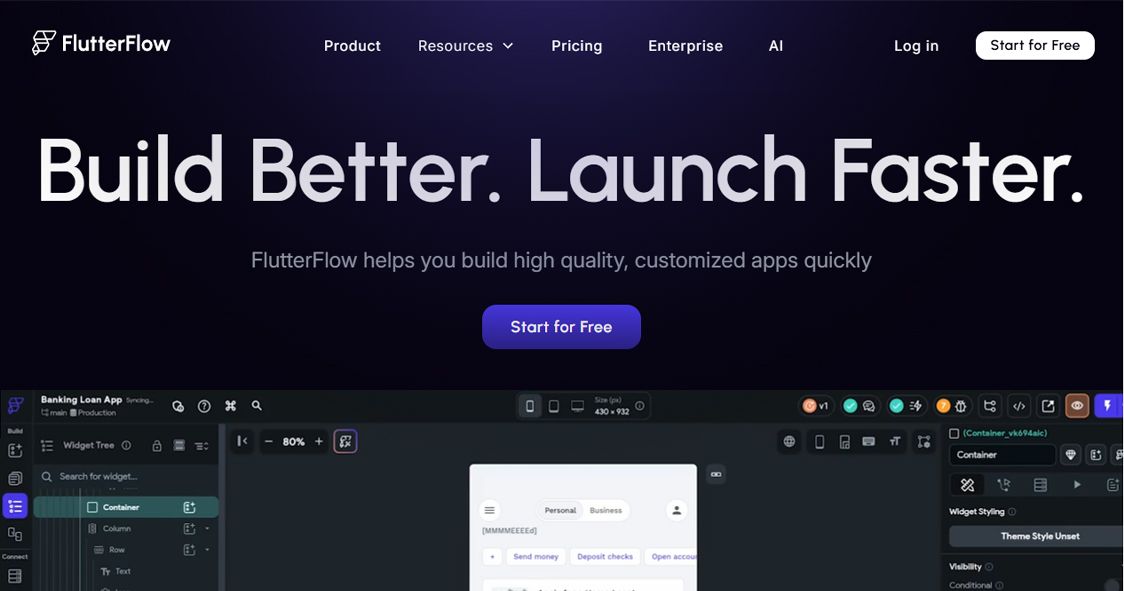
5. FlutterFlow: Best Low-Code Mobile App Builder
Key 2026 Stats:
- Over 700,000 developers and founders using FlutterFlow as of 2024, continuing to grow in 2026
- Backed by Google and deeply integrated with Firebase and Supabase
- Paid plans start from $30/month with code export available on all paid tiers
- Supports real-time data, custom API integrations, Stripe payments, push notifications, and AI integrations out of the box
- Low-code tools can compress development timelines from 6-12 months to as little as 1-4 weeks for an MVP
- 72% of users successfully develop and launch an app within three months using low-code platforms (industry survey, 2025)
Best For: Founders who want to build a mobile app faster than hiring a full team, but still want to own the codebase and transition to custom Flutter development later. The code export feature is the key differentiator from pure no-code tools.
Watch Out For: The exported Flutter code can sometimes be complex and hard to maintain cleanly as your project grows. Plan your architecture before you build, not after. AI-assisted app builders are also emerging in 2026 (including FlutterFlow's own AI features) that further speed up this workflow.
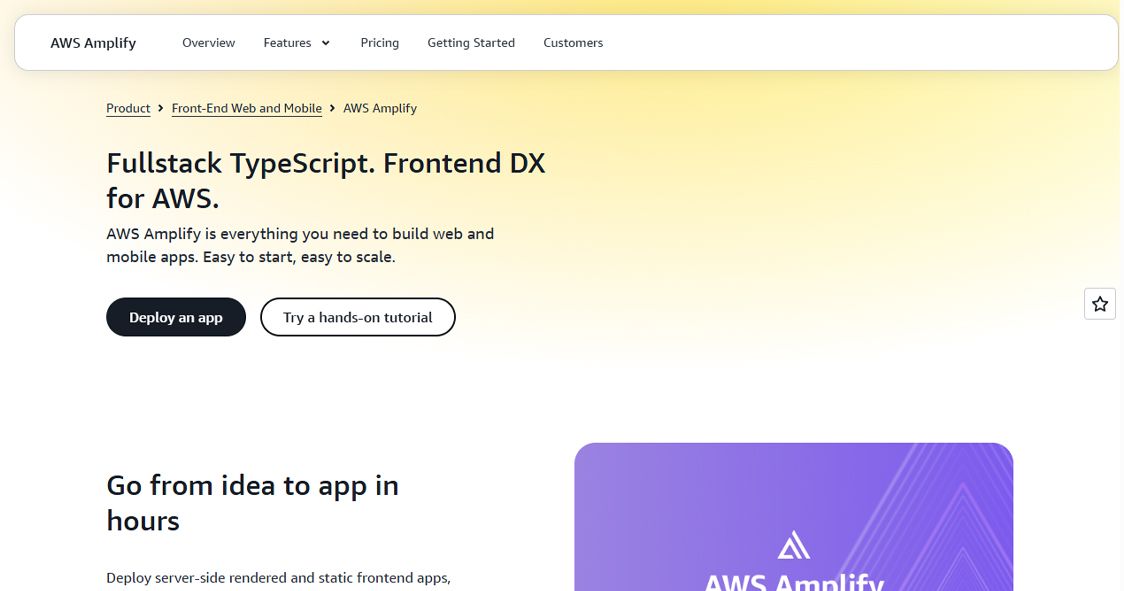
6. AWS Amplify: Best for Enterprise-Ready Startups
Key 2026 Stats:
- AWS holds approximately 30% of the global cloud market share the largest of any provider and powers the infrastructure behind Netflix, Airbnb, and NASA (Synergy Research, 2025)
- AWS Amplify supports React, Vue, Angular, Next.js, Flutter, and more
- Startup credits available through AWS Activate program up to $100,000 in credits for eligible startups
- Built-in support for compliance standards including HIPAA, SOC 2, and GDPR critical for healthtech and fintech founders
- 5G subscriptions will reach 2.9 billion by end of 2026, making cloud-native, scalable infrastructure more important than ever (Ericsson Mobility Report, 2026)
- 89% of organizations have adopted multi-cloud strategies building on AWS from day one avoids migration headaches later
Best For: Startups in regulated industries such as fintech and healthtech, or those planning rapid user growth who need enterprise-grade infrastructure from day one. If you expect serious scale, Amplify gives you the infrastructure of a Fortune 500 company.
Watch Out For: AWS can have a steep learning curve, and costs can escalate quickly without careful monitoring. Always set billing alerts from day one. If your product is still unvalidated, consider a simpler stack first and migrate to Amplify when you have real users.
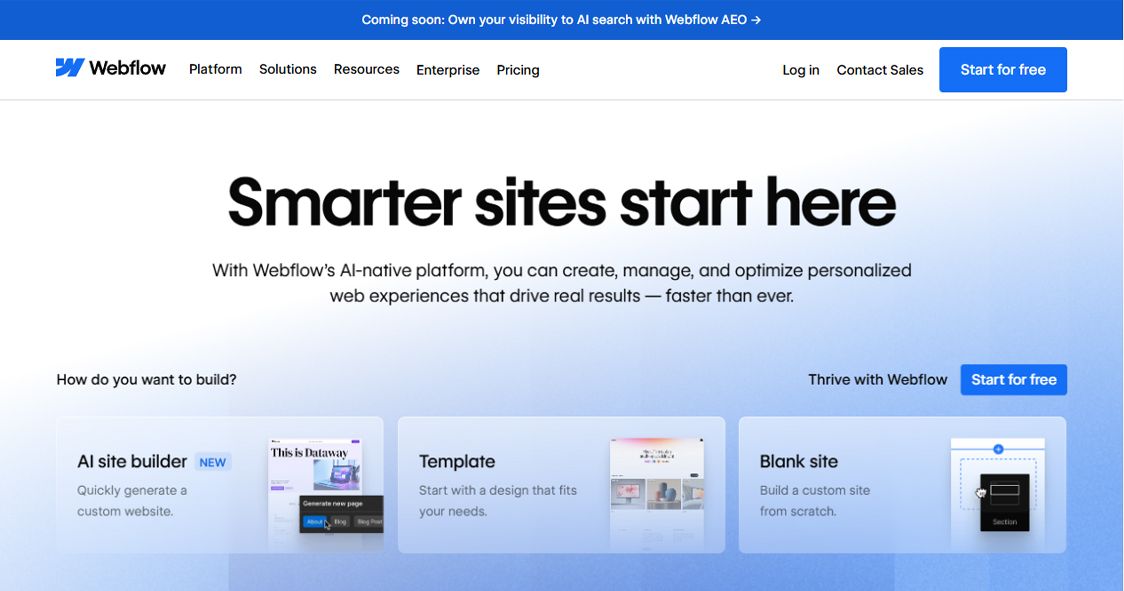
7. Webflow: Best for Marketing-First Startups
Key 2026 Stats:
- Webflow powers over 3.5 million websites globally and is used by brands including Dropbox, Lattice, and Dell (Webflow, 2024)
- Valued at $4 billion following its 2022 Series C a well-funded, stable platform
- Sites built in Webflow load significantly faster than comparable CMS alternatives on average
- Built-in CMS, e-commerce, and SEO tools all in one platform with no plugins required
- Over 63% of all website visits in 2026 come from smartphones Webflow sites are fully responsive by default (DemandSage, 2026)
- Webflow is also gaining AI-assisted design and content features in 2026, making it faster to build high-quality landing pages
Best For: Startups that want a professional, high-converting web presence fast while they build their actual product in the background. Perfect for generating waitlists, capturing leads, and testing messaging before you spend on development.
Watch Out For: Webflow is not suitable for building complex web applications. It is a marketing and content platform, not an app builder. Do not try to use it as one use Bubble or Next.js for that. Webflow pricing scales with team size, so plan accordingly.
Platform Comparison at a Glance
Use this table to quickly match the right platform to your startup's situation:
How to Choose the Right Platform for Your Startup
Here is a simple framework to help you decide:
Do you have a technical co-founder or developer on your team?
Yes → Flutter, React Native, or Supabase + Next.js give you the most control and scalability. No → Start with Bubble (web) or FlutterFlow (mobile).
Are you building for mobile, web, or both?
Mobile only → Flutter or React Native. Web only → Bubble, Next.js, or Webflow. Both → Flutter or React Native with a web companion, or Supabase + Next.js for a unified web-first approach.
What is your timeline?
Need to launch in weeks → Bubble, FlutterFlow, or Webflow. Have 3-6 months → Flutter, React Native, or full custom stack.
Are you in a regulated industry like fintech or healthtech?
Yes → AWS Amplify for enterprise-grade security and compliance from day one. HIPAA and SOC 2 compliance built in saves months of architecture work.
Do you need AI features?
In 2026, AI integration has moved from a nice-to-have to a baseline expectation in many consumer and B2B apps. Flutter, React Native, Next.js, and Supabase all have strong AI tooling support. FlutterFlow and Bubble are also adding AI-assisted development features. If AI is central to your product, factor in an additional $10,000-$30,000 to your build budget (Cynoteck, 2025-2026).
Frequently Asked Questions (FAQs)
Q1: What is the cheapest way for a startup to build an app in 2026?
A: The cheapest way is to use a no-code or low-code platform. Bubble is free to start for web apps, and FlutterFlow starts at $30 per month for mobile apps. Both allow you to build a fully functional MVP without hiring a development team. No-code tools can reduce development time by up to 90% and have ROI payback periods as short as 7 months (Forrester / Kissflow, 2025-2026). Once you have validated your idea and raised funding, you can invest in custom development.
Q2: Should a startup build a native app or a cross-platform app?
A: For most startups, cross-platform is the smarter choice in 2026. Platforms like Flutter and React Native let you build once and deploy on both iOS and Android, cutting development cost and time by 30-50% compared to separate native builds. Flutter currently holds approximately 46% of the cross-platform market share in 2026, with React Native at 35-38% (Statista, 2026). Native development only makes sense if your app requires very complex, platform-specific features like deep hardware integration or advanced AR that cross-platform frameworks cannot handle.
Q3: Can I really build a serious app with no-code tools?
A: Absolutely. No-code has grown up significantly in the last few years. By 2026, 70% of new enterprise applications use no-code or low-code technologies (Gartner). Apps built on these tools achieve 30% higher user retention rates and 75% meet or exceed performance expectations (Adalo, 2026). Bubble in particular supports complex logic, user authentication, real-time databases, payment processing, and API integrations. It is more than capable of supporting a real, revenue-generating business.
Q4: How long does it take to build an app using these platforms?
A: It depends on the platform and complexity. With Bubble or FlutterFlow, a simple MVP can be ready in 1 to 4 weeks. With Flutter or React Native and a small team, expect 2 to 6 months for a full MVP. With a custom full-stack build using Next.js and Supabase, 3 to 6 months is typical for a solid v1. AI-assisted development workflows are compressing all of these timelines. In 2026 some agencies report cutting project timelines by 30-50% using AI coding tools. Building for both iOS and Android natively (no cross-platform framework) can add 30-50% to your total timeline and budget.
Q5: What platform is best if I have no technical background?
A: If you have no technical background, start with Bubble for web apps or FlutterFlow for mobile apps. Both have visual drag-and-drop interfaces with extensive tutorials and active communities. Webflow is also excellent if you just need a professional marketing website to launch your brand and capture early leads. In 2026, AI-assisted features in these platforms will also make it faster and easier to build without coding many platforms now let you describe what you want in plain language and generate components for you.
Q6: Will my app be able to scale if I start on a no-code platform?
A: No-code platforms can scale to a meaningful point. Bubble can handle thousands of users on its higher-tier plans. However, if you reach tens of thousands of daily active users or need very complex performance optimization, you may eventually need to migrate to a custom-built solution. The key insight is this: most startups never reach that scale. According to CB Insights, 42% fail because of no market need well before scaling becomes a problem. Build fast, validate first, and tackle scaling problems when they are real problems.
Q7: Is Flutter or React Native better for startups in 2026?
A: Both are excellent. Flutter holds ~46% of cross-platform market share in 2026 and surpassed React Native in GitHub stars (~175K vs ~125K), making it the more popular choice among developers exploring new technologies. Flutter's Impeller rendering engine delivers consistent 120fps performance and superior UI consistency. React Native has a 3-4x larger talent pool due to JavaScript's dominance, making hiring faster and cheaper in North American markets, there are significantly more React Native job postings than Flutter. If your team already knows JavaScript, go with React Native. If you are hiring fresh or prioritizing UI quality, Flutter is an excellent pick for 2026.
Q8: Do I need to hire developers to use these platforms?
A: Not always. No-code platforms like Bubble and Webflow are designed to be used without developers. Low-code platforms like FlutterFlow significantly reduce the need for developers. However, for Flutter, React Native, Next.js, and AWS Amplify, you will need coding knowledge or a developer on your team. If your budget is tight, consider hiring a freelance developer on platforms like Toptal, Upwork, or Contra for a specific build phase rather than a full-time hire. AI-assisted development tools in 2026 also allow semi-technical founders to accomplish more than was previously possible without a dedicated developer.
Final Thoughts
Choosing an app development platform is not a decision to stress over for months. It is a decision to make quickly and revisit as you grow. Many of the most successful startups in the world started with simple tools and evolved their tech stack over time.
Instagram started as a simple app built in 8 weeks. Airbnb's first version was a basic website with hard-coded HTML. The point was never to build something perfect. It was to build something real, get it in front of users, and learn.
In 2026, you have better tools than any generation of founders before you. No-code platforms let you launch an MVP in days. Cross-platform frameworks cut your development cost by 30-50%. Cloud platforms like AWS give a two-person startup the infrastructure of a Fortune 500 company. And AI-assisted development tools are compressing timelines. Even further projects that took 6-9 months a few years ago are being delivered in 3-5 months with AI-assisted coding workflows.
The startup that waits for the perfect tech stack never ships. The startup that ships something, learns from real users, and keeps improving is the one that wins.
Pick the platform that fits your team, your timeline, and your budget right now. Build, launch, learn, and iterate. That is the startup way in 2026.