A practical, no-jargon look at what's actually changing on the ground
Let me paint you a picture.
It's Monday morning. Sarah, a Scrum Master at a mid-sized fintech company in London, sits down for sprint planning. Two years ago, this meeting would take three to four hours sticky notes everywhere, spreadsheets open, everyone arguing about story points. Today? Her AI planning tool has already analyzed last sprint's velocity, flagged three potential bottlenecks, and drafted a suggested sprint backlog overnight. The meeting wraps in 45 minutes.
Meanwhile, across town, a developer named James is reviewing code but not code he wrote. His AI coding assistant generated it. His job now is less about writing every line and more about making sure it all fits together, meets quality standards, and doesn't introduce security risks.
This is Agile in 2026. It looks different. It feels different. And if your team is still running Agile the way you did in 2021, you might already be falling behind.
First, Let's Talk Numbers
Before we get into what's actually changing, here are some facts worth knowing.
According to the State of Agile Report 2025, AI adoption inside Agile teams has jumped from 68% to 84% in just one year. That's not a slow trend, that's a wave. And yet, only 49% of those teams have proper governance guardrails in place. In other words, more than half of teams using AI tools have no real system to check if the AI is doing the right thing.
McKinsey reports that AI-augmented Agile teams deliver projects up to 35% faster, with 25% fewer post-release defects. GitHub's own research shows developers using AI coding assistants complete certain tasks up to 55% faster. These aren't small gains. These are numbers that change business cases and hiring decisions.
And the market is responding. Global enterprise agile transformation services are growing at a CAGR of 19.5%. The Agile market overall is expected to hit $96.28 billion by 2029, up from where it stands today.
So yes, AI and Agile are not separate conversations anymore. They have the same conversation.
The Big Shift: From "Tool" to "Teammate"
Here's the thing nobody tells you in the marketing brochures.
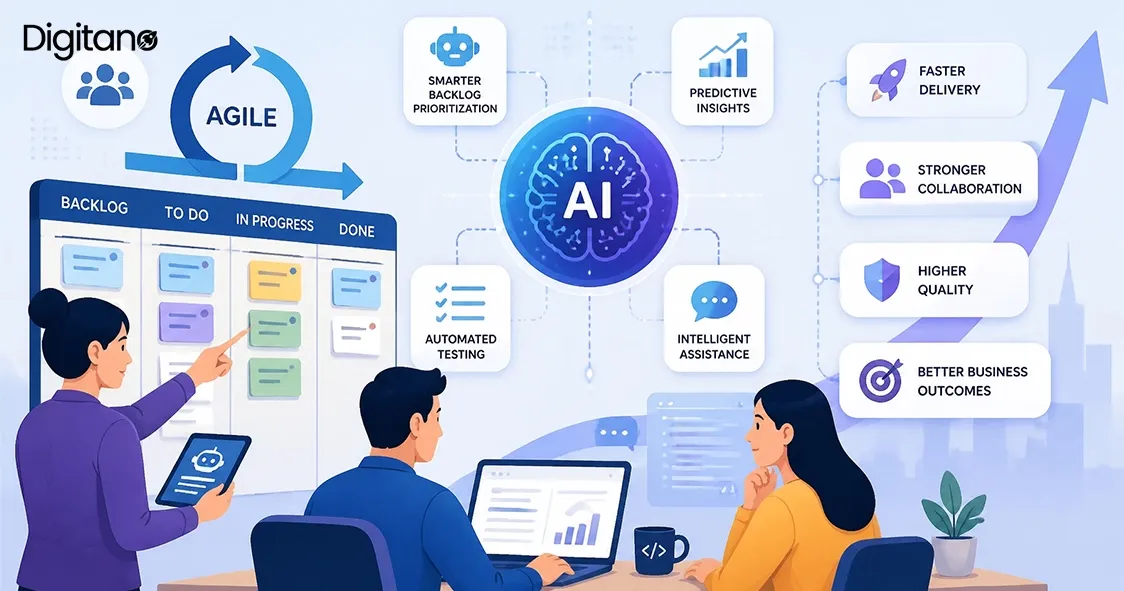
AI started as a helper. You'd ask it to write a unit test or summarize a meeting. That was useful, but it wasn't transformational. What's happening in 2026 is different. AI is no longer just assisting it is actively participating in the software delivery lifecycle.
Researchers at ScienceDirect published a paper this year calling this evolution "AI-gile." Their analysis found three major patterns in how AI is changing Agile: human/AI role re-balancing, collaboration management, and principle erosion and regeneration. That last one is the most interesting. Some old Agile principles are being replaced by new ones, not abandoned, just updated for a world where your team includes both humans and machines.
Think about the original Agile Manifesto from 2001. It said "individuals and interactions over processes and tools." In 2026, some of those interactions now involve AI. The question teams are asking is: how do we keep the human part at the center while letting AI handle the noise?
What's Actually Changing Day-to-Day
1. Sprint Planning Is Getting Smarter (Not Replaced)
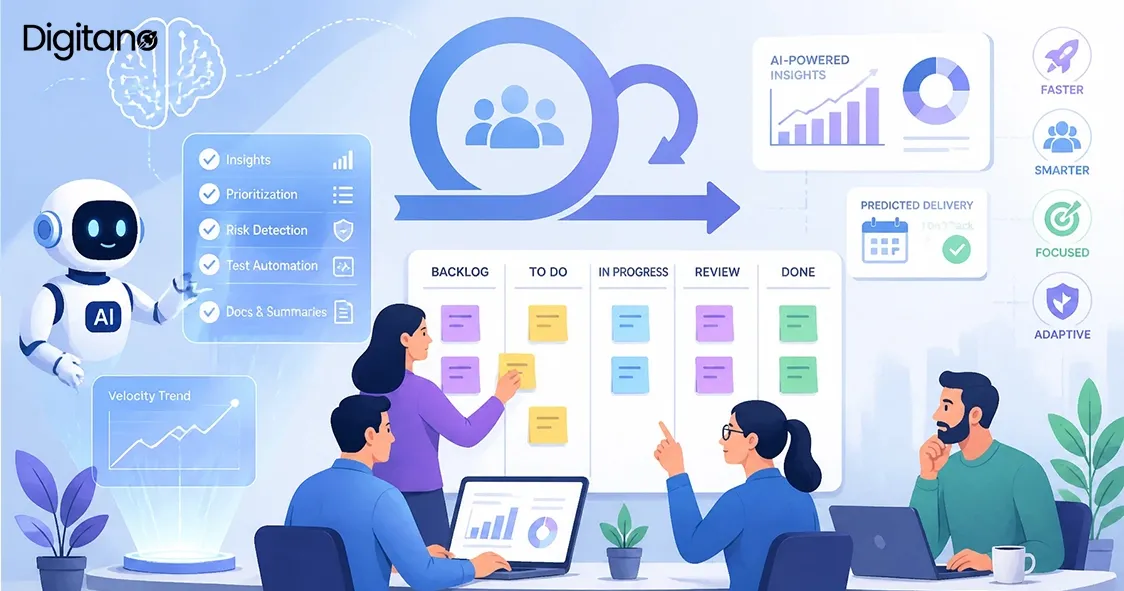
Remember spending hours estimating story points? Tools like Jira's AI assistant and Monday.dev Copilot are changing that. They analyze historical sprint data, team capacity, and even external factors like holiday calendars to suggest sprint plans that are genuinely realistic.
But and this is important, the decision still belongs to the team. The AI suggests, the humans decide. Teams that get this balance right are moving faster without burning out.
Real-world example: A software team at a logistics company in Germany reported cutting their sprint planning meetings from four hours to 90 minutes after introducing AI-assisted planning. They didn't remove the meeting. They made it sharper.
2. Developers Are Becoming Integrators
This is a big cultural shift, and it's not always comfortable.
Developers in 2026 spend less time writing boilerplate code and more time reviewing, integrating, and quality-checking AI-generated code. Studies show productivity gains of 20–50% for routine tasks like writing unit tests, documentation, and standard functions.
But here's the real talk: junior developers are feeling the squeeze. The "Velocity Paradox" a term coined this year describes a strange situation where teams ship code faster but experience more instability. Why? Because AI generates code quickly, but if junior developers aren't learning how to evaluate it, technical debt piles up quietly until something breaks in production.
This is a real problem. One engineering manager in a startup told his team: "We're writing more code than ever, but I'm not sure we understand all of it anymore." That should make every tech lead pay attention.
3. The Scrum Master Is Becoming a Coach, Not an Admin
Traditionally, a lot of a Scrum Master's time went into facilitation logistics scheduling meetings, tracking metrics, chasing updates, writing retrospective notes.
AI is swallowing that work. Tools can now summarize standups, generate retrospective insights from sprint data, track sentiment in team communication, and automatically flag when a team's velocity drops.
What this frees up is the human stuff. Conflict resolution. Team morale. Coaching underperformers. Building psychological safety. The best Scrum Masters in 2026 are those who lean into being a people leader, not a process police officer.
One Scrum Master at a healthcare tech company put it plainly: "I used to spend 30% of my week on reporting. Now I spend that time actually talking to my team."
4. Product Owners Are Becoming Product Managers
This role evolution is significant. The classic Product Owner job was mostly about managing the backlog writing user stories, prioritizing tickets, saying yes or no to features.
In 2026, AI tools handle a big chunk of that. They analyze user feedback, monitor product analytics, sort support tickets by theme, and even suggest roadmap priorities based on market trends.
So what does the human do? Strategy. Customer empathy. Vision. Stakeholder management. The role is expanding to look more like a full Product Manager who owns the entire product lifecycle from idea to launch to post-release improvement not just the backlog.
This is why organizations are now listing "Product Manager" on job postings where they used to say "Product Owner." The title change reflects a real change in responsibility.
The Governance Gap: The Biggest Risk Nobody Talks About
Here is the part that should make every tech leader uncomfortable.
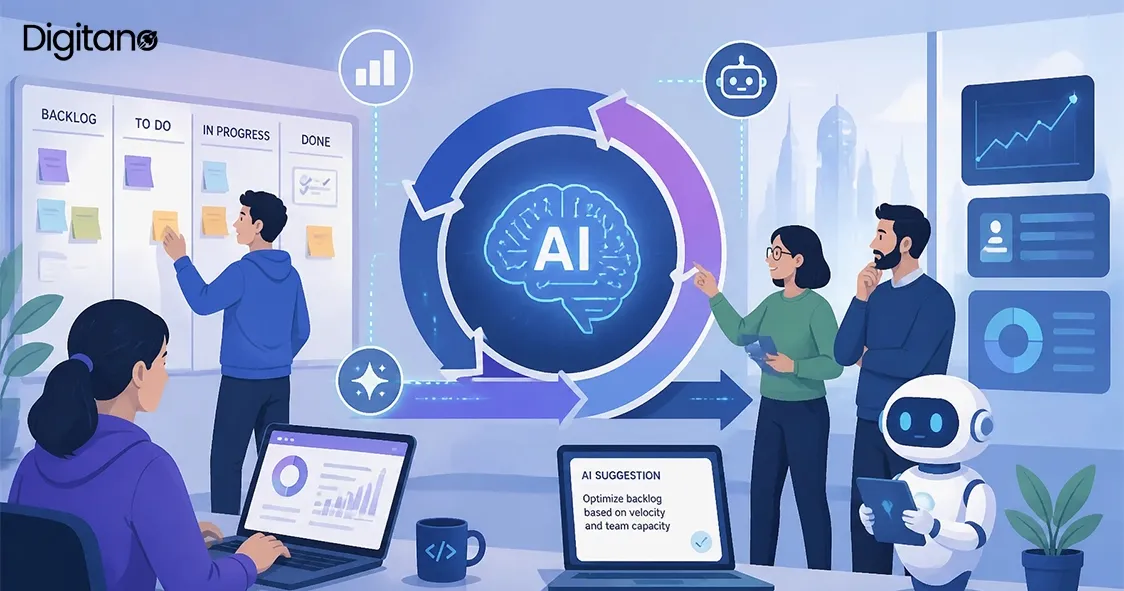
Only 49% of organizations using AI in their Agile processes have governance guardrails in place. That means more than half of companies are letting AI make or influence decisions without a solid system for checking if those decisions are good.
What does that look like in practice? AI-generated code going into production without proper security review. Backlog priorities shaped by AI recommendations that no one questioned. Sprint plans built on flawed historical data.
The companies getting this right are building what's called "validation pipelines" checkpoints where humans review what the AI produced before it moves forward. It's not about distrusting AI. It's about being accountable for what ships. Because when something goes wrong in production, the AI doesn't get the incident ticket. Your team does.
The New Agile ManifestoYes, Really
In 2026, the Project Management Institute and the Agile Alliance jointly released the "Manifesto for Enterprise Agility." It's essentially an update to the original 2001 document, and it reflects how much has changed.
The key difference? The original Manifesto was about team-level practices. Sprint here, retrospective there. The new one treats agility as a strategic organizational capability, something that lives at the executive level, not just in the engineering team.
It emphasizes purpose-driven alignment, shared outcomes, and human-centric adaptability. Translation: Agile is no longer just how developers work. It's how the whole company thinks about change.
This matters for leaders. If you're an executive who still thinks "Agile is a developer thing," 2026 is the year to update that view.
What's Not Changing (And Shouldn't)
Amidst all this transformation, it's worth being clear about what AI cannot and should not replace.
Agile is fundamentally about learning under uncertainty. No AI can do that for you. AI can speed up the loops. It can flag risks. It can reduce noise. But the ability to look at ambiguous customer feedback, make a judgment call, and decide what to build next that's a deeply human skill.
The best teams in 2026 are not the ones with the most AI tools. They're the ones who use AI to remove friction so humans can focus on judgment, creativity, and collaboration.
As one tech leader wrote recently: "If coding gets faster but lead time doesn't improve, the bottleneck was never engineering output. It was prioritization, dependencies, validation, and decision latency." That's still true. AI doesn't fix a broken prioritization process. It just makes the mess happen faster.
Practical Tips: How to Adapt Right Now
If you're leading an Agile team today, here's what to actually do:
Start small with AI tooling. Don't try to replace your entire workflow overnight. Pick one repetitive pain point, maybe it's generating test data, or summarizing standups and automate just that. See what happens. Then expand.
Invest in governance before you need it. Before AI-generated code hits production, define who reviews it and what the criteria are. Build that habit now, not after an incident.
Reskill your junior developers. They need to learn how to evaluate AI output, not just accept it. Code review skills, system thinking, and security awareness are more important than ever.
Upgrade your metrics. Velocity is becoming a less useful number. Cycle time, lead time, and deployment frequency are better indicators of whether AI is actually helping. Track outcomes, not output.
Talk to your Scrum Masters. Ask them what administrative work they're still doing that could be automated. Then free that time up for real coaching.
Frequently Asked Questions (FAQs)
Q1: Is AI replacing Agile teams entirely?
A: No, and this is probably the most common fear people have. AI is not replacing Agile teams. It's changing what those teams spend their time on. The repetitive, administrative work writing meeting notes, generating reports, and tracking metrics is being automated. But strategic thinking, customer empathy, conflict resolution, and creative problem-solving? That still needs humans. In fact, many Agile roles like Scrum Master and Product Owner are becoming more important, not less, because their focus is shifting to higher-value work.
Q2: What AI tools are Agile teams actually using in 2026?
A: The most widely used tools right now include GitHub Copilot and Amazon Q Developer for writing and reviewing code, Jira's AI assistant and Atlassian Intelligence for sprint planning and backlog refinement, and tools like Monday.dev Copilot for project tracking. Teams are also using general AI assistants to summarize standups, write user stories, analyze customer feedback, and generate retrospective insights. The tools vary by team size and budget, but the pattern is the same: AI handles the noise so humans can handle the decisions.
Q3: How does AI affect sprint planning specifically?
A: AI makes sprint planning faster and more data-driven. It can analyze your last 10 sprints, identify patterns in where tasks got stuck, account for team capacity and upcoming holidays, and suggest a realistic sprint backlog often overnight. What used to take 3–4 hours can now happen in under 90 minutes. That said, the team still reviews and approves the plan. The AI gives you a better starting point; it doesn't make the final call.
Q4: What is the "Velocity Paradox" and should I be worried about it?
A: The Velocity Paradox is a real phenomenon where teams ship code faster because of AI, but experience more deployment instability and technical debt at the same time. It happens when teams accept AI-generated code without fully understanding it, especially junior developers who don't yet have the skills to evaluate what the AI produced. Yes, you should be aware of it. The fix is not to slow down AI adoption, but to invest in code review practices, stronger testing, and reskilling your junior team members so they can be effective reviewers, not just consumers of AI output.
Q5: Do I need to change my Agile framework (Scrum, Kanban) to work with AI?
A: Not necessarily from scratch, but you will likely need to adapt some practices. For example, traditional story point estimation doesn't account well for AI-assisted tasks that take near-zero time. Some teams are moving to a tiered estimation model zero-point stories for fully automated tasks, standard story points for human-led work, and a new "review and integrate" category for tasks where a human reviews AI output. The core Scrum or Kanban structure can stay, but how you measure effort and success inside it needs updating.
Q6: Is it safe to use AI-generated code in production?
A: It can be, but only with proper governance in place. The biggest risk right now is that more than half of companies using AI in their development process have no formal review process for AI-generated code. That means code with security vulnerabilities, logic errors, or licensing issues could ship without anyone catching it. Best practice is to treat AI-generated code the same way you treat any external code; it needs review, testing, and sign-off before it goes anywhere near production.
Q7: How should junior developers adapt to this AI-driven environment?
A: Junior developers need to shift their focus from "writing code" to "understanding and evaluating code." The ability to read AI-generated code critically, spot errors, understand security implications, and ask the right questions is now more valuable than being able to write boilerplate from scratch. Learning prompt engineering how to give AI clear, specific instructions is also a genuinely useful skill. The developers who thrive are those who treat AI as a powerful tool they control, not a replacement for their own thinking.
Q8: What metrics should Agile teams track in the AI era?
A: Velocity is becoming less meaningful on its own because AI can artificially inflate it without improving real outcomes. Better metrics to focus on include cycle time (how long does it take from starting a task to deploying it?), lead time (from idea to production), deployment frequency, and change failure rate. These tell you whether AI is actually improving your delivery pipeline or just making you feel busy. Customer satisfaction and business outcomes should always be the north star.
Q9: How do small teams or startups benefit from AI in Agile?
A: Small teams and startups arguably benefit the most. A two-person team with good AI tooling can now do the work that used to require five people for certain tasks. AI handles documentation, test generation, code review assistance, and backlog management all things that eat up disproportionate time on small teams. The key is to start with one or two tools that solve a specific pain point, get comfortable with them, and scale from there. Don't try to automate everything at once.
Q10: Is Agile still relevant in 2026, or is it being replaced by something new?
A: Agile is absolutely still relevant in fact, it's more relevant than ever. What's dying is what some people call "Agile theater": the checkbox meetings, the rigid ceremonies performed out of habit rather than purpose. The core of Agile is iterating fast, learning from feedback, adapting to change is exactly what you need when working with AI systems that produce probabilistic, sometimes unpredictable results. The 2026 Manifesto for Enterprise Agility even elevates Agile from a team practice to a company-wide strategic capability. Agile isn't going anywhere. It's just growing up.
The Bottom Line
AI is not killing Agile. It's forcing Agile to grow up.
The teams that will win in 2026 are not those who adopt every AI tool available. They're the ones who understand what Agile was always supposed to be about delivering value, learning fast, and adapting and use AI to do more of that, better.
The Agile Manifesto said: "Responding to change over following a plan." In 2026, AI is both a change to respond to and a tool to respond with.
The question is: is your team ready?