A No-Nonsense Guide for Business Owners Who Want Real Results
Picking an SEO agency feels a lot like hiring a mechanic you have never met. You know you need the service. You just do not know who to trust, how much to pay, or how to tell the difference between someone who genuinely knows their craft and someone who is just good at talking.
The stakes are real. SEO is not a small investment. According to multiple 2026 industry surveys and agency pricing reports, the average monthly retainer for an SEO agency in the USA ranges from $1,500 to $5,000 per month for small to mid-sized businesses, with mid-market companies paying $5,000 to $10,000 and enterprise organizations spending $10,000 or more. Spend that money on the wrong agency and you could waste an entire year and tens of thousands of dollars with nothing to show for it.
But here is the good news: choosing the right SEO agency is not rocket science once you know what to look for. The problem is that most business owners go into the process without a clear framework. They get dazzled by fancy decks and impressive-sounding buzzwords, and they sign a contract before asking the questions that actually matter.
This guide fixes that. We will walk you through exactly how to evaluate, vet, and choose an SEO agency in the USA that will actually grow your business. We will keep it simple, back it up with 2026 data, and give you real questions to ask before you sign anything.
Why SEO Still Matters More Than Ever in 2026
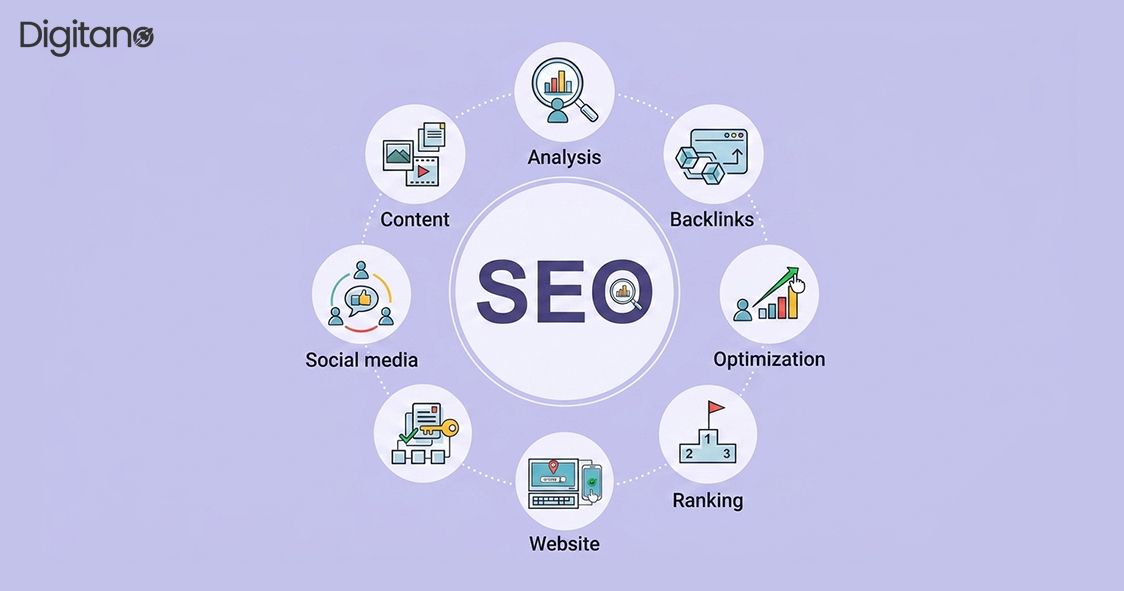
Before you spend money on an SEO agency, it helps to understand exactly what you are buying and why it is worth buying.
SEO, or Search Engine Optimization, is the process of getting your website to appear higher in Google search results when potential customers search for what you offer. It sounds simple. But the impact is enormous.
Consider these 2026 numbers:
Important 2026 context: the search landscape has shifted. AI Overviews now appear in roughly 55% of Google searches and can cut click-through rates for top-ranked pages by 34.5%. Approximately 60% of searches now end without a click to any website. This makes the work of a skilled SEO agency more important than ever not less. Businesses that invest in SEO for brand authority, AI-cited content, and genuine search intent alignment are the ones capturing the clicks that still happen.
The SEO services market in North America alone accounted for $31.4 billion of global revenue in 2025 (Xamsor, 2026). If your business is not on the first page of Google for the searches your customers are doing, you are invisible to the majority of the market. A great SEO agency's job is to fix that and increasingly, to ensure your business is also cited in AI-generated search answers.
Red Flags to Watch Out For
Before we get to what a good SEO agency looks like, let us talk about what a bad one looks like. This will save you from the most common and costly mistakes.
Walk away immediately if an agency:
- Guarantees page one rankings. No legitimate SEO agency can guarantee a specific ranking on Google. Google's algorithm is controlled by Google, not the agency. Anyone who promises you '#1 on Google in 30 days' is either lying or planning to use spammy tactics that will eventually hurt your site.
- Refuses to explain their strategy. A trustworthy agency will walk you through exactly what they plan to do, why they are doing it, and how they will measure success. If an agency says their methods are 'proprietary' and cannot be explained, that is a major red flag.
- Focuses only on vanity metrics. Rankings and traffic are good, but they are not the end goal. If an agency talks only about rankings without mentioning leads, conversions, or revenue impact, they may be optimizing for the wrong outcomes.
- Offers extremely low pricing. Agencies charging under $500 per month are almost certainly delivering automated reports and no real work. Quality SEO in 2026 requires skilled professionals and cannot be done meaningfully at rock-bottom prices. Run from anyone offering 'SEO packages' at $99 per month.
- Builds links from irrelevant or low-quality sites. Link building is a critical part of SEO, but the quality of links matters far more than the quantity. Ask any prospective agency about their link-building approach. If they mention PBNs (Private Blog Networks) or bulk link purchases, end the conversation. Note: after Google's March 2026 core update, the consequences of cheap link schemes are more severe than ever.
- Cannot show you real case studies or references. Any agency worth hiring will have a portfolio of real results they can share. If they cannot point to specific examples of businesses they have helped rank and grow, there is a reason for that.
- Publishes AI-generated content without editing or expertise. In 2026, Google actively penalizes thin AI-only content that lacks genuine expertise, authority, and trustworthiness. Any agency that mass-produces unedited AI content is putting your site at serious risk.
What a Great SEO Agency Actually Does

Now that you know what to avoid, let us look at what the best SEO agencies actually do. Understanding this helps you evaluate whether a prospective agency is the real deal.
A legitimate, results-driven SEO agency will:
- Start with a thorough audit. Before doing anything, a good agency will audit your existing website to understand what is working, what is broken, and where the biggest opportunities are. This includes technical SEO, content quality, backlink profile, Core Web Vitals, and competitor analysis.
- Build a custom strategy. There is no one-size-fits-all SEO strategy. A good agency tailors their approach to your specific industry, target audience, competition level, and business goals. If every client gets the same plan, that is a problem.
- Communicate clearly and regularly. You should receive monthly (or more frequent) reports that clearly explain what was done, what changed, and what it means for your business. Reports should include ranking movements, organic traffic trends, leads generated, and next steps.
- Focus on sustainable, white-hat techniques. White-hat SEO means following Google's guidelines: creating genuinely helpful content, building real links from reputable websites, and improving the technical health of your site. These methods take longer but produce lasting results.
- Optimize for AI-driven search visibility. In 2026, great agencies also help your business appear in Google AI Overviews and AI platforms like ChatGPT and Perplexity. This involves structured data, semantic content clarity, E-E-A-T signals (Experience, Expertise, Authoritativeness, Trustworthiness), and building a multi-platform review presence.
- Align SEO with your broader business goals. Great agencies think beyond search rankings. They understand your customer journey and optimize for the pages and keywords that actually bring in leads and revenue, not just traffic.
- Be honest when things are not working. SEO takes time, typically 4 to 12 months to see meaningful results. A good agency sets realistic expectations from day one and communicates openly if a strategy needs to change.
10 Questions to Ask Before Hiring Any SEO Agency
These are the questions that separate serious, capable agencies from the rest. Take these into every discovery call or proposal meeting.
- Can you show me case studies from businesses similar to mine in terms of industry and size?
- What does your onboarding process look like and how long before I start seeing results?
- How do you conduct keyword research and how do you decide which keywords to target?
- What is your link-building strategy and can you give me examples of the types of sites you build links from?
- How do you handle technical SEO issues like site speed, crawlability, and Core Web Vitals?
- How are you adapting your strategy for AI-driven search, including Google AI Overviews and tools like ChatGPT?
- What tools do you use and will I have access to the reports and dashboards you use?
- Who will actually be working on my account and what are their qualifications?
- How do you measure success and what KPIs will you report on each month?
- What happens to the work you have done if I decide to leave and cancel my contract?
Pay close attention not just to what the agency says but how they say it. Do they answer confidently and specifically, or do they deflect and speak in vague generalities? The quality of their communication during the sales process is usually a preview of how they will communicate once you are a client.
Types of SEO Agencies: Which One Fits Your Business?
Not all SEO agencies are the same. They come in different shapes and sizes, each suited to different types of businesses. Here are the current 2026 ranges based on aggregated industry pricing data:
Note: AI tools have reduced SEO service costs for routine tasks by 20-30% since 2024 (DigitalApplied, 2026). Agencies that have adopted AI workflows may pass some savings to clients, but strategic and creative work remains labor-intensive and commands premium pricing. The right type depends entirely on your business size, industry, goals, and budget.
How to Evaluate SEO Proposals Like a Pro
Once you have shortlisted two or three agencies, you will receive proposals. Here is how to read them critically.
A strong SEO proposal should include:
- A summary of your current SEO situation. Good agencies do pre-proposal research. If a proposal clearly shows they have already looked at your website, your competitors, and your keyword opportunities, that is a strong sign.
- A clearly defined strategy. Not just 'we will do SEO' but specifically what technical fixes will be addressed, what content will be created, what link-building activities will take place, and how the agency plans to optimize for AI-driven search visibility in the first 90 days.
- Realistic timelines. Most legitimate SEO agencies will tell you to expect 4 to 6 months before seeing meaningful traffic growth. According to SE Ranking data, 78.2% of SEOs charge on a monthly retainer basis that consistency matters because SEO is a compounding long-term investment.
- Clear pricing and deliverables. What exactly are you getting for your monthly fee? How many hours of work? How many pieces of content? How many links? Vague pricing usually means vague work.
- KPIs and reporting cadence. What metrics will they report on and how often? Make sure the answer includes organic traffic growth, keyword ranking movement, conversions from organic traffic, technical health scores, and in 2026 visibility in AI-generated search results.
One more tip: do not automatically pick the cheapest option or the most expensive. Businesses that invest consistently in SEO report an average ROI of 5.3x over 18-24 months (Search Engine Journal, 2025). Under-investing in SEO is often worse than not doing it at all, because low-quality SEO can actually damage your rankings and require costly penalty recovery work.
Contract Terms, Ownership & Onboarding: What to Know
Once you have chosen an agency, the contract stage is where many business owners make a final costly mistake. They sign without reading carefully.
Before you sign any SEO contract, confirm the following:
- You own all the content. Any blog posts, landing pages, or other content created for your website should belong to you, not the agency. If they leave, you keep the content.
- You retain access to all accounts. Your Google Analytics, Google Search Console, and any SEO tools should be in your name with the agency added as a user, not the other way around.
- Understand the contract length. Most agencies in 2026 require a minimum commitment of 6 to 12 months, which is reasonable given how long SEO takes. Many offer 30-60 day exit clauses after the initial term. Make sure there are clear performance expectations tied to any exit clause.
- Clarify what happens if you leave. Will they hand over all reports, data, and work completed? Get this in writing.
- Check for auto-renewal clauses. Some contracts auto-renew with little notice. Read the fine print.
A smooth onboarding process is also a signal of a well-run agency. Expect a kickoff call, access requests to your website and analytics accounts, an initial audit within the first two to three weeks, and a written 90-day strategy plan. If the agency disappears after signing without a structured onboarding process, that is a problem.
Frequently Asked Questions (FAQs)
Q1: How much does it cost to hire an SEO agency in the USA in 2026?
A: The cost varies widely based on the agency's size, reputation, and the scope of work involved. Based on aggregated 2026 industry pricing data, most small to mid-sized businesses pay between $1,500 and $5,000 per month for SEO services. Mid-market companies typically invest $5,000 to $10,000 per month, and enterprise organizations spend $10,000 to $50,000 or more. Local SEO campaigns often start lower, at $1,500 to $3,000 per month. Freelance SEO consultants typically charge $75 to $300 per hour in North America, with senior technical specialists commanding $200 to $400 or more. Be wary of anything under $500 per month at that price point, the work is almost certainly automated and unlikely to produce meaningful results.
Q2: How long does it take to see results from SEO?
A: SEO is a long-term investment. Most experts, including Google itself, advise businesses to expect 4 to 12 months before seeing significant results. The good news is that once rankings are established, they tend to be durable. Unlike paid ads that stop the moment you stop paying, organic rankings continue generating traffic as long as you maintain your site. Businesses that invest consistently in SEO report an average ROI of 5.3x over 18 to 24 months (Search Engine Journal, 2025), with most campaigns breaking even within 7 to 9 months.
Q3: What is the difference between local SEO and national SEO?
A: Local SEO focuses on ranking your business in searches that include geographic intent, such as 'plumber near me' or 'dentist in Chicago.' It involves optimizing your Google Business Profile, building local citations, earning reviews, and ensuring NAP (name, address, phone) consistency across directories. National SEO targets broader keywords without a geographic focus, which is typically more competitive and takes longer. If you serve customers in a specific city or region, local SEO is your priority. If you sell products or services nationwide online, you need a national SEO strategy.
Q4: Can I do SEO myself instead of hiring an agency?
A: Yes, especially for a small local business. There are excellent free resources including Google's own documentation, Moz's Beginner's Guide to SEO, and Ahrefs' blog. Tools like Google Search Console (free), Ubersuggest, and Semrush (paid) can help you manage the basics. However, SEO at a competitive level in 2026 also requires understanding AI search optimization, E-E-A-T signals, Core Web Vitals, and structured data all of which raise the expertise bar. Most business owners find that their time is better spent running their business. If you are just starting out and budget is tight, DIY SEO for 6 to 12 months is a legitimate option while you save for a proper agency engagement.
Q5: What is the difference between SEO, PPC, and content marketing?
A: SEO (Search Engine Optimization) is earning organic search rankings through content, technical improvements, and link building. It is slow to start but free to maintain once established. PPC (Pay-Per-Click) is paid advertising on search engines like Google Ads. You pay for every click, which means traffic stops the moment your budget does. Content marketing is creating helpful articles, videos, and guides that attract and educate your audience. The three strategies work best together: content feeds SEO, SEO amplifies content, and PPC provides immediate visibility while your SEO builds. In 2026, all three should also be considered with AI search visibility in mind.
Q6: How do I know if my SEO agency is doing a good job?
A: The most important metrics to monitor are: organic traffic growth (are more people visiting your site from Google?), keyword ranking improvements (are you moving up for the terms that matter to your business?), conversion rate from organic traffic (are those visitors becoming leads or customers?), and domain authority growth over time. In 2026, also ask your agency to report on your visibility in AI Overviews and whether your content is being cited in AI-generated answers. You should receive regular, clear monthly reports from your agency that explain what was done and what impact it had. If your agency cannot clearly explain what they did last month and what changed, that is a problem.
Q7: Should I hire a local SEO agency or does location not matter?
A: Location matters less than it used to. The pandemic normalized remote working relationships, and today many of the best SEO agencies in the USA work with clients across the country entirely remotely. What matters far more than location is industry experience, track record, communication quality, and cultural fit. According to a 2025 agency pricing survey by SE Ranking, 78.2% of SEOs charge monthly retainers the model itself implies an ongoing remote relationship. That said, if you specifically need local SEO for a city or region, hiring an agency with deep knowledge of that market can be a genuine advantage.
Q8: What happens if the SEO agency uses black-hat tactics on my site?
A: Black-hat SEO tactics such as keyword stuffing, buying spammy links, cloaking, or mass-publishing unedited AI content can result in a Google penalty that causes your site to lose rankings or be removed from search results entirely. After Google's March 2026 core update, the consequences of cheap link schemes and AI-only content are more severe than in previous years. If this happens, your first step is to request a full account of everything the agency did. You will then need to submit a disavow file to Google to distance your site from bad links and potentially file a reconsideration request. Recovering from a Google penalty can take many months. This is why vetting an agency thoroughly before hiring them is so critically important. Prevention is far cheaper than recovery.
Final Thoughts
Choosing the right SEO agency in the USA is one of the most important marketing decisions your business can make. Get it right, and you will build a growing stream of organic traffic that brings in leads and customers every single day without paying for every click. Get it wrong, and you could waste a year and tens of thousands of dollars on an agency that delivers reports full of numbers that mean nothing.
The good news is that choosing the right agency is absolutely doable when you know what to look for. Ask the right questions. Watch for red flags. Read proposals critically. Protect your ownership rights in the contract.
Remember what the 2026 data tells us: organic search still drives 53% of all web traffic. Google processes over 8.5 billion searches every day. The global SEO services market has crossed the $108 billion mark for the first time. And businesses that invest consistently in SEO report an average ROI of 5.3x over 18 to 24 months.
Yes, AI is changing the search landscape. Yes, click-through rates are under pressure from AI Overviews. But search demand itself has not decreased total usage of search combining search engines and AI tools has actually increased by 26% worldwide (Graphite, March 2026). The businesses that win are the ones with strong SEO foundations, genuine expertise-driven content, and agencies that understand the new AI-influenced search environment.
A great SEO agency is not a vendor. They are a growth partner. The right one will understand your business, speak honestly about timelines, communicate clearly every step of the way, and build your online presence in a way that compounds over time.
Take your time with this decision. Do your homework. The agency that is right for you is out there. This guide gives you everything you need to find them.