Practical tactics, real numbers, and zero fluff because ranking in 2026 is harder than ever, but absolutely doable.
Let's skip the part where I tell you SEO is important. You already know that. You're here because you want to know what actually works right now not strategies that worked in 2018, not vague advice about 'creating quality content,' but specific, actionable things you can do to rank higher and bring more people to your business.
The SEO landscape in 2026 is genuinely different from just a few years ago. AI Overviews have changed how search results look. Voice search has grown to over 8 billion active assistants worldwide. Zero-click searches now account for 60% of all queries. If your SEO strategy hasn't evolved to account for these shifts, you're leaving real traffic on the table.
Here are 10 strategies that are working right now backed by data, explained in plain English.
68% of all online experiences begin with a search engine. SEO drives over 1,000% more traffic than organic social media.
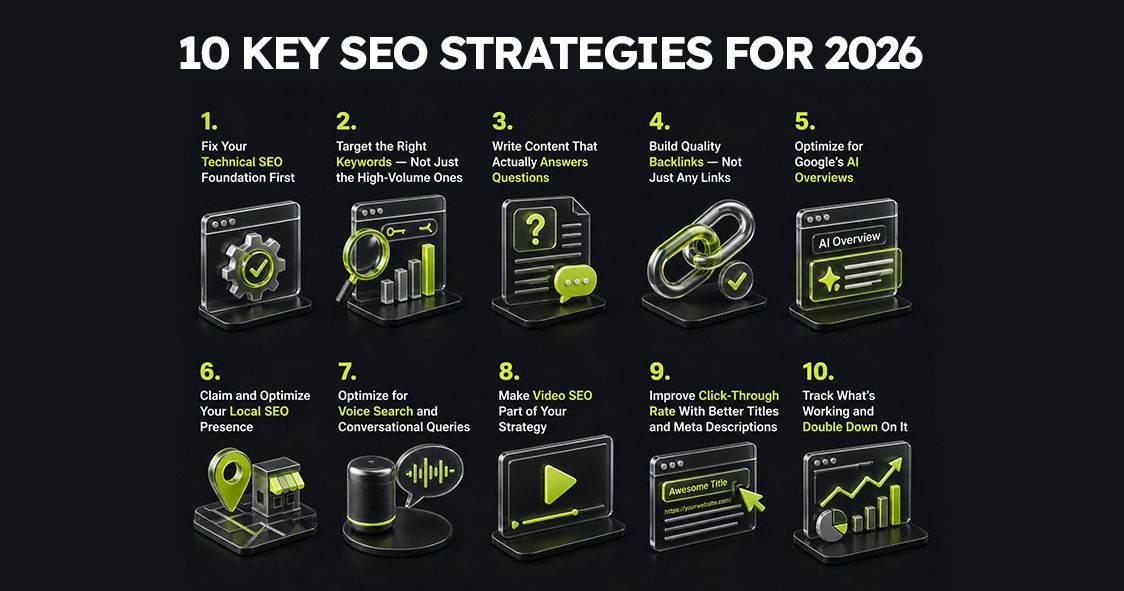
Strategy #1: Fix Your Technical SEO Foundation First
Before any other strategy can work, your site needs to be technically sound. This is the boring stuff, but it's the stuff that blocks everything else if it's broken.
Google uses Core Web Vitals as a ranking signal, which means your site's load speed, visual stability, and responsiveness directly affect where you appear in search results. A page that takes 5 seconds to load has a bounce rate probability 38% higher than one that loads in under 3 seconds. That's not a small difference.
The basics to check and fix:
- Page speed: aim for under 2.5 seconds on mobile (check with Google PageSpeed Insights)
- Core Web Vitals: LCP (Largest Contentful Paint), INP (Interaction to Next Paint), and CLS (Cumulative Layout Shift)
- Mobile responsiveness, over 62% of all global web traffic now comes from mobile devices
- HTTPS, 70.4% of voice search results come from HTTPS sites, and it's a confirmed Google ranking signal
- Crawlability, make sure Google can actually find and index your pages (check Google Search Console)
- Broken links and 404 errors, these waste your crawl budget and hurt user experience
A 1-second delay in page load time reduces conversions by 7% on average, and up to 20% on mobile.
Strategy #2: Target the Right Keywords, Not Just the High-Volume Ones
Here's the thing about keywords that most people get wrong: they chase the big numbers and ignore the realistic opportunities. A keyword with 100,000 monthly searches sounds great until you realize you're competing against Forbes, Wikipedia, and a company with a $500,000 SEO budget.
The smarter move in 2026 is to focus on long-tail keywords, phrases of three or more words that are specific to what your business actually offers. They have lower search volume but much higher intent and much lower competition.
The data backs this up:
- Over 29% of search terms with more than 10,000 monthly searches have three or more words (DemandSage, 2026)
- Nearly 74% of all keywords get 10 or fewer searches per month, but collectively they make up a massive portion of total search volume (SE Ranking, 2025)
- URLs that include target keywords earn a 45% higher click-through rate than those without (Backlinko, 2025)
Tools like Google Keyword Planner, Ahrefs, and Semrush can help you find these opportunities. Focus on keywords that match actual user intent, informational, commercial, navigational, or transactional, because Google has gotten very good at matching content to intent.
Strategy #3: Write Content That Actually Answers Questions
Google has been clear about what it wants from content for years now: helpful, reliable, people-first content. In 2026, with AI-generated content flooding the internet, the gap between genuinely useful content and AI-generated filler has become one of the most important ranking differentiators.
The E-E-A-T framework (Experience, Expertise, Authoritativeness, Trustworthiness) has never mattered more. Google wants to see content written by people who actually know what they're talking about, with real examples, first-hand experience, and a clear perspective.
Practically speaking:
- Long-form pages attract 77% more backlinks than short posts, depth signals expertise (Young Urban Project, 2026)
- The typical voice search result page has around 2,312 words, comprehensiveness helps you appear in rich results
- Approximately 15% of Google searches are brand new every day, there's always fresh opportunity if you cover topics thoroughly
- Titles with 40–60 characters consistently achieve the highest organic click-through rates (Backlinko, 2025)
Don't just write what you think people want to read. Use Google's 'People Also Ask' boxes, search autocomplete, and tools like AnswerThePublic to find the exact questions your audience is typing in.
Strategy #4: Build Quality Backlinks Not Just Any Links
Backlinks remain one of Google's strongest ranking signals in 2026. But this is also one of the areas where bad advice can genuinely hurt you. A hundred spammy links from irrelevant sites does nothing or worse, triggers a penalty.
What works is earning links from sites that are relevant to your industry, have real traffic, and are genuinely respected by Google. The data is clear:
- Pages ranking #1 on Google have 3.8x more backlinks than pages in positions 2–10 (Young Urban Project, 2026)
- Long-form, genuinely useful content is still the #1 reason other sites choose to link to you
The best link-building strategies in 2026:
- Guest posting on respected industry publications, write something genuinely useful, not promotional
- Digital PR: get your data, research, or opinion pieces picked up by journalists
- Broken link building: find broken links on relevant sites and offer your content as a replacement
- Creating 'linkable assets': original research, free tools, comprehensive guides that people naturally reference
- Internal linking: don't forget to link between your own pages. It helps Google understand your site structure and passes authority between pages
Strategy #5: Optimize for Google's AI Overviews
This is the strategy most businesses aren't thinking about yet which is exactly why it's worth paying attention to. Google's AI Overviews now appear in 47% of search results and reduce organic traffic by an estimated 15–25% for those results. That sounds bad. But it's also an opportunity.
If your content is chosen as a source for an AI Overview, you get visibility at the very top of the results page even if the user doesn't click through. And the traffic that does come from AI Overviews tends to be higher quality and more engaged.
How to optimize for AI Overviews:
- Structure your content clearly, use headings, bullet points, and direct answers to questions
- Answer the exact question in the first paragraph, then expand below, this matches how AI pulls answers
- Keep your content accurate and up-to-date, AI Overviews pull from pages Google trusts
- Maintain strong traditional SEO: websites with more organic traffic get mentioned in AI Overviews more frequently
Strategy #6: Claim and Optimize Your Local SEO Presence
If your business serves people in a specific location and most businesses do local SEO is genuinely one of the highest-ROI things you can invest time in. The numbers here are striking.
- 98% of consumers search online for nearby businesses (up from 90% in 2019) (WiserReview, 2026)
- 76% of people who perform a local search on their smartphone visit the business within 24 hours (Ahrefs / Google)
- 28% of those searches result in a purchase (Ahrefs)
- 46% of all monthly Google searches have local intent (AIOSEO, 2026)
The foundation of local SEO is your Google Business Profile. If it's not claimed, claimed it today. If it is claimed, make sure it's complete every category, every attribute, real photos, accurate hours, and a compelling description. Respond to reviews. Post updates. Google treats an active, complete profile as a strong signal of legitimacy.
Beyond Google Business Profile:
- Get consistent citations (your business name, address, phone) across directories like Yelp, Apple Maps, and industry-specific directories
- Create location-specific pages on your website if you serve multiple areas
- Encourage happy customers to leave Google reviews, reviews are a confirmed local ranking factor
Strategy #7: Optimize for Voice Search and Conversational Queries
Voice search is no longer a niche concern. There are now over 8.4 billion voice assistants active worldwide more than the global population. In the US alone, 153.5 million people are expected to use voice assistants this year.
Voice searches are fundamentally different from typed searches. They're longer, more conversational, and usually phrased as questions. Instead of 'best pizza London,' someone might say 'What's the best pizza place near me that's open right now?'
Key voice search facts for 2026:
- 76% of voice searches are local, 'near me' and location-based queries dominate (SeoProfy, 2026)
- 40.7% of voice answers come directly from featured snippets. so ranking for snippets is critical
- Only 13% of marketers currently include voice search optimization in their strategy, this is a huge gap to exploit (HubSpot)
To optimize for voice search: target question-based keywords (who, what, where, when, how), write in a conversational tone, aim for featured snippets, and make sure your site loads fast on mobile.
Strategy #8: Make Video SEO Part of Your Strategy
YouTube is the second largest search engine in the world, with over 3 billion searches per month. People search for tutorials, product reviews, how-tos, and comparisons on YouTube just as they do on Google, often before making a purchase decision.
Beyond YouTube, Google now shows video results in standard search results for many queries, especially how-to and tutorial searches. If your competitor has a well-optimized video and you don't, they're getting visibility you're missing entirely.
Video SEO basics:
- Use your target keyword in the video title, description, and tags
- Write full, keyword-rich descriptions: YouTube can't watch your video, so the description matters a lot
- Add timestamps (chapters): they help both YouTube's algorithm and viewers
- Transcribe your videos: it makes them accessible and helps search engines understand the content
- Embed videos on relevant pages of your website to improve time-on-page
Roughly 88% of consumers say they're more likely to make a purchase after watching a video about a product. Video isn't just a nice extra, it's a conversion tool.
Strategy #9: Improve Click-Through Rate With Better Titles and Meta Descriptions
Most people treat meta descriptions as an afterthought. That's a mistake. Your title and meta description are your ad in the search results, they're what convinces someone to click on your result rather than the five others on the page.
The data on what works is actually quite specific:
- Titles with 40–60 characters achieve the highest click-through rates in organic search (Backlinko, 2025)
- The #1 organic result receives 39.8% of all clicks when no featured snippet is present (FirstPageSage, 2025)
- Only 0.63% of users click on page two results, over 99% of organic traffic goes to page one (Backlinko)
Practical tips for better titles and meta descriptions:
- Include your target keyword, but write for humans first, not Google
- Use numbers when relevant, '7 ways to...' consistently outperforms generic alternatives
- Add a clear value proposition, what does the reader get from clicking?
- Test different versions using Google Search Console, monitor CTR by page and adjust titles that underperform
- Meta descriptions don't directly affect rankings, but they directly affect click-through rate, don't leave them blank
Strategy #10: Track What's Working and Double Down On It
The final strategy sounds obvious, but it's genuinely the one most businesses skip or do badly. SEO without measurement is just guessing. You need to know what's driving traffic, what's driving conversions, and where the gaps are otherwise you're spreading your effort evenly across things that may or may not matter.
The tools you need (most are free):
- Google Search Console: tracks rankings, impressions, clicks, and technical issues. This should be the first thing you check every week
- Google Analytics 4: shows what happens after people arrive: which pages convert, how long they stay, where they drop off
- Ahrefs or Semrush: for competitor analysis, keyword research, and backlink tracking (paid, but worth it for serious SEO)
- PageSpeed Insights: checks your Core Web Vitals scores and suggests improvements
What to actually measure:
- Organic traffic trends are they going up month-over-month?
- Keyword ranking positions, especially for your main commercial keywords
- Click-through rate by page, if a page ranks well but no one clicks, your title and meta description need work
- Conversion rate from organic traffic, traffic that doesn't convert is just a vanity metric
SEO delivers up to 700% ROI when executed as a consistent long-term strategy. But you only know if it's working if you're measuring it properly.
Frequently Asked Questions
Q1: How long does it take to see SEO results?
A. Honest answer: it depends on your starting point, but typically 3–6 months before you see meaningful movement for new or low-authority sites. For sites with some existing domain authority and content, it can be faster. SEO is a compounding strategy the work you put in this month pays dividends for months and years to come. Don't judge it by week-four results.
Q2: Is SEO still worth it with AI Overviews taking over search results?
A. Yes, absolutely but your strategy needs to adapt. AI Overviews are actually pulling from well-optimized, trustworthy content, so strong SEO is still what gets you featured. The businesses that will suffer are those relying purely on clicks from informational queries. If your SEO strategy includes conversion-focused content and builds genuine authority, AI Overviews become an opportunity rather than a threat.
Q3: Do I need to blog to do SEO?
A. Blogging is one of the most effective ways to build organic traffic, but it's not the only way. Product pages, service pages, landing pages, and video content all contribute. The real question is whether you're producing content that answers the questions your potential customers are searching for. A blog is usually the most efficient vehicle for doing that at scale, but the content type matters less than the intent behind it.
Q4: How much should a small business spend on SEO?
A. According to industry data, 74% of small businesses invest in SEO, with average monthly services costing around $497. For most small businesses, a realistic budget is $500–$2,000/month if you're hiring externally, or a serious weekly time commitment if you're doing it in-house. The key is consistency a modest, sustained effort beats sporadic big pushes every time.
Q5: What's the difference between on-page SEO and off-page SEO?
A. On-page SEO is everything you control on your own website content, titles, meta descriptions, URL structure, page speed, internal linking, and technical setup. Off-page SEO is everything that happens elsewhere primarily backlinks from other sites, but also brand mentions, social signals, and your broader digital presence. You need both. Most businesses should start by getting their on-page fundamentals right before investing heavily in off-page tactics.
Q6: Will AI kill SEO?
A. Short answer: no. Longer answer: AI is changing how people search and how search engines present results, but the fundamental goal connecting people with the most relevant, trustworthy information hasn't changed. If anything, AI makes the quality bar higher. Thin, low-effort content is getting filtered out faster than ever. Businesses that build genuine expertise and serve their audience well will continue to benefit from SEO, regardless of how the presentation layer evolves.
Q7: What is the most important SEO factor in 2026?
A. There isn't one single factor, and anyone who tells you otherwise is oversimplifying. Google uses over 200 ranking signals. That said, if I had to prioritize: content quality and relevance, page experience (especially mobile and speed), and backlinks from authoritative sources are still the three pillars that matter most. Get those right and everything else becomes easier.
Final Thoughts
SEO in 2026 rewards businesses that are genuinely useful to their audience and technically competent enough to let Google see that. That's it. The tactics in this guide aren't tricks or shortcuts they're the foundations of a digital presence that compounds over time.
If you're just starting out, don't try to do all 10 things at once. Pick two or three that align with where your biggest gaps are. Fix your technical foundation, start creating content that answers real questions, and claim your local presence if you haven't already. Those three alone will move the needle.
If you're more established, the opportunity in 2026 is in the areas others are ignoring: AI Overview optimization, voice search, and doubling down on the specific content topics where you already rank on page one but aren't fully exploiting.
The businesses that win at SEO aren't the ones with the biggest budgets. They're the ones that show up consistently, track what's working, and keep improving. That's always been true, and it's even more true now.